
 (317)516-7460
  service@ampvortex.com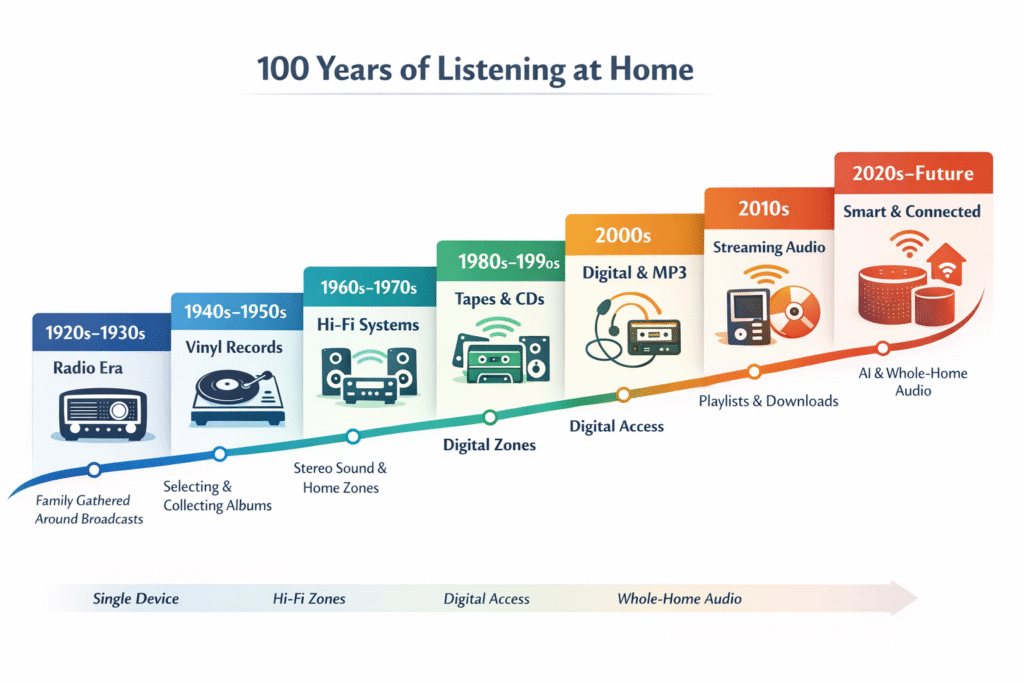
100 Years of Listening at Home: From Radios to Smart Multi-Room Amplifiers
Over the past 100 years, the way people listen to music at home has changed more dramatically than almost any other part of daily life. What started with a single radio in the living room has evolved into intelligent, distributed multi-room audio systems powered by advanced multi-room amplifiers.
This evolution is not only about sound quality. It reflects deeper changes in technology, home architecture, and how audio integrates into everyday living.
When Music First Entered the Home
In the 1920s and 1930s, radio brought music into private homes for the first time. Families gathered around one device, listening together to scheduled broadcasts.
Music was shared, temporary, and centrally controlled. Listeners had little choice, but the experience felt revolutionary.
At this stage, music was something people received.
Vinyl, Choice, and Intentional Listening
By the 1940s and 1950s, vinyl records introduced choice. Listeners could decide what to play and when.
Home turntables and early amplifiers turned listening into an intentional activity. Albums were played in full, and sound quality mattered.
Music became something people engaged with.
Hi-Fi Systems and the Birth of Home Audio Zones
During the 1960s and 1970s, Hi-Fi systems became more sophisticated. Stereo amplifiers and dedicated speakers improved realism and spatial imaging.
For the first time, listeners began to think about zones, room acoustics, and speaker placement. The idea that different rooms could have different sound experiences started to emerge.
Music was no longer just content. It became part of the space.
Convenience Over Ritual
The 1980s and 1990s shifted priorities toward convenience. Cassette tapes and CDs made music easier to access, skip, and share.
At the same time, televisions and home theaters became central to living rooms. Music often moved into the background.
Listening became routine rather than ceremonial.
Digital Music and Unlimited Access
The 2000s marked the transition to digital files. MP3 players, computers, and media libraries removed physical limitations.
People gained access to vast collections of music. However, attention became fragmented. Albums gave way to playlists.
Music was abundant, but often less immersive.
Streaming and the Rise of Whole-Home Audio
In the 2010s, streaming services and networked audio changed listening habits again. Music escaped the living room and spread throughout the home.
Wireless speakers and early multi-room amplifiers made synchronized playback possible across multiple spaces. Control shifted to apps and networks.
Music became an environmental layer rather than a single listening event.
Today: Smart Multi-Room Amplifiers as the Audio Backbone
Modern homes now expect audio systems that are flexible, reliable, and deeply integrated.
A contemporary multi-room amplifier must support:
- Multiple independent audio zones
- Synchronized or separate playback
- High-resolution streaming services
- Integration with smart home platforms
This is where platforms like AmpVortex position their core products. Models such as the AmpVortex-16060, AmpVortex-16060A, AmpVortex-16060G, and AmpVortex-16100 series are designed specifically for whole-home audio scenarios, combining multi-zone amplification with modern network control.
Rather than relying on multiple standalone devices, a centralized multi-room amplifier becomes the foundation of the home audio system.
You can explore how this architecture works in practice on the AmpVortex Multi-Room Audio & Home Automation page
Interoperability and the Role of Matter
As smart homes grow more complex, interoperability becomes essential. Audio systems can no longer operate in isolation.
The Matter smart home standard enables devices from different brands to communicate using a common protocol. For multi-room audio systems, this means amplifiers can coordinate more easily with lighting, sensors, automation rules, and voice assistants.
To learn more about Matter, visit the Connectivity Standards Alliance
The Next Step: AI-Driven Audio Orchestration
The next major shift in home audio is already taking shape.
Artificial intelligence is moving audio systems from manual control to contextual orchestration. Instead of selecting music room by room, users will rely on systems that understand time, presence, and activity.
Combined with Matter-based interoperability, multi-room amplifiers will play a central role in coordinating sound across the home—automatically and intelligently.
Music will no longer wait for commands. It will adapt to life.
What the Future Home Will Sound Like
In the coming years, whole-home audio systems will:
- Adapt dynamically to rooms and movement
- Manage multiple zones without complexity
- Integrate audio into smart home logic
- Deliver immersive sound without user friction
At the center of this evolution will be intelligent multi-room amplifiers—not as accessories, but as infrastructure.
Conclusion: From Single Devices to Smart Audio Platforms
Across a century of change, the direction is clear:
- From single listening points to distributed zones
- From physical media to networked streaming
- From manual control to intelligent orchestration
Modern home audio is no longer about a single speaker or player.
It is about building a cohesive, scalable, whole-home audio system.
That journey has led naturally to today’s generation of smart multi-room amplifiers.