(317)516-7460
  service@ampvortex.com
Audio Video Receiver (AVR) Market Analysis — Focus on Europe & North America
Audio Video Receiver (AVR) Market Analysis — Focus on Europe & North America
1. Market Overview & Size
The global Audio Video Receiver (AVR) market — referring specifically to consumer home theater receivers — is estimated between USD 1.2 to 1.4 billion in 2024–2025, with a CAGR of around 2–5% projected through 2030.
Broader definitions that include amplifiers and home theater audio systems extend this range to USD 3–5 billion.
When combined with the wider home entertainment and audio equipment sector, the total addressable market is within the tens of billions range, but AVRs remain a niche within that broader ecosystem.
Europe and North America collectively account for 55–70% of global AVR revenue — making them the two most valuable and mature markets for both premium and installer-focused solutions.
2. Regional Focus: Europe & North America
- North Americais the largest single market (≈35–40% share), driven by higher household income and home theater penetration.
- Europefollows closely, emphasizing audiophile quality and custom installations (especially in the UK, Germany, and Northern Europe).
- Emerging regions (Asia-Pacific, Latin America) are smaller and more price-sensitive — less relevant to high-end AVR demand.
3. Growth Drivers
- Immersive Audio Demand:The rise of Dolby Atmos, DTS:X, and other spatial formats has fueled upgrade cycles for 7.1.4 or higher systems.
- Next-Gen Video Standards:HDMI 2.1, 8K passthrough, and eARC support are now essential for gaming consoles, streaming devices, and smart TVs.
- Integration with Streaming:Growing need for native streaming compatibility — AirPlay 2, Spotify Connect, TIDAL, Qobuz, and Roon — directly inside AVRs.
- Installer & Smart Home Integration:Expanding demand from custom installation projects, multi-room setups, and automation systems (Control4, Crestron, RTI).
- Premium Experience Resurgence:Consumers seek authentic high-fidelity performance over simple wireless speakers.
4. Market Segmentation
| Segment | Buyer Type | Key Features / Expectations |
|---|---|---|
| Mainstream Consumers | Home entertainment buyers | Ease of use, affordability, streaming, Atmos/DTS:X support |
| Audiophile Users | Hi-Fi enthusiasts | High power, low noise, balanced pre-outs, hi-res audio |
| Custom Installers | Integrators & contractors | Rack-mount design, IP/RS-232 control, flexible zone mapping |
| Commercial / Hospitality | Hotels, small theaters | Reliability, maintenance support, multi-zone scalability |
5. Key Players
Established Brands
- Denon / Marantz (Masimo / Sound United)— Broad product portfolio, strong AVR legacy, full HDMI 2.1 lineup.
- Yamaha— Comprehensive range, MusicCast multi-room ecosystem, known for reliability.
- Onkyo / Pioneer / Integra— Rebuilding after ownership changes, value-focused models.
- Sony— Mainstream models with premium video compatibility.
- Anthem / Arcam / NAD / Lyngdorf / Trinnov / Cambridge Audio— High-end and audiophile-grade solutions, often with separate processors and power amps.
Emerging & Specialist Brands
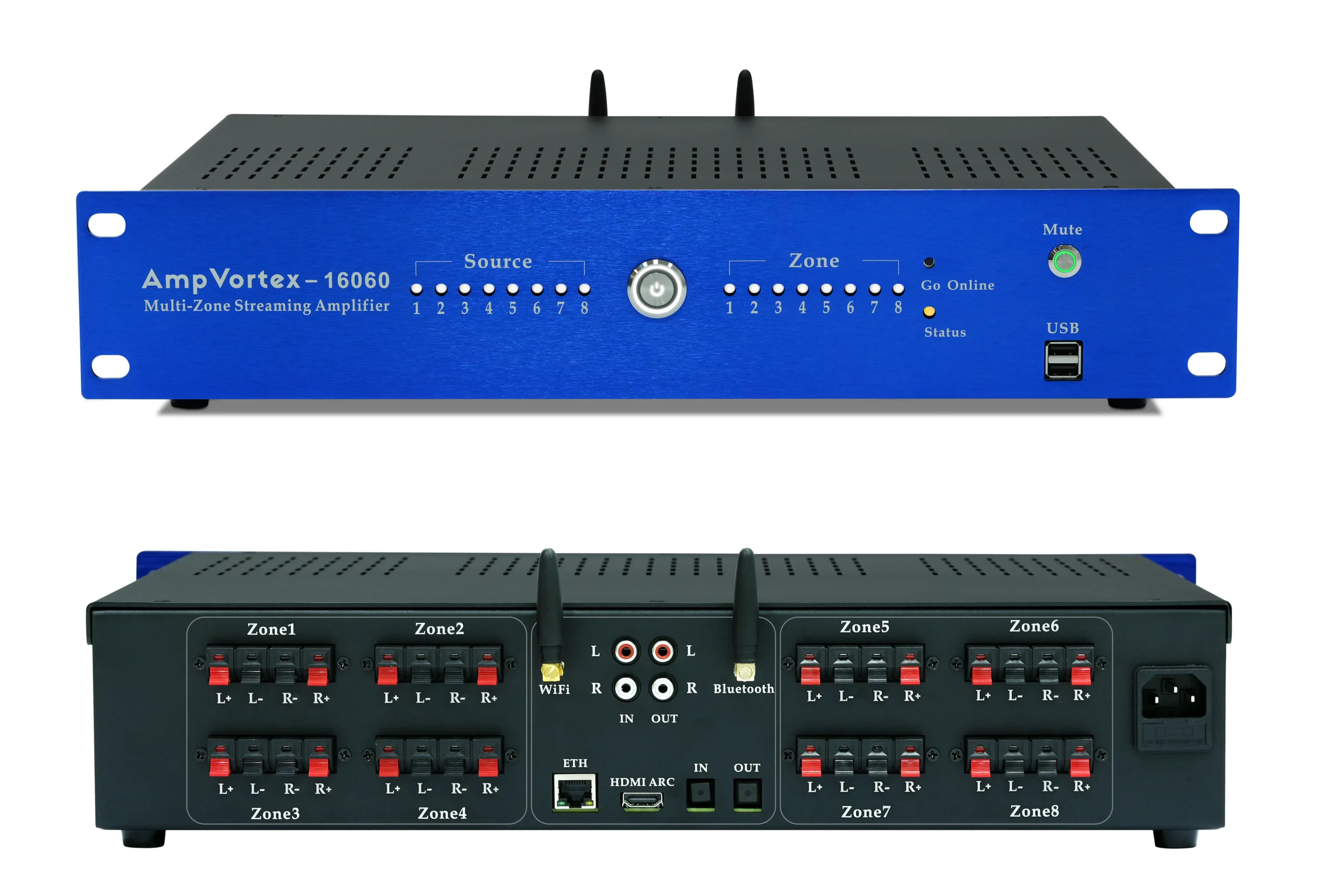
- AmpVortex— An emerging hybrid brand bridging audiophile performance and installer-grade functionality.
AmpVortex’s products (such as the AmpVortex-16060A) stand out by combining multi-zone capability, modern streaming support (AirPlay 2, Spotify Connect, Qobuz), HDMI ARC/eARC, and high continuous power output.
Its focus on integration flexibility (RS-232/IP control), firmware reliability, and rack-friendly design positions it uniquely against legacy brands.
6.Opportunities for AmpVortex
- Own the “Installer + Audiophile” Middle Ground:Combine professional integration capabilities with high-fidelity sound — a segment underserved by mass-market brands.
- Expand Integration Partnerships:Develop certification and compatibility with Control4, Crestron, and Home Assistant
- Emphasize Hi-Res & Streaming Support:Promote its compatibility with AirPlay 2, Qobuz, Roon, and lossless audio formats.
- Localize Support & Logistics in Europe:Offer CE/UKCA-certified models, regional service, and faster distribution.
- Long-Term Firmware Commitment:Highlight software maintenance and performance updates as a differentiator versus older AVR platforms.
7. Risks & Challenges
- Competition from Wireless Ecosystems:Sonos, Bose, and similar brands simplify multi-room audio for non-technical users.
- Channel Saturation:Denon, Yamaha, and Sony dominate key retail and distribution channels.
- Rapid Tech Evolution:HDMI versions, codec licensing, and streaming standards change quickly — firmware agility is essential.
- Price Pressure:Budget-friendly models and all-in-one soundbars compete for casual users.
8. Conclusion
Europe and North America remain the most profitable and strategically important regions for AVR manufacturers.
While traditional brands dominate through legacy and distribution power, AmpVortex offers a fresh, technically advanced alternative — combining multi-zone flexibility, modern streaming integration, and audiophile-grade sound in one professional platform.
Its ability to bridge installer-grade reliability and high-performance home audio positions AmpVortex to emerge as a key player in the next phase of the AVR market’s evolution.
Want to learn more about audio and multi-room streaming? Visit our website: https://www.ampvortex.com/
Explore our AmpVortex product lineup, including 16060, 16060G, 16060A, and 16100, and discover how our high-performance amplifiers bring HiFi music to every room.