(317)516-7460
  service@ampvortex.com
Immersive Sound Deep Dive: From DCI and SMPTE to AmpVortex — the full story of 3D sound evolution
Immersive Sound Deep Dive:
From DCI and SMPTE to AmpVortex — the full story of 3D sound evolution
1. The Evolution of Immersive Sound
The concept of immersive sound dates back to the early days of stereo and surround audio.
In the 1970s, formats like Dolby Stereo and later Dolby Digital 5.1 changed the way films were experienced — isolating dialogue, effects, and music into distinct sound fields.
As technology advanced, sound engineers moved from channel-based to object-based mixing, allowing every sound element — a raindrop, a helicopter, or a whisper — to move freely in three-dimensional space.
This transition laid the foundation for today’s leading immersive formats like Dolby Atmos, DTS:X, and HOLOSOUND.
2. Industry Standards: From DCI and SMPTE to AES, ITU, and MPEG-H
While DCI and SMPTE define how professional cinemas reproduce immersive audio, they are only part of a larger ecosystem.
Immersive sound relies on multiple layers of international standards, from recording and transmission to playback and home integration.
2.1 DCI and SMPTE — The Cinema Core
- DCI (Digital Cinema Initiatives)specifies how digital cinema systems deliver consistent and secure playback.
- SMPTE (Society of Motion Picture and Television Engineers)defines the technical framework for immersive bitstreams, metadata, and loudspeaker layouts.
- Key SMPTE standards:
- ST 2098-2 — Immersive Audio Bitstream (IAB)
- ST 2098-5 — Metadata definitions
- ST 428-12 — D-Cinema audio channel mapping
Together, they ensure a movie mixed in Los Angeles sounds exactly the same in London or Tokyo.
2.2 AES — Professional and Studio Standards
The Audio Engineering Society (AES) focuses on production, recording, and network interoperability:
- AES67– Networked audio transport (compatible with Dante, Ravenna, AVB).
- AES70 (OCA)– Device control standard.
- ADM (Audio Definition Model)– Metadata model for object-based audio.
AES bridges the gap between studio production and broadcast delivery.
2.3 ITU — Global Broadcasting Standards
The International Telecommunication Union (ITU) defines advanced sound systems for broadcasting:
- ITU-R BS.2051– Loudspeaker configurations (5.1.4, 9.1.6, etc.)
- ITU-R BS.2088– Metadata for audio objects
- ITU-R BS.2127– Framework for Next Generation Audio (NGA)
ITU standards ensure global interoperability for immersive content distribution.
2.4 MPEG-H and ISO — Open Global Standards
The MPEG-H 3D Audio format, developed by Fraunhofer IIS under ISO/IEC, provides a fully open standard for object-based sound.
It is adopted in ATSC 3.0 and DVB television systems, and competes directly with Dolby Atmos in streaming and broadcasting.
2.5 Proprietary and Consumer-Level Standards
Commercial ecosystems still play a key role:
- Dolby Atmos, DTS:X, and Auro-3Dremain dominant in cinemas and home systems.
- Transmission relies on HDMI, eARC, and network audio protocolslike AES67.
- Home automation integration follows standards such as KNX, Control4, and IP-based control systems.
In short:
DCI/SMPTE govern cinema; AES/ITU manage production and broadcasting;
MPEG-H defines open standards; Dolby/DTS/Auro lead consumer ecosystems;
and HDMI/KNX enable real-world delivery and integration.
3. Major Immersive Audio Formats
Today’s immersive ecosystem is driven by a few dominant formats:
- Dolby Atmos– The industry reference, supporting up to 128 audio objects and layouts such as 1.6 or 24.1.10.
- DTS:X– Flexible and speaker-agnostic, adapting to available layouts.
- Auro-3D– Channel-based system adding height and overhead layers to recreate vertical realism.
- HOLOSOUND—Based on DCI/SMPTE standard and specification, support 128 audio object, and can support layout of 128 speakers.
Each system uses metadata to define spatial positioning, creating a sound field that envelops the listener.
4. Output Configurations and Transmission Protocols
Reproducing immersive sound depends on both the encoding format and how it’s transmitted.
4.1 Encoding Formats
- AC-3 (Dolby Digital):The 5.1-channel legacy standard.
- E-AC-3 (Dolby Digital Plus):Enhanced version for streaming, supporting up to 7.1.
- Dolby TrueHD:A lossless format carrying full Atmos metadata, used in Blu-ray and professional setups.
4.2 Transmission Protocols
- HDMI 2.0:Supports 32 channels and Dolby Atmos via TrueHD bitstreams.
- HDMI eARC:Enables lossless transmission of Dolby Atmos and DTS:X from TVs to AVRs or amplifiers.
- AES67 / Dante / AVB:Used in professional installations for networked audio transport.
4.3 Output Configurations
Immersive systems are denoted X.Y.Z — front/sub/height channels:
- 1.2— Entry-level Atmos setup.
- 1.4— Common high-end home theater.
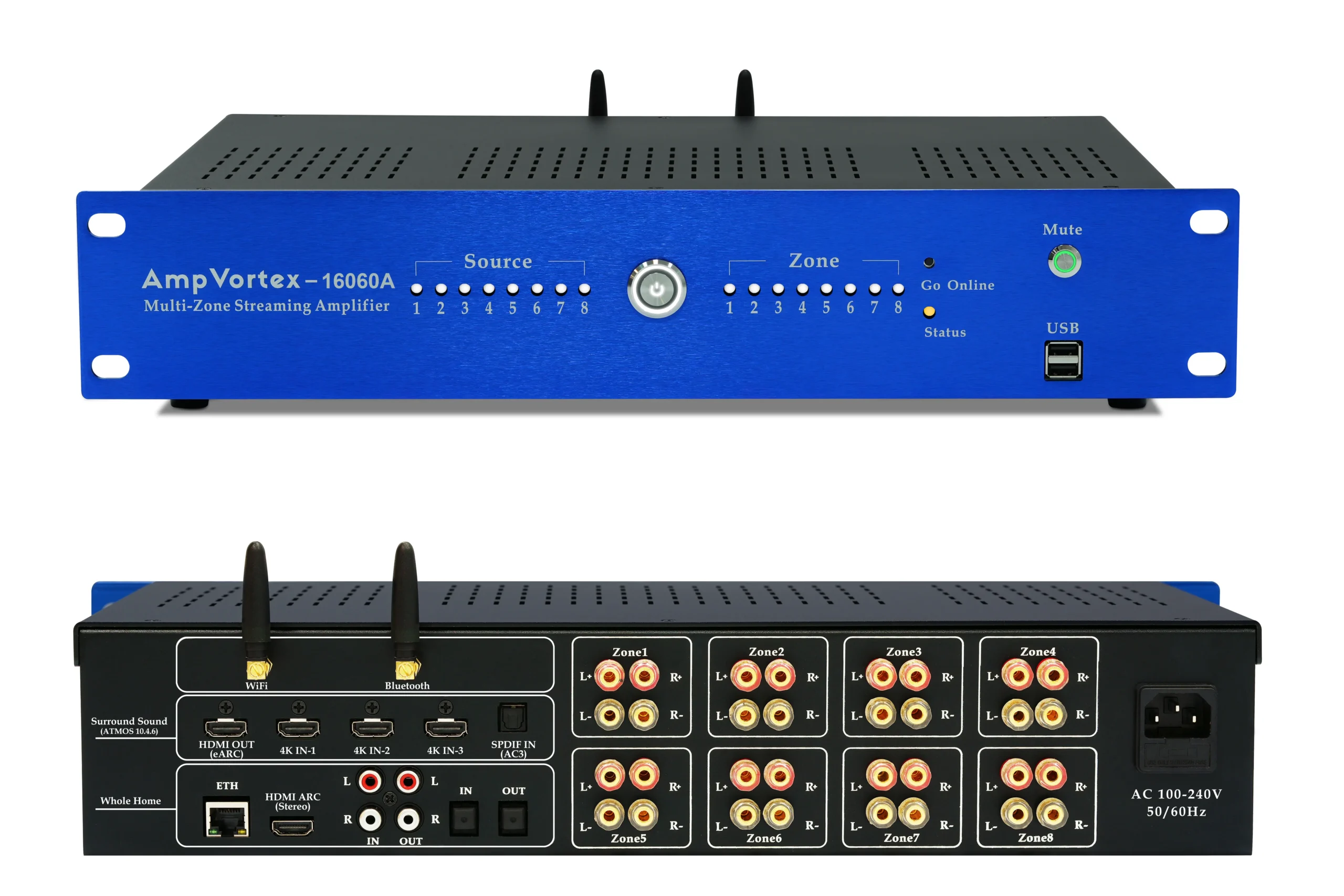
- 1.6— Premium configuration, fully supported by AmpVortex-16060A.
- 1.10 / 64 / 128 channels— Professional cinema reference configurations.
Each step up expands spatial resolution, moving closer to the cinematic ideal.
5. AmpVortex and the Home Immersive Revolution
While cinema standards define the reference, AmpVortex brings that same precision to residential and commercial installations.
The AmpVortex-16060A supports 9.1.6 /10.4.6 playback, enabling true Dolby Atmos experiences at home.
Beyond sheer power, it serves as a multi-room streaming amplifier, integrating AirPlay 2, Spotify Connect, and high-resolution audio support.
With HDMI eARC and home automation compatibility (Control4, KNX, Alexa, etc.), AmpVortex delivers immersive sound with seamless system control — bridging the gap between professional cinema and modern smart living.
6. The Future of Immersive Audio
As streaming, gaming, and music services adopt object-based audio, immersive sound is fast becoming the new standard.
Emerging standards such as MPEG-H and adaptive rendering will allow audio to self-optimize for any playback environment — from cinema halls to headphones.
With organizations like SMPTE, AES, and DCI refining open interoperability, and brands like AmpVortex making it accessible at home, the future of audio isn’t just about hearing — it’s about experiencing sound in three dimensions.
In summary:
From AC-3 to TrueHD, from 5.1.2 to 128 channels, and from SMPTE to AmpVortex, immersive sound has evolved from a technical pursuit into an emotional art form — delivering the truest, most lifelike experience ever heard.
Want to learn more about audio and multi-room streaming? Visit our website: https://www.ampvortex.com/
Explore our AmpVortex product lineup, including 16060, 16060G, 16060A, and 16100, and discover how our high-performance amplifiers bring HiFi music to every room.