(317)516-7460
  service@ampvortex.com
The Principles of Audio Compression Technology: Algorithms and Formats
The Principles of Audio Compression Technology: Algorithms and Formats
Introduction
Audio compression is a fundamental aspect of digital audio processing, allowing for efficient storage and transmission of audio files while maintaining or compromising sound quality. This article explores the principles behind audio compression, including the underlying algorithms such as Discrete Cosine Transform (DCT) and Wavelet Transform. We will also delve into the common algorithms and formats used in the industry, and highlight how AmpVortex amplifiers support high-resolution audio playback, including lossless formats and high sampling rates like 192kHz.
Principles of Audio Compression
Lossless Compression
Lossless compression reduces file size without losing any of the original audio data. This is achieved by identifying and eliminating redundant information in the audio signal. Common techniques include Huffman coding, arithmetic coding, and predictive coding. Formats like FLAC (Free Lossless Audio Codec) and ALAC (Apple Lossless Audio Codec) are widely used for their ability to compress audio files significantly while retaining all the original data. This makes them ideal for applications where sound quality is paramount, such as professional music production and high-fidelity audio systems.
Lossy Compression
Lossy compression reduces file size by discarding some of the audio data, typically parts that are less perceptible to the human ear. This is based on psychoacoustic models that identify frequencies and sounds that can be removed without significantly affecting the listener’s experience. Common lossy formats include MP3, AAC (Advanced Audio Coding), and OGG Vorbis. These formats offer much higher compression ratios than lossless formats, making them suitable for streaming and portable devices where storage space is limited. However, the trade-off is a reduction in sound quality.
Underlying Algorithms
Discrete Cosine Transform (DCT)
The Discrete Cosine Transform (DCT) is a widely used algorithm in lossy audio compression. It converts the audio signal from the time domain to the frequency domain, allowing for the identification and removal of less important frequency components. The DCT is particularly effective in identifying and discarding high-frequency components that are less perceptible to the human ear. This is a key step in reducing file size while maintaining acceptable sound quality.
Wavelet Transform
Wavelet Transform is another powerful tool used in audio compression. Unlike the DCT, which operates on fixed-size blocks of data, wavelet transforms can capture both time and frequency information simultaneously. This makes them highly effective in capturing transient sounds and sudden changes in the audio signal. Wavelet-based compression can achieve high compression ratios while preserving the quality of the audio signal, making it suitable for both lossy and lossless compression applications.
Psychoacoustic Models
Psychoacoustic models are integral to lossy compression algorithms. These models are based on the principles of human hearing and are designed to identify and discard audio components that are less likely to be perceived by the listener. By focusing on the most perceptible parts of the audio signal, these models can significantly reduce file size without a noticeable loss in sound quality. This is a key factor in the success of formats like MP3 and AAC.
Audio File Formats and Bitrate
Common Audio Formats
- WAV and AIFF: These are uncompressed formats that offer high-quality audio but result in large file sizes. They are commonly used in professional audio production and as source files for further processing.
- MP3: A widely-used lossy format that balances file size and sound quality. It uses a psychoacoustic model to remove inaudible sounds, resulting in smaller files suitable for portable devices and streaming.
- AAC: An advanced lossy format that generally offers better sound quality than MP3 at similar bitrates. It is used extensively in streaming services and mobile devices.
- FLAC and ALAC: These lossless formats provide high-quality audio with smaller file sizes compared to uncompressed formats. They are popular among audiophiles and in professional settings.
Bitrate
Bitrate refers to the number of bits processed per second and is a measure of the audio file’s quality and size. Higher bitrates generally mean better sound quality but larger file sizes. For example, CD-quality audio has a bitrate of about 1.4 Mbps (44.1kHz, 16-bit, stereo), while high-resolution audio formats like 192kHz, 24-bit can have much higher bitrates. Lossy formats like MP3 and AAC use variable bitrates to balance quality and file size, with common settings ranging from 128kbps to 320kbps.
AmpVortex: High-Resolution Audio Playback
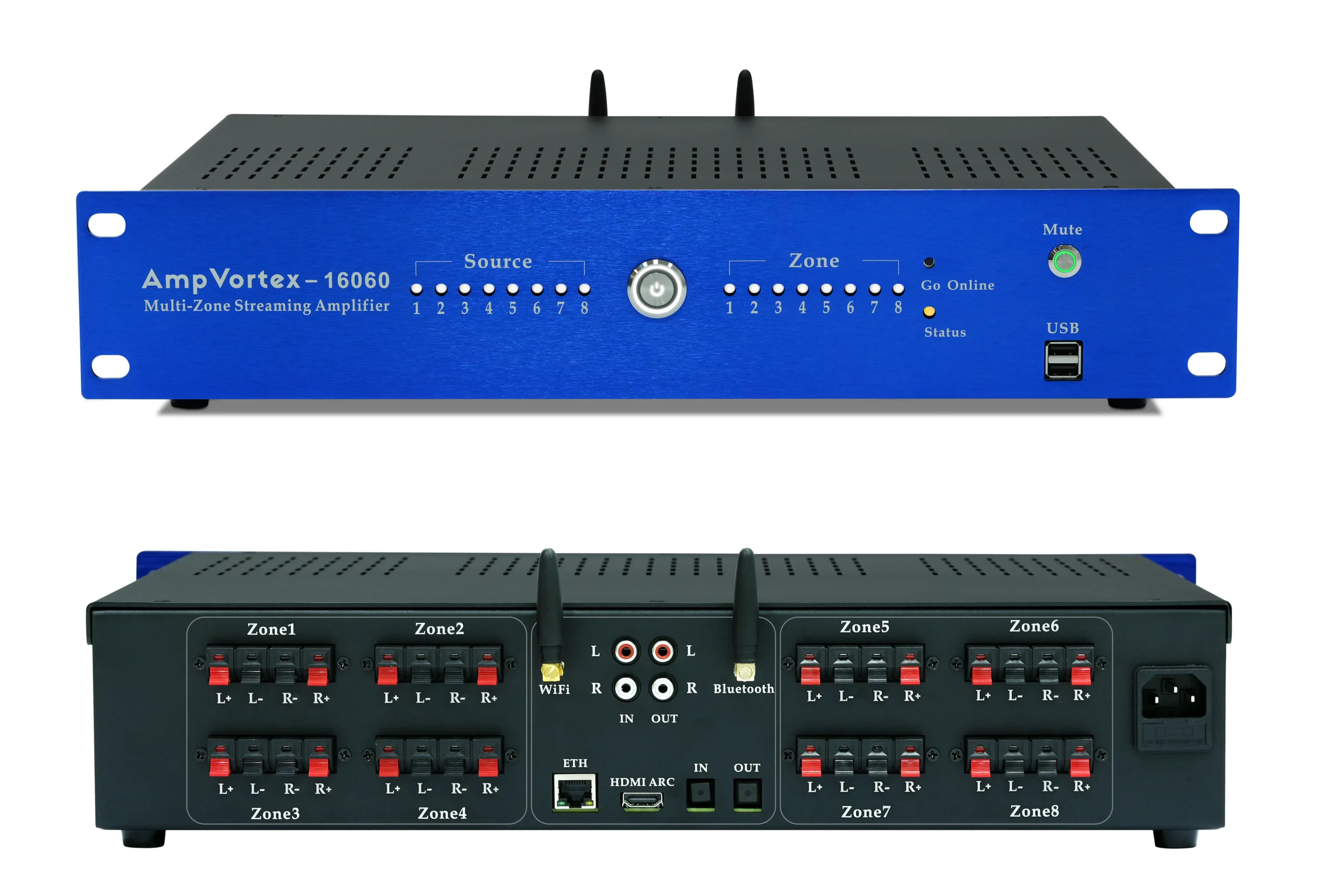
AmpVortex amplifiers are designed to support high-resolution audio, including lossless formats and high sampling rates like 192kHz. This commitment to high-fidelity audio ensures that listeners can experience the full richness and detail of their favorite music. By supporting lossless playback, AmpVortex ensures that no audio data is lost during playback, delivering the best possible sound quality. Whether you are a professional audio engineer or an audiophile, AmpVortex provides the tools to enjoy audio in its purest form.
Conclusion
Understanding the principles of audio compression and the underlying algorithms like DCT and Wavelet Transform is essential for anyone looking to optimize their audio experience. While lossy formats offer significant advantages in terms of file size and portability, lossless formats are indispensable for applications where sound quality is paramount. AmpVortex amplifiers, with their support for high-resolution audio and lossless playback, stand out as a leader in high-fidelity audio solutions, allowing listeners to enjoy music in its most detailed and immersive form.
Want to learn more about audio and multi-room streaming? Visit our website: https://www.ampvortex.com/
Explore our AmpVortex product lineup, including 16060, 16060G, 16060A, and 16100, and discover how our high-performance amplifiers bring HiFi music to every room.