(317)516-7460
  service@ampvortex.com
HDMI Cable Deep Dive
The 48Gbps Challenge: Analyzing HDMI 2.1 Cable Selection based on Signal Integrity and Jitter
Keywords: HDMI 2.1, 48Gbps, TMDS, FRL, Signal Jitter, Timing Integrity, Active Optical Cable, eARC, HDCP 2.3, Amplifier
The HDMI cable is the digital backbone of the modern home theater, responsible for transferring up to $48 \text{ Gbps}$ of massive digital data between your source, AmpVortex amplifier, and display. At such high bandwidths, the cable is not merely a piece of copper; it is a high-speed digital channel, where minor signal degradation can lead to transmission failure, screen flickering, or audio jitter.
This article explores how to safeguard signal integrity in the era of HDMI 2.1 from a digital engineering perspective.
- The Core Technological Leap: TMDS to FRL
The realization of HDMI 2.1 performance relies on a fundamental shift from TMDS (Transition Minimized Differential Signaling) to FRL (Fixed Rate Link).
- TMDS (HDMI 2.0 and earlier):Up to $18 \text{ Gbps}$, relatively stable, but bandwidth-limited.
- FRL (HDMI 2.1):Uses data packet transmission for up to $48 \text{ Gbps}$. FRL’s high transfer rate is extremely sensitive to cable quality and length, requiring the cable to maintain superior timing integrity at a microscopic level.
The Critical Challenge: Conventional copper cables are highly susceptible to Crosstalk and Inter-Symbol Interference (ISI) in FRL mode. These effects prevent the receiving device (like your amplifier) from decoding the data correctly, leading to display blackouts or intermittent failures.
- The Digital Audio Killer: Signal Jitter
For lossless audio signals, such as Dolby Atmos transmitted via eARC, cable quality is paramount.
- Jitter Definition:Jitter is the deviation of a digital signal’s timing pulse from its ideal clock position.
- Impact on Audio:High-speed Jitter causes temporal instability in the digital audio stream. Even if the data packet successfully arrives, timing errors prevent the AmpVortex amplifier from accurately reconstructing the original waveform, resulting in blurred sound and reduced resolution.
- Solution:Only high-quality, meticulously shielded cables can maintain the clock synchronization necessary to minimize digital jitter.
- Long-Distance Engineering: Active vs. Optical (AOC) Solutions
Passive copper cables are typically limited to $3$ to $5$ meters for stable $48 \text{ Gbps}$ FRL transmission. For custom installations or long runs, active technology is essential.
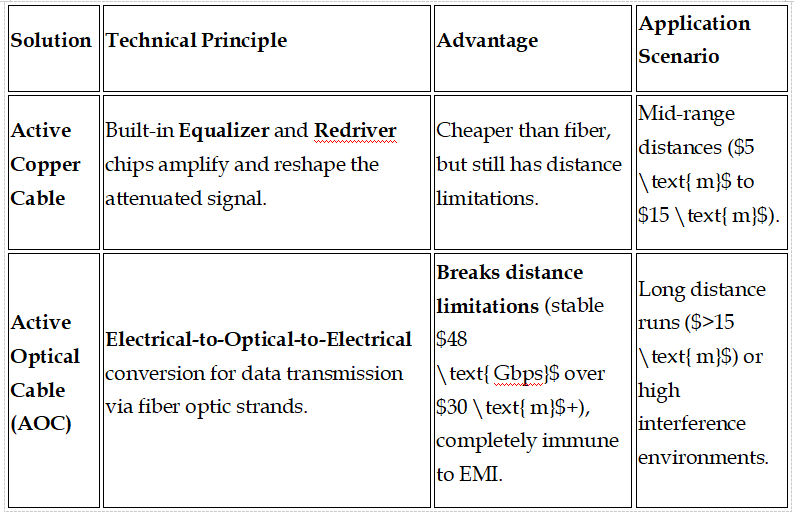
Professional Advice: AOCs are often directional; ensure they are connected correctly. For AmpVortex users, AOC is the only professional choice to guarantee $48 \text{ Gbps}$ signal integrity over long distances.
- Purchase Assurance: Certification and Compatibility
- Official Certification:Always look for the Ultra High Speed official certification label or QR code, confirming the cable has been validated by an HDMI Forum Authorized Test Center.
- HDCP 2.3:The cable must reliably support the latest HDCP 2.3 digital content protection handshake. Otherwise, you will be unable to play protected 4K/8K content, even if the picture displays.
Conclusion: The Invisible Digital Guardian
At $48 \text{ Gbps}$, the HDMI cable is no longer an accessory—it is a critical, high-precision electronic component in your digital pipeline. Cable quality directly dictates whether your AmpVortex amplifier can reliably receive and process the highest specification A/V signals.
Invest in officially certified, $48 \text{ Gbps}$-capable cables to ensure your high-end system is not limited by invisible digital jitter.