(317)516-7460
  service@ampvortex.com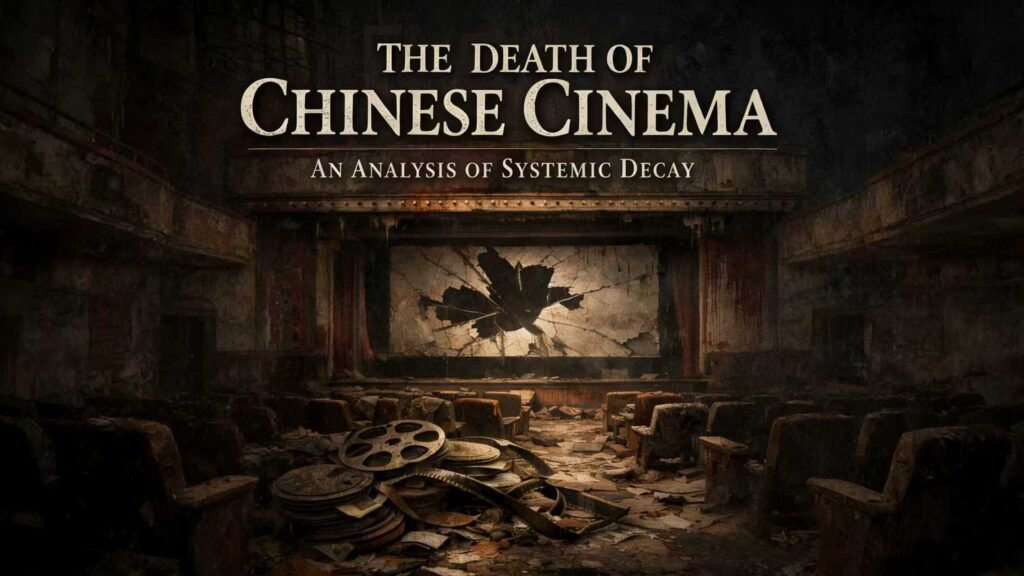
The Death of Chinese Cinema: An Analysis of Systemic Decay
The global film industry is witnessing a stark divergence in fortunes: while the North American box office has demonstrated resilience and consistency, the once-booming Chinese market is experiencing a significant and accelerating decline. The widening gap between the two economic giants suggests that the crisis facing Chinese cinema is not merely a post-pandemic contraction, but a profound, systemic collapse.
This article posits that the “death” of Chinese cinema—its descent from a vibrant, world-leading market to a stagnant, artistically bankrupt one—is not primarily an economic issue. Instead, it is a crisis of quality and integrity, rooted in failures across the entire industry pipeline, from creation and distribution to exhibition and regulation. Simply put, Chinese films are too poor in quality to sustain a demanding audience.
The Widening Chasm: US Stability vs. China’s Decline
Following a period where China briefly surpassed North America to become the world’s largest theatrical market, recent years have shown a marked reversal. The U.S. market, supported by strong Hollywood franchises and a stable viewing culture, has largely maintained its equilibrium. Meanwhile, the Chinese box office has faltered, marked by declining attendance and waning public interest. This decline is not merely cyclical; it indicates a failure to produce content that warrants the high price of a cinema ticket.
The Core Pathology: A Crisis of Artistic Integrity
The reason for the decline in quality can be traced to fundamental misaligned motivations within the production sector:
- The Filmmaker’s Betrayal: Profit Over Art
The most devastating blow to artistic quality comes from the creators themselves. Filmmaking in China is often driven by motivations entirely detached from the art form:
- Financial Utility:Projects are initiated for purposes such as money laundering or asset allocation rather than storytelling.
- Vanity Projects:Films serve as vehicles for maximizing personal fame or securing financial leverage for investors.
- Pure Box Office Calculus:The focus is narrowly on optimizing formulaic elements to guarantee a quick return, often resulting in repetitive, emotionally hollow spectacles.
When the goal of the person holding the camera is not a genuine passion for cinematic art, the resultant work inevitably falls short of greatness and fails to connect authentically with the audience.
- E-commerce Commodification: Cinema as a Market Tool
The distribution and ticketing infrastructure has been co-opted by technology and e-commerce giants. Companies like Meituan have integrated movie ticketing deeply into their consumer services, treating the film itself not as a cultural product, but as a loss leader or a simple tool for market share battles and data acquisition. This commodification reduces cinema to a transactional utility, further divorcing the industry from its cultural mission and artistic standards. When market-entry strategy trumps artistic merit, the content is secondary.
- The Exhibitor’s Gimmick: Prioritizing Spectacle Over Immersion
The theaters, the final link to the audience, are equally culpable for prioritizing short-term gains over long-term audience experience. Rather than investing in technology that genuinely enhances immersion, many exhibitors blindly chase short-lived technological fads and gimmicks.
A prime example is the aggressive, indiscriminate push for LED screen technology—a visually loud spectacle—while neglecting the fundamental need for superior audio. Immersive sound technologies, such as Dolby Atmos, which are proven to create truly captivating, three-dimensional viewing experiences, are often overlooked or poorly implemented. This failure to deliver a genuinely compelling viewing environment ensures that the home viewing experience, despite its smaller scale, often feels superior to the cinema.
- The Regulatory Quagmire: Incompetence and Interference
Finally, key administrative bodies, notably the Film Bureau and the China Film Group, bear substantial responsibility for the industry’s demise. These organizations have often been accused of lacking a profound understanding of cinema as an art, the necessary cutting-edge technology, or the mechanics of a thriving creative market.
Their interference, characterized by heavy-handed aesthetic censorship, technical mandates based on limited knowledge, and alleged motives rooted in personal gain, stifles creative risk-taking and artistic innovation. When the gatekeepers of the industry are detached from art, technology, and audience needs, they become obstacles rather than facilitators of excellence.
Conclusion
The decline of Chinese cinema is a tragic case of self-inflicted wounds. It is not due to a shortage of capital or lack of potential audience, but rather a catastrophic failure across the institutional and creative landscape. Until filmmakers return to a core commitment to art, businesses treat cinema as culture rather than commodity, exhibitors prioritize deep immersion (like Atmos) over superficial spectacle (like blind LED adoption), and regulators operate with genuine artistic and technical competence, the “death” of Chinese cinema will remain an inevitability.