(317)516-7460
  service@ampvortex.com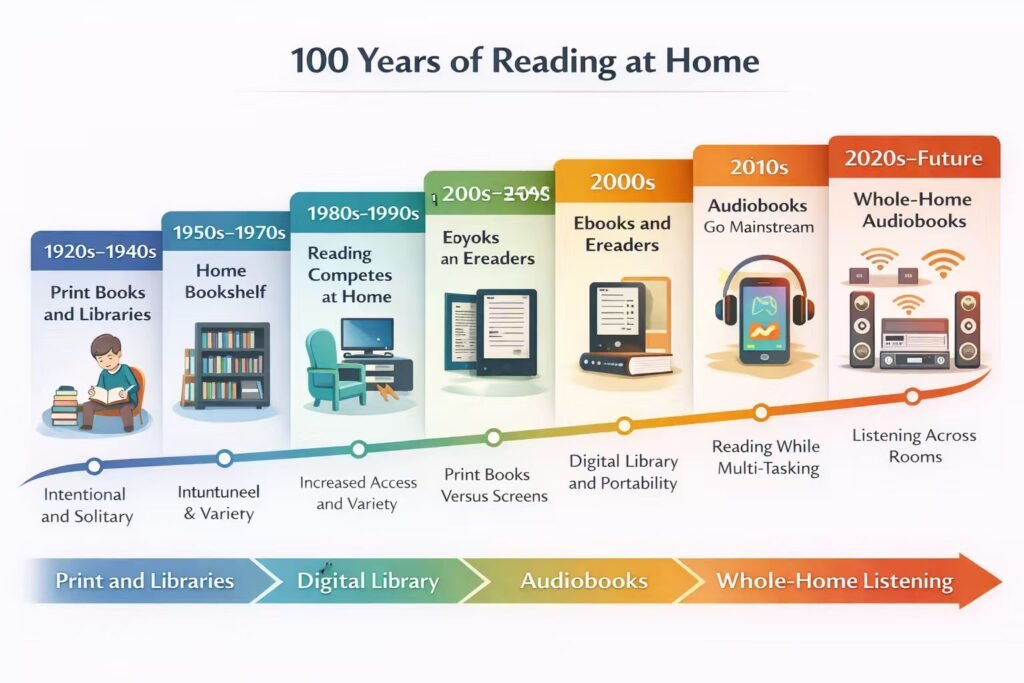
100 Years of Reading at Home: From Paper Books to Whole-Home Audiobooks
For more than a century, reading at home has reflected how people live, think, and use technology. What began as a quiet, solitary activity centered on printed books has gradually expanded into a flexible, multi-format experience that now includes ebooks, audiobooks, and whole-home listening.
This evolution is not about replacing books. Instead, it shows how reading adapts to modern life—especially when time, attention, and space are constantly in motion.
Early 20th Century: Reading as a Quiet Ritual
In the early 1900s, home reading revolved around physical books, newspapers, and magazines. Reading required silence, focus, and dedicated time. Homes contained few competing forms of entertainment, so books naturally occupied a central place.
Access was limited. Many families relied on libraries or small personal collections. As a result, reading felt intentional and often ceremonial.
Mid-Century: Mass Publishing and Everyday Reading
After World War II, publishing expanded rapidly. Paperbacks, book clubs, and wider distribution made books more affordable and accessible.
Reading became more casual and frequent. Homes filled with novels, reference books, and children’s literature. The bookshelf became part of personal identity, reflecting taste and education.
At this stage, reading still depended entirely on print, but it was no longer rare or formal.
Late 20th Century: Competing Media and Changing Habits
By the 1980s and 1990s, television, video games, and home video competed for attention. Reading remained important, but it increasingly had to fit into busy schedules.
Books stayed relevant because they required no setup and no technology. However, time pressure began to shape reading habits. Many people read less, even if they still valued books.
This tension set the stage for digital transformation.
Early 2000s: Ebooks and the Digital Library
Ebooks removed physical limitations. Thousands of titles could live on a single device. Readers gained search, highlights, and instant access.
Print did not disappear. Instead, reading split into two modes:
- Print for presence and immersion
- Digital for convenience and portability
The home library became both physical and virtual.
2010s: Audiobooks Enter the Mainstream
Audiobooks changed reading more dramatically than ebooks. With smartphones and streaming platforms, listening became effortless.
Audiobooks allowed people to read while:
- Cooking
- Exercising
- Cleaning
- Moving through the house
As a result, reading expanded into time that was previously unavailable. For many households, audiobooks became the most practical way to read consistently.
Today: Reading as a Whole-Home Experience
Modern reading is no longer tied to a chair or a screen. Audiobooks can now flow naturally through the home.
Whole-home audio systems make spoken content feel ambient rather than isolated. A chapter can begin in the kitchen and continue in the living room without interruption.
This is where a AmpVortex-16100 Multi-Room Streaming Amplifier becomes relevant. Designed for synchronized audio across multiple rooms, it allows audiobooks to become part of daily routines rather than a private headphone activity.
Why Audiobooks Are Real Reading
Audiobooks are not shortcuts. They deliver the same ideas, narratives, and information as print—often with added clarity through narration.
They also expand accessibility. People with limited time, visual fatigue, or busy households can continue reading without sacrificing daily responsibilities.
For many modern families, listening is the difference between reading occasionally and reading every day.
The Future: AI Narration and Intelligent Audio Spaces
Looking ahead, reading will continue to evolve. AI-driven narration will become more natural and customizable. Content may adapt to pace, context, or listener preference.
As reading becomes more ambient and intelligent, the infrastructure that delivers it matters. Reliable multi-room audio will be essential to turning spoken content into a seamless part of home life.
Conclusion: From Pages to Presence
Over the past 100 years, reading at home has shifted:
- From scarcity to abundance
- From silence to flexibility
- From pages to sound
Books remain central. What has changed is how they fit into everyday life. Today, reading moves with us—and in many homes, audiobooks played across the entire house are how reading survives and grows.