(317)516-7460
  service@ampvortex.com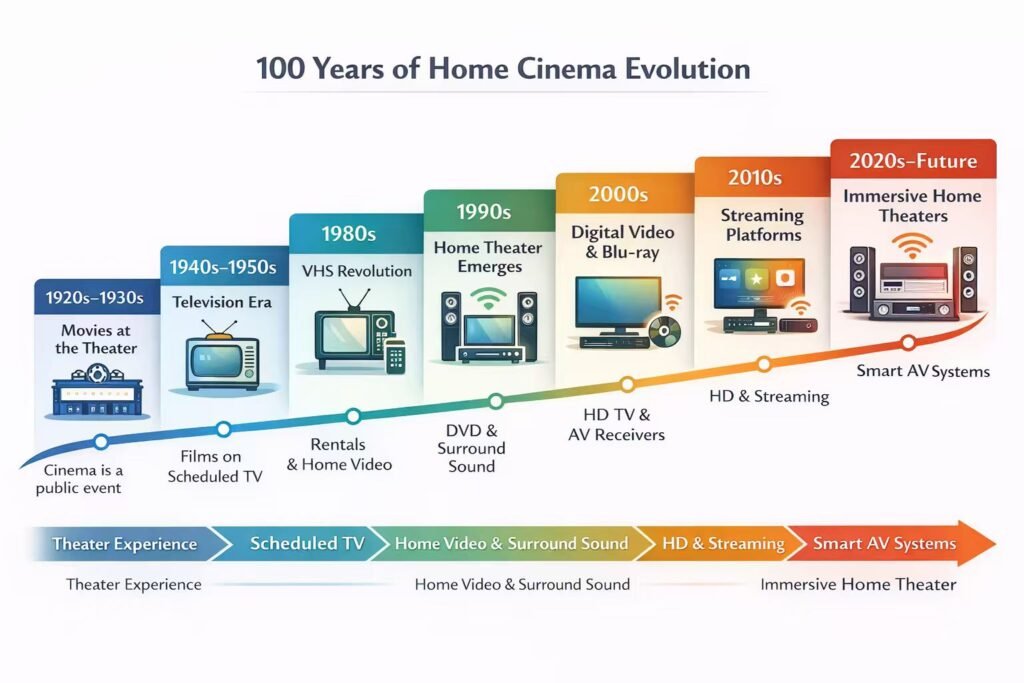
100 Years of Home Cinema Evolution: From TVs to Immersive AV Receivers
Over the past 100 years, the way people watch movies at home has evolved dramatically. What began with small, shared screens has transformed into immersive home theater systems powered by advanced AV receivers (AVRs).
This evolution is not just about larger displays or higher resolution. Instead, it reflects deeper changes in sound, space, and how technology integrates into everyday living.
When Movies Belonged Only to Theaters
In the early 20th century, movies existed almost exclusively in theaters. Cinema was a public event defined by scale, sound, and shared experience.
At home, entertainment relied on radio rather than moving images. Watching movies required leaving the house.
At this stage, cinema was something people went out to experience.
Television Brings Cinema into the Living Room
During the 1940s and 1950s, television brought moving images into private homes for the first time.
Families gathered around a single screen at scheduled times. Viewers had limited control, and sound quality remained basic. However, movies were no longer confined to theaters.
Cinema entered daily home life.
Choice Changes Everything: VHS and Home Video
The 1980s marked a turning point with the arrival of VHS.
For the first time, viewers could choose what to watch and when to watch it. They could pause, rewind, and replay movies at will.
As a result, movie nights became intentional. Home viewing shifted from passive consumption to active choice.
The Birth of the Home Theater
In the 1990s, home theater systems emerged as a serious alternative to cinemas.
DVDs improved picture quality, while AV receivers enabled multi-channel surround sound. Dedicated speakers and subwoofers changed how movies sounded at home.
For the first time, people aimed to recreate the cinema experience inside their living rooms.
Digital Video and High-Definition Cinema
The 2000s introduced flat-panel TVs and Blu-ray discs. Screens became larger and thinner, while audio formats grew more sophisticated.
AV receivers evolved to handle multiple sources, higher bandwidth video, and improved surround sound. Home cinema became a premium experience rather than a compromise.
Streaming Redefines Home Cinema
In the 2010s, streaming platforms reshaped viewing habits.
Movies became instantly accessible without physical media. At the same time, large-screen TVs and projectors became common.
Home cinema shifted from an occasional event to an everyday experience.
Today: Immersive Home Theater Powered by Modern AVRs
Today’s home theaters are complete audio-visual ecosystems.
A modern AV receiver must support:
- Multi-channel and object-based audio
- High-bandwidth HDMI sources
- Precise audio routing and processing
This is where the AmpVortex-16060A AV Receiver fits naturally into today’s home theater architecture, enabling immersive configurations such as Dolby Atmos layouts for modern cinematic experiences.
Rather than acting as a simple switch, the AVR has become the central hub of the home cinema system.
Immersive Audio as the Core of Modern Cinema
While display technology continues to improve, sound now defines immersion.
Formats such as Dolby Atmos immersive audio allow sound to move freely in three-dimensional space. Dialogue remains clear, while effects gain height and depth.
Immersive audio transforms movies from something you watch into something you feel.
Smart Homes and the Future of Home Cinema
Home theaters no longer exist in isolation.
Integration with smart home systems allows lighting, audio, and video to respond together. When a movie begins, the room itself can adapt.
As a result, watching movies becomes a seamless experience rather than a technical setup process.
Conclusion: From Screens to Cinematic Spaces
Over the past century, home cinema has evolved:
- From public theaters to private spaces
- From flat images to immersive environments
- From manual control to intelligent systems
Modern home theaters are no longer about copying cinemas.
They are about creating cinematic spaces designed for modern living.