(317)516-7460
  service@ampvortex.com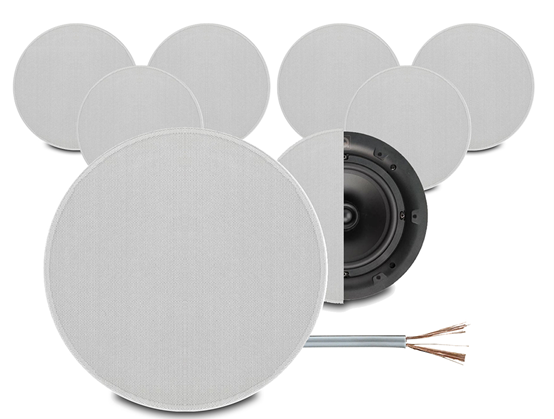
How to Choose Passive Speakers for a Multi-Room Amplifier | AmpVortex Guide
How to Choose the Right Passive Speakers for an AmpVortex Multi-Room Streaming Amplifier
A Practical, System-Level Guide for Whole-Home & Commercial Audio
In a professional multi-room audio system, amplifiers and speakers should never be chosen independently.
With AmpVortex Multi-Room Streaming Amplifiers, the goal is not simply high output power, but long-term stability, predictable load behavior, and consistent sound quality across multiple zones.
This guide focuses on speaker selection first, then explains how AmpVortex power platforms (16060 / 16100 / 16200) naturally support different speaker types and usage scenarios—without turning this into a product datasheet.
Start with Speaker Type, Not Amplifier Power
In multi-room systems, space type defines speaker type, and speaker type defines system requirements.
Speaker Categories and Best Practices
In-Ceiling Speakers – The Backbone of Multi-Room Audio
Best for:
Living rooms (background music), kitchens, bedrooms, hallways, offices, retail spaces
Why they work so well in multi-room systems
- Even sound coverage
- Low visual impact
- Predictable impedance and load behavior
- Designed for long listening sessions
Selection guidelines
- Standard rooms: 6.5″
- Large or high-ceiling spaces: 8″
- Prefer 8Ω impedance and high sensitivity (≥88 dB)
- Pivoting tweeters improve vocal clarity
AmpVortex pairing logic
- 16060 (65W/channel): Ideal for most residential and standard commercial ceiling speakers
- 16100 (110W/channel): Better headroom for large rooms or zones with multiple speakers
- 16200 (210W/channel): Typically unnecessary for indoor ceiling speakers unless load is unusually demanding
Ceiling speakers do not require extreme power—they require stability.
In-Wall Speakers – Directional Sound Where It Matters
Best for:
TV areas, open-plan living spaces, presentation zones
Advantages
- More focused imaging than ceiling speakers
- Better dialogue clarity
Considerations
- Installation height and listening position are critical
- Avoid mixing brands or voicing styles within the same zone
Recommended power
- Medium rooms: 16060 or 16100
- Larger or louder zones: 16100 preferred
Bookshelf & On-Wall Speakers – Higher Fidelity Zones
Best for:
Home offices, master bedrooms, listening-focused spaces
Why they make sense
- Higher sonic detail per dollar
- Excellent for single, dedicated zones
System advice
- Choose high-sensitivity models
- Avoid complex parallel wiring
Floorstanding Speakers – Impact and Scale
Best for:
Large living rooms, showrooms, feature areas
Notes
- Require space and careful placement
- Often unnecessary for pure background-music systems
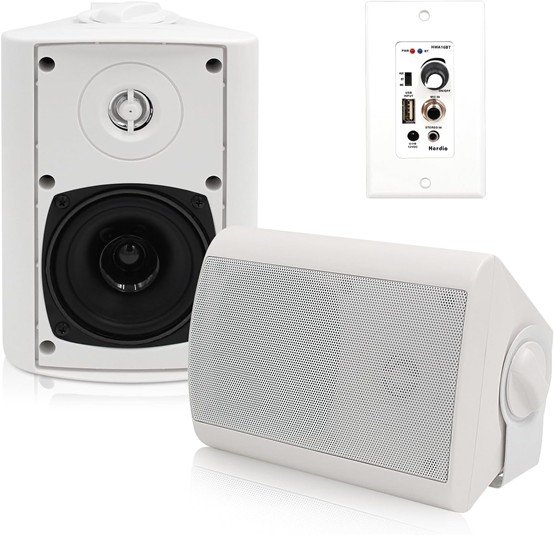
Outdoor Speakers – Where Power Margin Matters Most
Best for:
Patios, gardens, pool areas, outdoor dining
Non-negotiable rule
- Use purpose-built outdoor passive speakers (UV, moisture, corrosion resistant)
Why outdoor zones need more power
- Higher ambient noise
- Faster sound dissipation
- Users naturally turn volume higher
Recommended platform
- AmpVortex 16200 (210W/channel) for safe, long-duration outdoor playback
Outdoor power is about endurance, not loudness.
Commercial Ceiling & Column Speakers
Best for:
Retail stores, cafés, corridors, meeting rooms
Priorities
- High sensitivity
- Wide, even coverage
- Reliability over tonal coloration
Understanding Power: Headroom Beats Loudness
In multi-room environments, amplifiers face:
- Multiple zones playing simultaneously
- Continuous daily operation
- Multiple speakers per system
What higher power really provides
- Lower distortion at normal volumes
- Reduced thermal stress
- Greater tolerance for complex loads
65W vs 110W vs 210W is not about volume, but about operating comfort under load.
Impedance & Parallel Wiring: The System’s Lifeline
Strong recommendations
- Prefer 8Ω speakers
- One stereo pair per zone whenever possible
- Plan impedance carefully when adding more speakers
Common mistakes
- “More power means impedance doesn’t matter” ❌
- “High-power amps allow unlimited parallel speakers” ❌
Higher power increases responsibility, not forgiveness.
Sensitivity: The Most Underrated Specification
Why sensitivity matters
- Less amplifier strain at the same volume
- Cooler operation
- Lower distortion
Practical benchmarks
- ≥90 dB: Excellent for multi-room and outdoor systems
- 86–89 dB: Acceptable, but room size matters
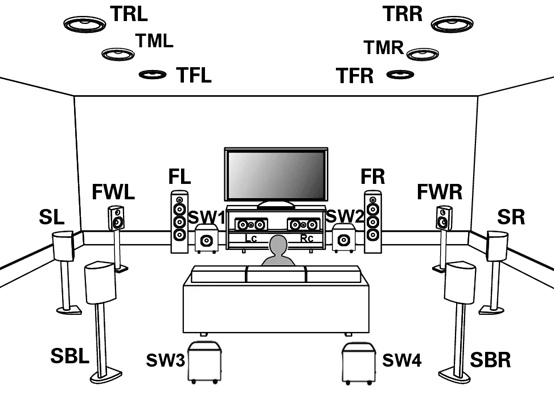
How Dolby Atmos (A) Influences Speaker Choice
A = Dolby Atmos
Atmos affects speaker layout, not speaker voicing.
Typical speaker roles
- Front L/C/R: In-wall, bookshelf, or floorstanding
- Surrounds: In-wall or on-wall
- Height channels: In-ceiling speakers
Key takeaway
In Atmos systems, speaker count and placement matter more than per-speaker wattage.
For medium to large Atmos installations, 16100 or 16200 platforms provide healthier system margins.
How Google Cast (G) Influences Speaker Choice
G = Google Cast
Google Cast scenarios emphasize:
- Long playback sessions
- Multiple users
- Multi-zone synchronization
Speaker priorities
- High sensitivity
- Thermal durability
- Stable impedance behavior
In Cast-heavy systems, speakers behave like always-on infrastructure, not occasional devices.
Speaker Brand Selection (Use-Case Driven)
In-Ceiling / In-Wall
- Sonance, KEF CI, Bowers & Wilkins CI, Monitor Audio, Focal, Polk Audio, JBL Installation
Bookshelf / Floorstanding
- KEF, Bowers & Wilkins, DALI, Focal, Klipsch, Wharfedale
Outdoor
- Sonance Outdoor, Polk Atrium, JBL Outdoor, Klipsch Outdoor
Best practice
Keep the same brand and model within the same zone or automation scene.
Conclusion: Design the System Around Speakers—Then Choose the AmpVortex Platform
AmpVortex power platforms (16060 / 16100 / 16200) are not meant to complicate selection.
They allow designers to:
- Define the space and speaker type first
- Match the appropriate power headroom
- Achieve a system that is stable, consistent, and serviceable long-term
That is what a professional multi-room audio system should deliver.
Frequently Asked Questions (FAQ)
Start with the space type and speaker category (in-ceiling, in-wall, bookshelf/on-wall, floorstanding, outdoor, commercial). Then verify impedance (prefer 8Ω), sensitivity (higher is easier to drive), and the wiring plan (avoid risky parallel loads). Finally, choose an amplifier power platform that provides comfortable headroom for your room size and speaker count.
Use 16060 (65W/channel) for most whole-home background music zones with 8Ω in-ceiling or in-wall speakers.
Choose 16100 (110W/channel) for larger rooms, higher ceilings, or zones using multiple speakers where extra headroom improves clarity and stability.
Choose 16200 (210W/channel) for outdoor zones, high-noise environments, large coverage areas, or demanding speaker loads where long-duration playback needs maximum margin.
Not always. In multi-room audio systems, higher power is most valuable as headroom—meaning lower distortion at normal listening levels, cooler operation, and better stability under load. For standard in-ceiling background music, speaker sensitivity and impedance planning are often more important than raw wattage.
8Ω speakers are the safest and most predictable choice for multi-room systems.
6Ω speakers can work, but you should avoid complex parallel wiring and keep speaker counts per zone reasonable.
4Ω loads require careful planning and should only be used when the amplifier channel is designed for that load and when wiring and heat management are properly engineered.
Parallel wiring can reduce total impedance and overload an amplifier channel if not planned correctly. A safer approach is one stereo pair per zone. If multiple speakers are required for coverage, the wiring must be designed to keep impedance within safe limits, or impedance-matching solutions should be used.
Higher sensitivity delivers the same loudness with less amplifier strain. As a practical guideline, 90 dB or higher is excellent for multi-room and outdoor zones, while 86–89 dB is common but may require more amplifier headroom in larger rooms. Sensitivity is often more important than chasing very high power ratings.
In-ceiling speakers are the most common choice because they provide even coverage and a clean aesthetic. Use 6.5-inch models for most rooms and 8-inch models for larger spaces or higher ceilings. Prefer 8Ω speakers and consider pivoting tweeters for improved vocal clarity.
Always choose purpose-built outdoor speakers with weather resistance (UV, moisture, and corrosion protection). Outdoor zones require more headroom due to higher ambient noise and faster sound dissipation, so a higher-power platform such as 16200 (210W/channel) is often the best choice for stable, long-duration playback.
Dolby Atmos affects speaker layout, not speaker voicing. A typical Atmos system uses front L/C/R speakers (in-wall, bookshelf, or floorstanding), surround speakers (in-wall or on-wall), and height channels (in-ceiling speakers). For medium to large Atmos installations, choosing 16100 or 16200 provides healthier system margins.
Google Cast use cases often involve long playback sessions and multiple zones playing simultaneously. This makes speaker sensitivity, thermal durability, and stable impedance behavior especially important. In Cast-heavy systems, reliable 8Ω speakers and well-planned wiring are critical for continuous operation.