(317)516-7460
  service@ampvortex.com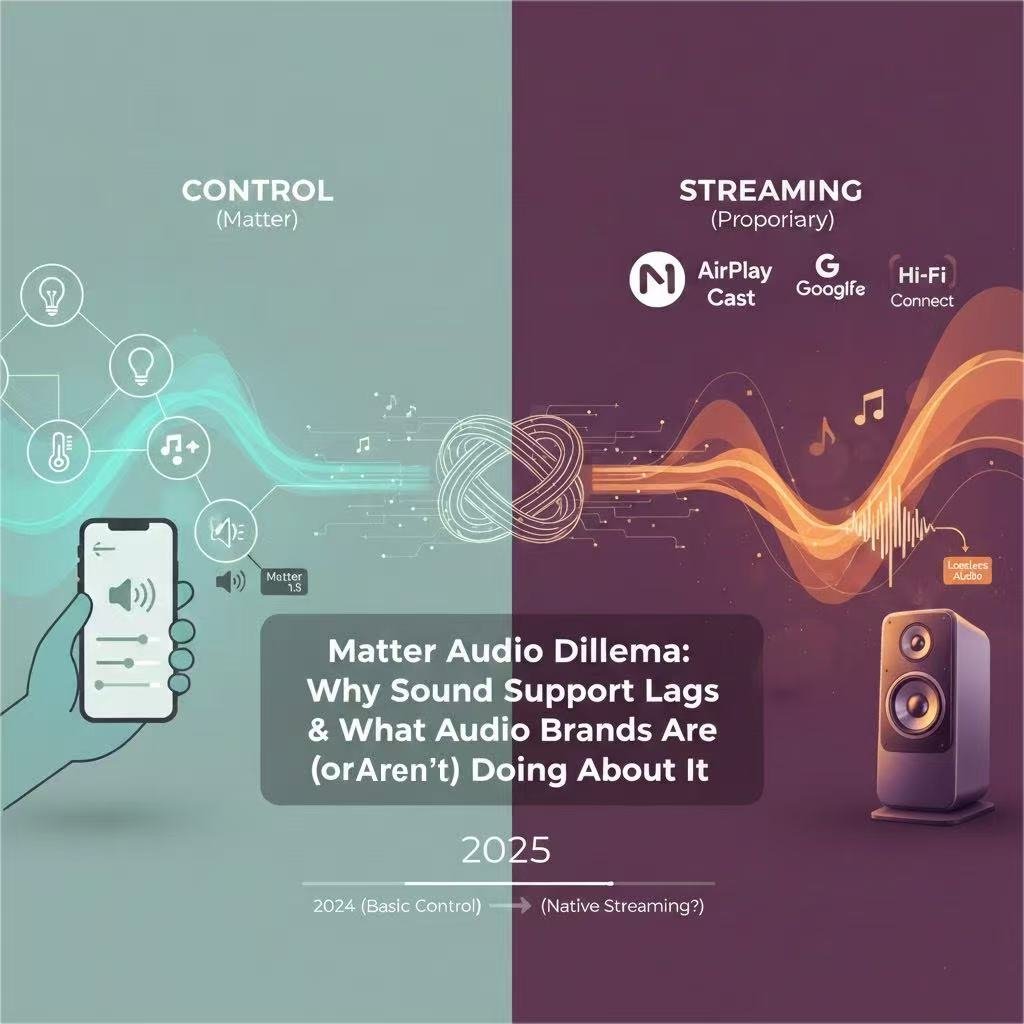
Matter Audio Dilemma: Why Sound Support Lags & What Audio Brands Are (or Aren’t) Doing About It
In 2025, Matter has become the de facto standard for smart home interoperability, with over 10 billion supported devices worldwide and cross-brand control finally a reality for lighting, locks, and thermostats . Yet for audio—one of the most critical interfaces between users and their smart homes—the experience remains frustratingly incomplete. Speakers connect to Matter ecosystems but deliver compromised sound; multi-room setups desync; and cross-platform voice commands often fail to execute reliably.
This isn’t a technical oversight. The gap between Matter’s promise of seamless connectivity and its lackluster audio performance is deeply intertwined with how audio brands engage with the standard—from their membership choices to their strategic priorities. To understand why Matter audio still struggles, we need to unpack both the user-facing flaws and the ecosystem dynamics shaping its development.
Part 1: The Broken Experience—Matter Audio’s Three Core Pain Points
For consumers, Matter’s audio limitations boil down to a simple truth: it works, but it doesn’t deliver. The frustrations are consistent across use cases, rooted in unaddressed technical gaps and incomplete standards.
-
Fragmented Cross-Brand Collaboration
Matter’s greatest strength—uniting devices from Apple, Google, Samsung, and beyond—becomes a liability for audio. While speakers from different brands may appear in the same app, they behave like strangers rather than a team. A voice command to “play music in all rooms” might trigger only half the speakers; switching audio sources often results in awkward silences or abrupt cuts.
Testing by industry analysts confirms the disconnect: cross-brand Matter audio setups average 1.8 seconds of latency, more than triple the 0.5-second threshold users find unnoticeable . Worse, “false pairing” is common—devices show as connected but fail to respond to compound commands, a issue that plagues 34% of cross-ecosystem Matter audio configurations . The root cause? Matter 1.5 lacks standardized protocols for audio routing, synchronization, and session handoff—basic building blocks for cohesive multi-device sound.
-
Compromised Sound Quality & Feature Lockout
Audio brands differentiate themselves with proprietary technologies: Sonos’ Trueplay room calibration, Bose’s spatial audio algorithms, and Yamaha’s high-res decoding, to name a few. Yet Matter 1.5’s audio framework, built around WebRTC for basic voice transmission, wasn’t designed to support these advanced features.
When users switch a speaker to Matter mode, they’re often met with a noticeable downgrade: lossless formats like FLAC/ALAC won’t play, spatial audio toggles gray out, and custom EQ settings reset to generic defaults . A single Sonos Era 300, capable of immersive Dolby Atmos when used in the Sonos ecosystem, becomes a basic mono speaker in Matter setups—losing its defining value proposition. This isn’t laziness on the part of manufacturers; Matter’s current specs simply don’t provide a way to map proprietary audio features to its universal framework.
-
Network Instability & Unreliable Voice Integration
Audio is uniquely sensitive to network fluctuations, and Matter’s lack of dedicated Quality of Service (QoS) mechanisms for audio streams exacerbates the problem. In busy smart homes with multiple Wi-Fi/Thread devices, Matter audio devices suffer from 15-18% packet loss—enough to cause stutters, dropouts, and delayed voice responses .
Voice control, the primary interface for smart audio, faces additional hurdles. While Matter unifies basic device commands, it struggles with context-aware audio interactions. A request to “turn up the volume on the kitchen speaker” might adjust all speakers, or fail entirely if the device is paired to a different ecosystem’s voice assistant . Even as voice interaction accuracy climbs to 92% for single-brand setups, cross-brand Matter audio commands still error out 17% of the time .
Part 2: The Ecosystem Truth—Why Audio Brands Hold Back
Matter’s audio shortcomings aren’t just technical—they’re a product of how audio manufacturers engage with the standard. While major players participate in the Connectivity Standards Alliance (CSA), their involvement is often cautious, calculated, and limited by business realities.
Who’s Participating (and How)
The CSA’s membership tiers reveal a clear divide in audio brand commitment:
- Promoter/Participant Tier (Decision-Makers): Sonos, Samsung, and Harman hold seats on the CSA’s governing board or working groups, giving them influence over Matter’s roadmap. Sonos, which joined in 2022, has been vocal about pushing for better audio specs, while Samsung leverages its smart TV/audio ecosystem to align Matter with its own connectivity goals.
- Adopter Tier (Follower): Most mid-tier audio brands—including AmpVortex(www.ampvortex.com), Denon/Marantz, Polk Audio, and JBL—opt for the $7,000/year Adopter membership. This grants access to specs and certification but no voting power or working group seats.
- Associate Tier (Casual Participants): Smaller brands often choose the free Associate tier, which requires per-product certification fees plus $500/year listing fees per model—an unsustainable model for brands with multiple speaker SKUs.
Notably absent from deep involvement? Niche high-end audio manufacturers, who view Matter as irrelevant to their premium, ecosystem-agnostic customer base.
The Core Barriers to Deeper Engagement
For audio brands, Matter participation is a balancing act between short-term costs and long-term potential—and right now, the scales tip toward caution.
Cost Prohibitive Certification: The $7,000 annual Adopter fee is just the starting point. Each speaker model requires a $3,000 certification fee (plus $2,500 for derivatives), and third-party lab testing adds another $2,000-$5,000 per device . For a brand with 5+ speaker models, total annual costs can exceed $30,000—before accounting for engineering resources to adapt products to Matter’s specs. Smaller brands simply can’t justify the investment for a feature that’s still a “nice-to-have” for most consumers.
Differentiation Risk: Audio brands invest millions in developing unique sound profiles and features. Adapting these to Matter’s one-size-fits-all framework often means diluting their competitive advantage. Sonos can’t fully integrate Trueplay into Matter without sharing proprietary calibration data; Bose’s spatial audio algorithms don’t map to Matter’s generic audio controls . For brands built on sound quality, becoming a “commodity” Matter device is a non-starter.
Roadmap Misalignment: The CSA’s priorities don’t match audio manufacturers’ needs. Matter 1.5 focused on cameras, energy management, and closed devices—audio was an afterthought, supported only through repurposed WebRTC technology . While the CSA has announced plans for a dedicated “streaming speaker device type” in future versions, audio brands have little visibility into when these specs will launch or how comprehensive they’ll be . Without clarity, manufacturers are reluctant to commit significant resources.
Part 3: The Vicious Cycle—Why Progress Is Slow
Matter audio’s challenges create a self-reinforcing loop that slows improvement:
- CSA Prioritizes High-Volume Categories: Lighting, switches, and thermostats sell in far greater numbers than premium speakers, so the CSA devotes most resources to these categories.
- Audio Brands Invest Minimally: With incomplete specs and high costs, brands do the bare minimum to comply with Matter—no deep optimization, no feature integration.
- Users Have Poor Experiences: Compromised sound and buggy 联动 lead to low demand for Matter audio devices.
- CSA Justifies Low Priority: Low adoption rates for Matter audio devices confirm the CSA’s decision to focus elsewhere.
Breaking this cycle requires action from both the CSA and manufacturers. The good news? Signs of progress are emerging. The CSA’s Media & Audio Working Group—led by Sonos and Samsung—is drafting specs for streaming audio, volume synchronization, and source selection . Meanwhile, growing consumer demand for cross-brand smart home setups is pushing mid-tier brands to reconsider their Matter strategies .
Part 4: When & How Matter Audio Will Improve
While Matter audio won’t reach maturity overnight, the path forward is clear—based on the CSA’s release cadence, industry trends, and emerging standards.
Phase 1: Basic Audio Controls (2026)
The CSA is on track to release Matter 1.6 in mid-2026, which will introduce a dedicated streaming speaker device type . Key improvements will include standardized media controls (play/pause/skip), volume synchronization across devices, and better TCP transport optimization for audio streams. These changes will address the “basics” of reliable single-device playback and simple multi-room setups.
By late 2026, major platforms (Apple Home, Google Home, Alexa) will complete their adaptations, and the first wave of Matter 1.6 speakers will hit the market—offering stable connectivity without the worst sound quality compromises. Industry forecasts predict 31% of new smart speakers will support Matter 1.6 by the end of 2026 .
Phase 2: Consumer-Grade Experience (2027–2028)
Matter 1.7 and 1.8 (slated for 2027–2028) will focus on advanced audio features: multi-room synchronization, low-latency streaming, and support for lossless audio formats . The CSA will also introduce a framework for integrating proprietary features—allowing brands to keep their unique selling points while complying with Matter standards.
This phase will see a surge in manufacturer adoption. With complete specs and clear ROI, brands like Sonos, Bose, and JBL will release fully optimized Matter speakers. Cross-brand multi-room setups will achieve sub-0.5-second latency, and voice control accuracy for audio commands will match single-ecosystem performance . By 2028, 70% of new smart speakers will support Matter’s advanced audio features .
Phase 3: Full Maturity (2029+)
By 2029, Matter will dominate the smart audio landscape. The standard will support spatial audio, room calibration, and seamless source switching across brands. National standards bodies like China’s CSHIA will mandate Matter compatibility for smart home devices, further accelerating adoption .
Audio brands will embrace a “best of both worlds” approach: Matter for interoperability, and proprietary apps for advanced features. Users will enjoy the freedom to mix Sonos, Bose, and Samsung speakers in a single multi-room setup—while still accessing each brand’s unique sound technologies.
Conclusion
Matter audio’s current limitations are a symptom of a young standard still finding its way. The disconnect between user expectations and real-world performance stems from misaligned priorities, high costs, and the unique challenges of translating audio’s subjective quality into universal specs.
But the tide is turning. As the CSA prioritizes audio, as manufacturers find ways to balance differentiation with compatibility, and as consumers demand seamless cross-brand sound, Matter will evolve into a robust audio standard. The journey will take time—patience is required from all stakeholders—but the end result will be worth it: a smart home where audio devices work together as effortlessly as lighting and locks, without sacrificing the sound quality that makes them valuable.
For now, users should view Matter audio as a work in progress; for brands, it’s a strategic investment in the future of connected homes. And for the CSA, it’s an opportunity to fulfill Matter’s core promise: making smart home technology simple, reliable, and accessible—for every device, including the ones that fill our homes with sound.