(317)516-7460
  service@ampvortex.com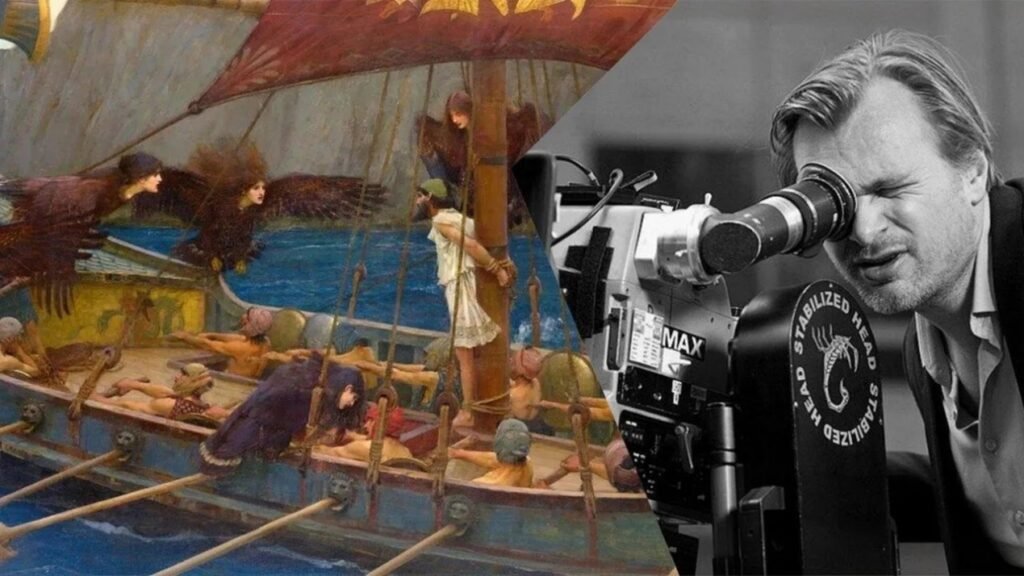
The Odyssey: A Timeless Epic Reimagined for the Modern Screen
For more than 2,700 years, The Odyssey has stood as one of the cornerstones of Western literature. Attributed to the ancient Greek poet Homer and composed around the late eighth or early seventh century BCE, this 24-book epic poem follows Odysseus, king of Ithaca, on his ten-year journey home after the fall of Troy. More than a tale of adventure, it is a profound exploration of homecoming, identity, resilience, and the tension between human choice and the will of the gods.
Literary and Historical Legacy
The Odyssey began as an oral tradition, passed down through generations of bards before being written down in the sixth century BCE. Its narrative structure—opening in medias res, or in the middle of the action—revolutionized storytelling. The poem’s themes have influenced countless works, from James Joyce’s Ulysses to modern films and television series. Its universal message of longing for home and the struggle to preserve one’s sense of self has ensured its place in the global cultural canon.
Adaptations Through the Ages
The Odyssey has inspired numerous screen adaptations, though few have attempted a full retelling of the epic. Among the most notable versions are:
- 1911: L’Odissea, directed by Giuseppe de Liguoro. The first film adaptation of the epic and a landmark of early Italian cinema.
- 1954: Ulysses, directed by Mario Camerini. A Hollywood-style epic starring Kirk Douglas as Odysseus.
- 1997: The Odyssey, a television miniseries directed by Andrei Konchalovsky. A relatively faithful adaptation featuring Armand Assante in the title role.
- 2000: O Brother, Where Art Thou?, directed by the Coen brothers. A loose, comedic retelling set in 1930s Mississippi.
- 2024: The Return, directed by Luca Guadagnino. A focused adaptation that centers on Odysseus’ final journey home.
These interpretations reflect the epic’s enduring ability to resonate across cultures and time periods.
Christopher Nolan: A Visionary Filmmaker’s Journey to The Odyssey.
To understand the anticipation surrounding Nolan’s The Odyssey, one must first recognize the director’s unparalleled legacy in modern cinema. Born in London on July 30, 1970, Christopher Nolan is widely regarded as one of the most influential filmmakers of the 21st century—a visionary who elevates blockbuster entertainment with philosophical depth, innovative storytelling, and uncompromising technical craft. With a career spanning over three decades, his films have grossed over $6.6 billion worldwide, earning him a knighthood in 2024 for his contributions to cinema, alongside two Academy Awards, a Golden Globe, and two BAFTA Awards .
Nolan’s filmography is defined by bold experimentation and thematic consistency, blending complex narratives with stunning, visceral practical visuals. His breakthrough came with Memento (2000), a thriller told through reverse chronological order that mirrored its protagonist’s short-term memory loss—establishing his signature style of challenging audiences to engage actively with storytelling . He rose to global prominence with The Dark Knight Trilogy (2005–2012), redefining superhero cinema by infusing it with gritty realism and moral complexity. Subsequent works solidified his reputation as a master of scale and ideas:
- Inception(2010): A mind-bending heist film set across nested dreams, exploring the malleability of memory and reality, with iconic practical sequences like the rotating hotel hallway .
- Interstellar(2014): A cosmic epic about love and survival, featuring scientifically grounded depictions of black holes and time dilation, brought to life with real cornfield sets and practical models .
- Dunkirk(2017): A tense war drama told through three interweaving timelines (land, sea, air), emphasizing immersive, visceral storytelling over dialogue .
- Tenet(2020): A high-concept spy thriller built around “time inversion,” pushing the boundaries of practical effects—including the real destruction of a Boeing 747 jet .
- Oppenheimer(2023): A biographical thriller about the “father of the atomic bomb,” which won seven Academy Awards (including Best Picture and Best Director for Nolan), cementing his status as a filmmaker who can balance critical acclaim with commercial success .
Across all these works, Nolan has championed two core principles: a devotion to practical filmmaking (avoiding overreliance on CGI) and a passion for large-format film, particularly IMAX 70mm. He believes these choices create a tangible, immersive experience that digital formats cannot replicate—philosophies that align perfectly with the mythic scale of The Odyssey .
Christopher Nolan’s Upcoming Adaptation of The Odyssey
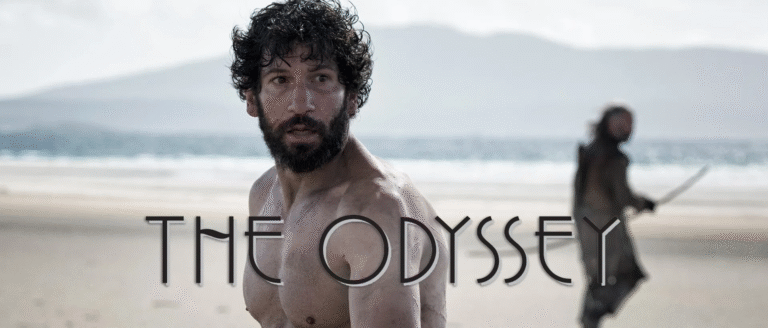
Scheduled for release on July 17, 2026, Christopher Nolan’s The Odyssey is one of the most anticipated films of the decade. Building on his legacy of ambitious storytelling, Nolan is approaching the epic with a scale and realism never before seen in an adaptation of The Odyssey.
Key highlights include:
- Filmed entirely on IMAX 70mm film, a format that delivers unparalleled clarity and depth—consistent with Nolan’s lifelong advocacy for traditional film stock .
- Extensive use of practical sets, including full-scale replicas of ancient Greek ships built in the Aegean Sea, and on-location shooting in Greece, Morocco, and Iceland to capture the raw beauty of the ancient world .
- A star-studded cast featuring Matt Damon (in his third collaboration with Nolan) as Odysseus, Tom Holland as Telemachus, and acclaimed actors such as Zendaya, Anne Hathaway, Charlize Theron, and Robert Pattinson—forming one of the most prestigious ensembles of Nolan’s career .
- A creative team that includes longtime Nolan collaborators such as cinematographer Hoyte van Hoytema and composer Ludwig Göransson, ensuring continuity with his distinctive visual and auditory style .
Nolan’s vision emphasizes physicality and emotional authenticity, grounding the epic’s mythic elements (from the Cyclops’ cave to the Sirens’ song) in tangible, visceral experiences. The film will also explore themes dear to the director—time, identity, and the cost of ambition—framing Odysseus’ decade-long journey as both a literal quest for home and a profound meditation on human resilience .
The Future of Epic Storytelling
Nolan’s The Odyssey represents a bold return to the grand scale of classical storytelling. By combining ancient narrative with cutting-edge filmmaking technology, it seeks to create a cinematic experience that honors Homer’s original vision while captivating modern audiences.
For home viewing, a high-performance audio system is essential to fully appreciate the film’s immersive sound design. A Dolby Atmos-capable AV receiver such as the AmpVortex-16060A can decode the film’s three-dimensional audio, allowing viewers to experience every wave, every whisper, and every battle sequence with remarkable clarity and depth. Its powerful amplification and precise spatial processing make it an ideal match for Nolan’s richly layered soundscapes, bringing the ancient world to life in the comfort of one’s living room.

From its ancient origins to its upcoming cinematic reimagining, The Odyssey continues to inspire and endure. As Nolan—one of our era’s greatest storytellers—prepares to take audiences on Odysseus’ legendary journey, the epic remains a timeless reminder of the power of storytelling and the universal desire to find one’s way home.