(317)516-7460
  service@ampvortex.com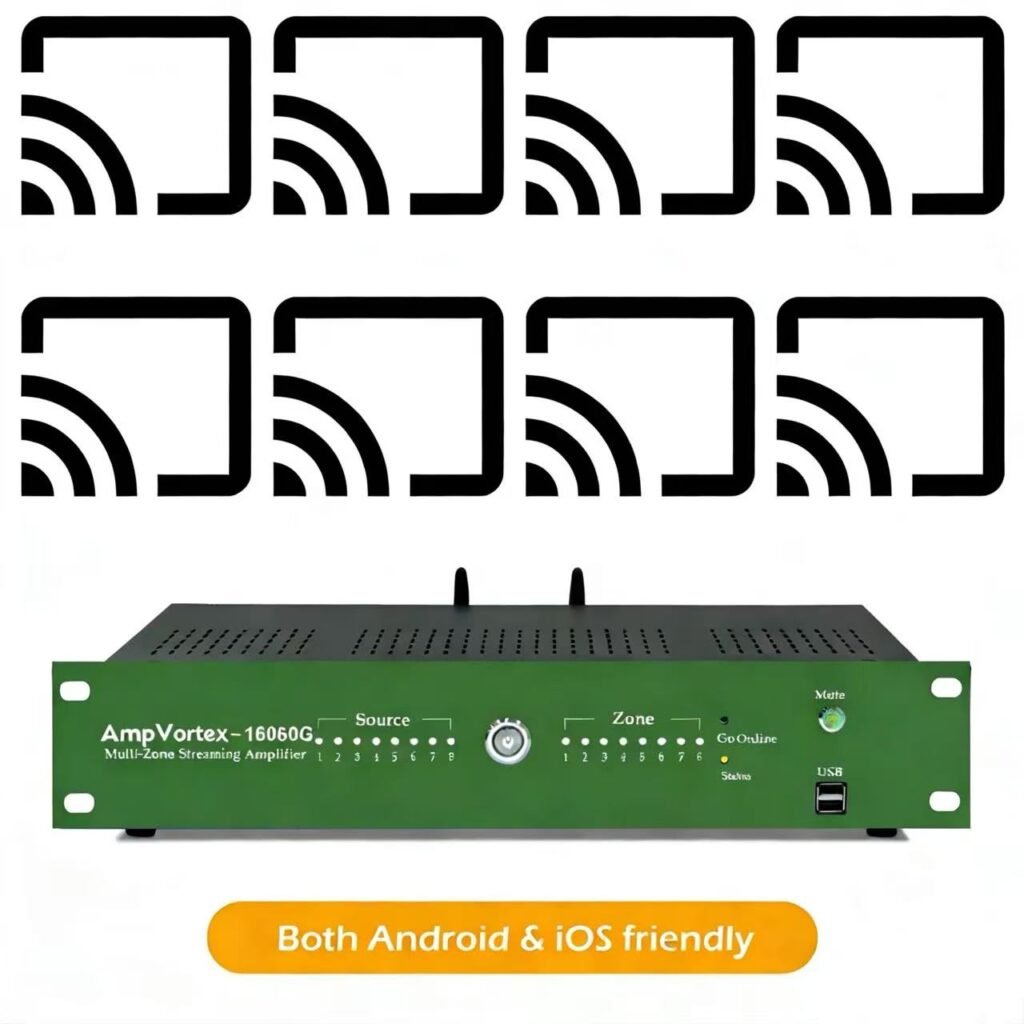
Why Google Cast Is the Only Streaming Protocol That Truly Scales in Multi-Room Homes
Why Google Cast Is the Only Streaming Protocol That Truly Scales in Multi-Room Homes
In the world of high-end home automation, “streaming” is often treated as a solved problem. But for the professional integrator installing a multi-room streaming amplifier, the gap between “standard streaming” and “true multi-zone orchestration” is a technical chasm.
While many competitors claim Google Cast compatibility, there is a fundamental difference between having a single Cast receiver and a high-density matrix like the AmpVortex-16060G/AmpVortex-16100G. Here is why Google Cast is the only protocol that truly scales, and why our 8-zone architecture is a game-changer.
1. The Multi-Zone Paradox: “One Cast ≠ Multiple Casts”
Most consumer amplifiers on the market offer a single Google Cast (Chromecast built-in) endpoint. To the user, this looks like one device in the Google Home app. If you want music in the kitchen and the patio, you are forced to use Google’s software-based “Group” function.
The Bottleneck: When you use software groups on a single-endpoint hardware, you are relying on the amplifier to split a single stream. This often leads to:
- Synchronization drift across zones.
- Reduced audio quality as the processor struggles to manage group buffer timing.
- Zero autonomy: You cannot play Jazz in the kitchen and Rock on the patio simultaneously from the same hardware.
2. Concurrency vs. Mirroring: The 8-Zone Architectural Edge
This is where AmpVortex redefines the category. Our system doesn’t just “support” Google Cast; it hosts 8 independent, hardware-isolated Google Cast nodes within a single chassis.
- Mirroring (The Old Way): One stream is “copied” to multiple speakers. It is fragile and limited by the master device’s bandwidth.
- Concurrency (The AmpVortex Way): Each of the 8 zones operates as a discrete native renderer. This means 8 different family members can cast 8 different streams from 8 different apps (https://www.google.com/chromecast/built-in/apps/) (Spotify, Tidal, YouTube Music, etc.) to 8 different rooms—all through one multi-room streaming amplifier.
3. Why 8× Google Cast is an Architecture Problem, Not a Feature
Adding eight Google Cast (https://developers.google.com/cast) endpoints isn’t as simple as a software update. It is a massive computational and networking challenge that requires a ground-up hardware rethink:
- Processing Overhead: Managing 8 concurrent high-resolution (24-bit/192kHz) streams requires a multi-core processing engine capable of handling massive packet throughput without jitter.
- Network Stability: Most consumer chips would crash under the MDNS (Multicast DNS) traffic generated by 8 simultaneous “Discovery” pings. Our architecture utilizes a dedicated network stack to ensure that even when all 8 zones are active, the “handshake” between the phone and the amplifier is instantaneous.
- Thermal Management: Processing 8 streams creates heat. Our industrial-grade design ensures that the AmpVortex maintains peak performance during 24/7 operation, a feat impossible for plastic-housed consumer streamers.
The OpenAudio Verdict
For a truly modern home, Google Cast multi-zone capability isn’t just about convenience; it’s about digital sovereignty. By moving the complexity from the software cloud into our hardware architecture, we ensure that the music never stops, the sync never drifts, and the quality remains Hi-Fi.