(317)516-7460
  service@ampvortex.com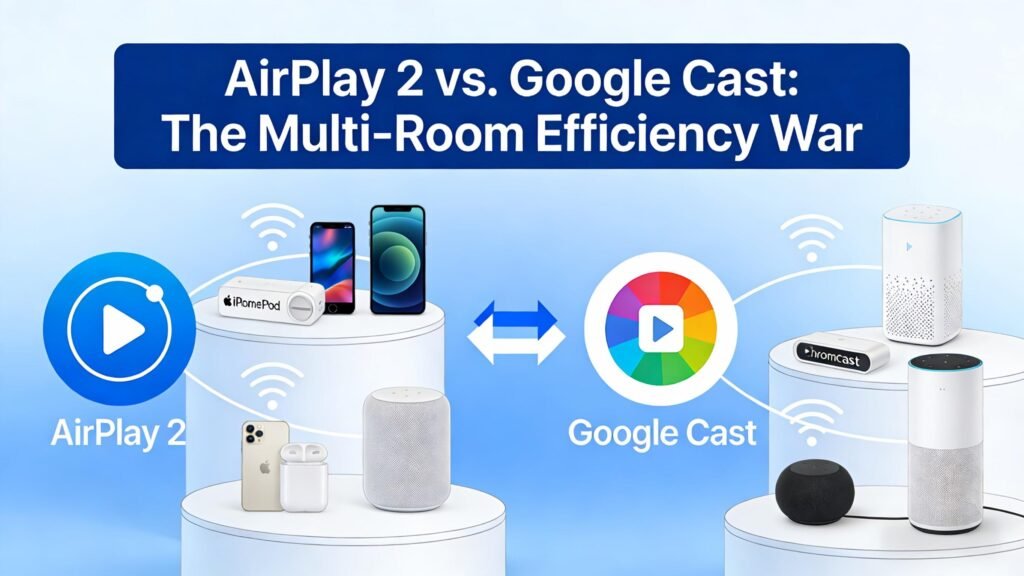
AirPlay 2 vs Google Cast: Which is Better for an 8-Zone Audio System?
AirPlay 2 vs. Google Cast: The Multi-Room Efficiency War
For Apple users, AirPlay 2 is the undisputed king of convenience. It’s baked into every iPhone, iPad, and Mac, allowing for quick multi-room grouping with a few taps. However, when we move from simple background music to a high-density 8-zone professional installation, the technical differences between AirPlay 2 and Google Cast become critical.
At AmpVortex, our AmpVortex-16060G and 16100G support both, but we want our users to understand why the 8-zone Google Cast matrix is often the secret to a more stable home.
The Charm of AirPlay 2: Elegance and Integration
AirPlay 2 is beloved for good reason:
- System-Wide Control: It is integrated into the iOS Control Center.
- Siri Voice Control: “Hey Siri, play Jazz in the Living Room” works flawlessly within the Apple ecosystem.
- Apple Music Native: For subscribers of Apple’s ecosystem, it offers a seamless path for spatial and lossless audio.
The Latency and Battery Reality
Despite its elegance, AirPlay 2 operates on a different fundamental logic than Google Cast, which can lead to friction in large-scale systems:
1. The “Push” vs. “Pull” Efficiency
AirPlay 2 is primarily a “Push” protocol. When you stream from your iPhone, the phone remains the “brain” of the operation. If you walk too far from the router, take a phone call, or if your phone enters a heavy processing task, the audio can stutter. The Google Cast Edge: Google Cast is a “Pull” protocol. Your phone simply sends a “handshake” to the AmpVortex-16100G, and the amplifier pulls the high-res stream directly from the cloud. Your phone is just a remote—saving battery and ensuring the music stays rock-solid even if you leave the house.
2. Bandwidth Bottlenecks in 8-Zone Homes
Streaming to 8 zones simultaneously via AirPlay 2 puts a significant load on your Wi-Fi network because the data is essentially being bounced from the cloud to your phone, and then back out to 8 different speakers. The AmpVortex Advantage: With 8 independent Google Cast nodes in the AmpVortex-16060G, the network traffic is distributed directly to the hardware. This drastically reduces Wi-Fi congestion, ensuring a jitter-free experience across all 8 rooms.
3. Cross-Platform Peace
AirPlay 2 is an Apple-only luxury. If a family member uses a Samsung or Pixel phone, they are locked out of the system’s core features. The Universal Language: By choosing Google Cast as our primary 8-zone matrix, AmpVortex bridges the gap. It provides the same high-resolution, multi-room experience to every family member, regardless of their smartphone choice.
The AmpVortex Hybrid Approach
We don’t believe in forcing our users to choose. That’s why the AmpVortex-16060G and 16100G offer a hybrid solution:
- Use AirPlay 2 for quick, casual streaming or Siri commands.
- Use the 8-zone Google Cast matrix for high-resolution, multi-user concurrency and long-term stability.
Conclusion: Scalability is the Ultimate Feature
AirPlay 2 is a masterpiece of user experience, but Google Cast is a masterpiece of network architecture. For a professional 8-zone audio system, the reliability of a hardware-based Cast matrix is what transforms a “smart home” into a “stable home.”