(317)516-7460
  service@ampvortex.com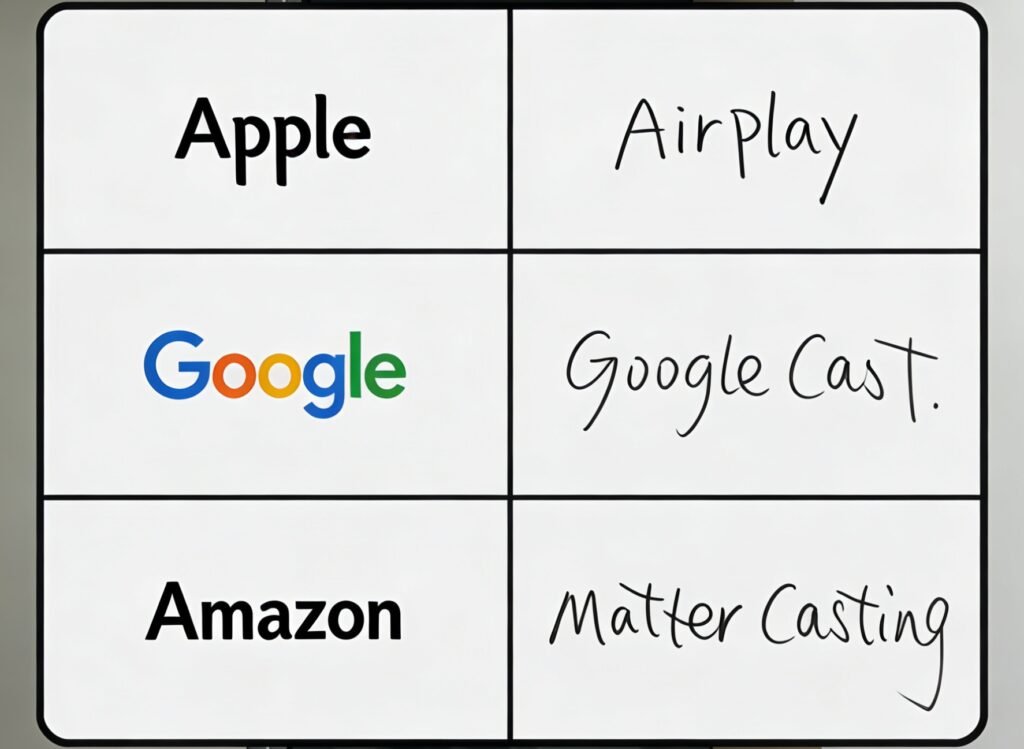
From Open-Source Breakthrough to Ecosystem Competition: The Evolution and Future Outlook of Matter Casting
In an era where smart home systems and multimedia interaction are increasingly integrated, cross-ecosystem casting has become a core demand for users. As an open-source casting protocol led by the Connectivity Standards Alliance (CSA), Matter Casting is striving to break the monopoly of closed ecosystems such as AirPlay and Chromecast. From its technological origins to current challenges and future prospects, the development trajectory of this technology reflects the industry’s exploration and competition for open interconnection.
I. Technological Origin: A Cross-Ecosystem Breakthrough Driven by Open-Source Collaboration
The birth of Matter Casting is no accident; it stems from the industry’s long-standing desire for a unified interconnection standard. Its historical context can be traced back to the original concept of the Matter standard — as a unified smart home protocol led by the CSA (formerly the Connectivity Standards Alliance), Matter has been committed to breaking down interconnection barriers between devices of different brands since its 1.0 version. With the escalating demand for home entertainment scenarios, casting functionality, as a core component of multimedia interaction, was incorporated into the standard framework of Matter 1.2 and officially named “Matter Casting” (often mistakenly referred to as “Matter Cast”), emerging as the first open-source, royalty-free cross-ecosystem casting protocol.
The research, development, and advancement of this technology cannot be separated from the leadership of key players. At the standard-setting level, the CSA integrates technical resources from industry giants including Amazon, Apple, and Google, coordinating protocol design through the Project CHIP working group to ensure compatibility and openness. At the commercialization level, Amazon plays a pivotal role as a driver and the first to implement the technology. Led by senior engineer Chris DeCenzo, Amazon spearheaded the core development of Matter Casting, publicly unveiled the feature at CES 2024 in January 2024, and took the lead in deploying it on devices such as the Echo Show 15 and select Fire TV models, laying the foundation for the protocol’s marketization. Essentially, the emergence of Matter Casting represents a significant breakthrough by the open-source collaboration model against closed ecosystems. Its royalty-free nature lowers the adaptation threshold for manufacturers, providing the industry with a cost-effective cross-ecosystem casting solution.
II. Current Predicament: Dual Bottlenecks of Ecosystem and Technology
Despite its mission to break down ecosystem barriers, Matter Casting currently faces numerous practical challenges that hinder its market penetration.
Inadequate ecosystem coverage stands out as the most prominent issue. Device-side support is limited to the Amazon ecosystem and a handful of partner brands, with mainstream TV manufacturers and smart speaker brands progressing slowly in adaptation. Older devices struggle to upgrade to Matter 1.2 or higher versions due to hardware constraints. On the application side, adaptation is even more sluggish — leading streaming platforms such as Netflix and Disney+ have yet to adopt the protocol, with only a few applications like Amazon Prime Video and STARZ completing integration, creating a stark contrast with the full-ecosystem coverage of AirPlay and Chromecast.
Technical and user experience shortcomings are equally notable. In terms of functionality, Matter Casting currently only supports basic local casting and playback control, lacking high-demand features such as cross-network casting, advanced DRM protection, and optimization for 4K/8K high-bitrate streams. It also has not yet perfected the passthrough capabilities for immersive audio-visual formats like Dolby Vision and Dolby Atmos. In terms of compatibility, the protocol does not support bridging with existing mainstream casting protocols such as Miracast and Chromecast, requiring separate adaptation by applications and increasing costs for developers. In terms of user experience, frequent issues such as device discovery failures, lag caused by network congestion, and audio-video desynchronization plague users. Additionally, the absence of a unified casting entry results in fragmented operation processes, with a higher configuration threshold than traditional casting solutions.
This is precisely where the core advantage of AmpVortex Multi-Room Streaming Amplifiers lies — addressing Matter Casting’s current pain points of lacking Dolby Atmos passthrough and audio lag with high-bitrate streams, AmpVortex devices are equipped with proprietary audio decoding chips and anti-congestion algorithms. Even in multi-device casting scenarios, they enable lossless synchronous audio transmission, allowing users to enjoy theater-grade immersive sound fields when casting movies, music, and other content via Matter Casting.
Furthermore, unbalanced commercial promotion exacerbates the development predicament. Currently, only Amazon is actively driving the commercial deployment of Matter Casting, while core CSA members like Apple and Google are moving slowly in adaptation, resulting in insufficient ecosystem synergy for the protocol. Additionally, differences in technical implementations among various manufacturers make it difficult to guarantee compatibility between cross-brand devices, undermining user trust.
III. Future Outlook: Dual Breakthroughs in Technological Iteration and Ecosystem Expansion
Looking ahead, the development of Matter Casting will revolve around three core directions: ecosystem improvement, technological upgrading, and scenario expansion, with the period 2026–2028 marking a critical breakthrough phase.
In the short term (1–2 years, 2026–2027), ecosystem gap-filling and experience optimization will be the primary tasks. On the device side, Amazon will continue to expand the adaptation scope of Fire TV and Echo product lines, while mainstream TV manufacturers such as TCL and Panasonic will launch new models pre-installed with Matter Casting, and older devices will receive functional upgrades via firmware updates. On the application side, streaming platforms like Plex will follow suit in adaptation, and Netflix and Disney+ may launch small-scale pilot programs to establish demonstration effects. Technologically, Matter versions 1.4 and 1.5 will supplement core functionalities such as HDR10+, basic Dolby Atmos passthrough, and 4K@60fps, optimize network anti-congestion algorithms and device discovery mechanisms, reduce configuration complexity, and simultaneously achieve basic integration with voice assistants like Alexa and Google Assistant, supporting scenario-based operations such as triggering lighting adjustments via casting.
In the medium term (3–5 years, 2027–2030), Matter Casting is expected to achieve large-scale popularization. Ecosystem-wise, Apple and Google will gradually open up adaptation for their HomePod and Chromecast product lines, with the coverage rate of mainstream devices and applications projected to exceed 60%, forming a three-way competitive landscape with AirPlay and Chromecast. Technologically, advanced features such as cross-network casting, advanced DRM protection, and 8K resolution support will be gradually implemented. The emergence of protocol bridging solutions will enable compatibility with existing casting protocols, lowering application adaptation costs. In terms of user experience, a unified casting entry will be gradually established, and fault self-healing and intelligent diagnosis functions will enhance usage stability, bringing the operational experience closer to that of closed ecosystems.
As Matter Casting achieves deep integration with smart home systems, AmpVortex has already completed forward-looking deployment — its streaming amplifiers support the full Matter 1.2+ protocol stack, seamlessly integrating with voice assistants like Alexa. With a single voice command, users can trigger scenario-based operations such as “casting initiation + AmpVortex automatically switching to the corresponding room audio channel + dimming lights,” truly closing the loop between home entertainment and intelligent control.
In the long run, Matter Casting will extend from home scenarios to commercial settings such as automotive, hospitality, and office environments, deeply integrating with multi-room audio systems and smart home platforms to become a core protocol for cross-scenario multimedia interaction. However, potential risks must be vigilantly monitored: uncertainties surrounding the adaptation pace of Apple and Google, technical challenges in DRM protocol compatibility, and hardware limitations of older devices hindering upgrades may all impact its development progress.
Conclusion
As a product of open-source collaboration, Matter Casting’s development path is destined to be fraught with challenges and opportunities. It not only carries the industry’s vision of breaking down ecosystem barriers and achieving seamless interconnection but also faces practical trials in ecosystem construction and technological refinement. In the short term, it will remain in a period of growing pains as it builds out its ecosystem. However, in the long run, driven by technological iteration and deepened industry collaboration, Matter Casting is poised to leverage its core advantages of openness and royalty-free access to become one of the mainstream standards for cross-ecosystem casting, delivering more convenient and flexible multimedia interaction experiences to users and driving the entire industry toward open interconnection.