(317)516-7460
  service@ampvortex.com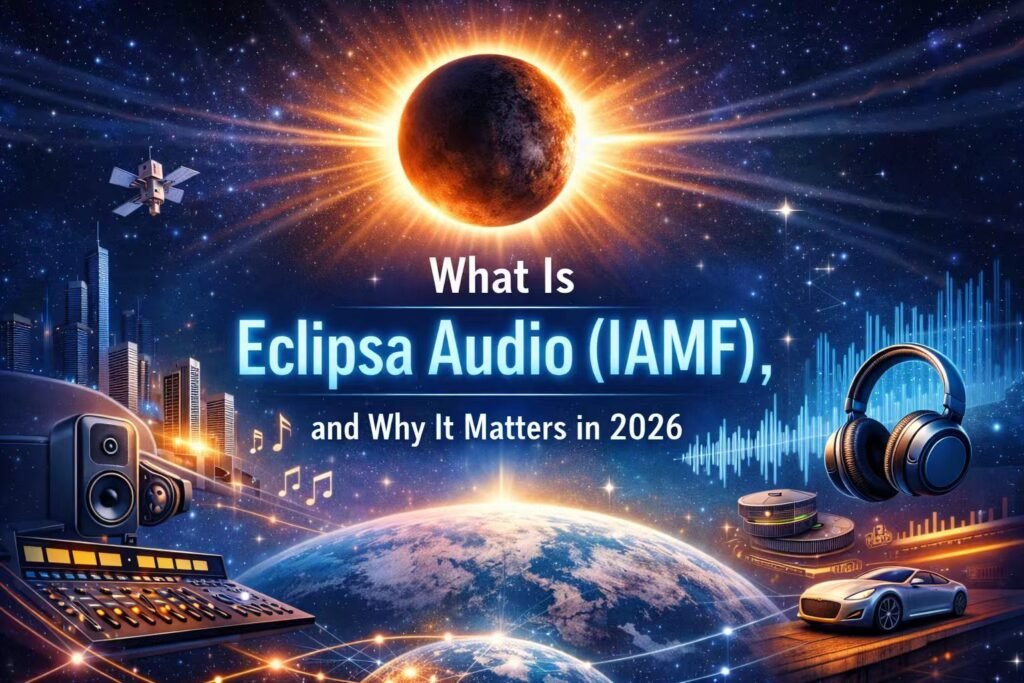
Eclipsa Audio (IAMF) Explained: The Royalty-Free Spatial Audio Challenger to Dolby Atmos
What Is Eclipsa Audio (IAMF), and Why It Matters in 2026
The next “default” spatial audio format may be royalty-free
Eclipsa Audio is an immersive (3D/spatial) audio format based on IAMF (Immersive Audio Model and Formats), the open specification published under the Alliance for Open Media (AOMedia) royalty-free license framework. Alliance for Open Media+1
In early 2025, Samsung announced Eclipsa Audio would ship across its 2025 TV lineup and soundbars, with YouTube positioned as an early content path. Samsung Global Newsroom Google also introduced Eclipsa Audio in its open-source blog as a format built on IAMF, with plans to bring playback support across platforms including Chrome and Android in future releases. Google Open Source Blog+1
The significance isn’t just “another format.” It’s the strategy: royalty-free standard + open tooling + ecosystem pre-installation.
IAMF in one paragraph (without the fluff)
IAMF is designed to carry immersive audio in a way that supports flexible rendering across different playback environments—headphones, TV speakers, soundbars, or multi-speaker home theaters—so the same content can be adapted at playback time. Alliance for Open Media+1
That idea—“author once, render everywhere”—is exactly what modern streaming needs, because device diversity is the rule, not the exception.
Why Eclipsa’s economics change the game
Dolby Atmos is widely adopted, but its ecosystem is traditionally built around licensing, certification, and commercial tooling. Eclipsa Audio approaches the same immersive promise through a different economic engine: an open standard under AOMedia’s royalty-free model, supported by open implementations and creation tools. Alliance for Open Media+1
This doesn’t mean Atmos disappears overnight—content libraries and studio pipelines don’t flip instantly. But it does mean hardware makers can add a “next-gen immersive” checkbox without the same licensing friction, which matters in cost-sensitive segments and broad OEM deployment.
The 2026 reality: coexistence is the winning posture
In 2026, the most pragmatic interpretation is: Eclipsa expands while Atmos remains the dominant legacy library. That creates a clear user need: devices that can handle both.
For AVRs, the buyer question becomes:
- Will my AVR keep working with today’s Atmos/DTS:X catalog?
- Will it also be ready for royalty-free immersive formats as they show up on mainstream platforms?
That’s exactly why “cross-standard” compatibility is becoming a premium differentiator.