(317)516-7460
  service@ampvortex.com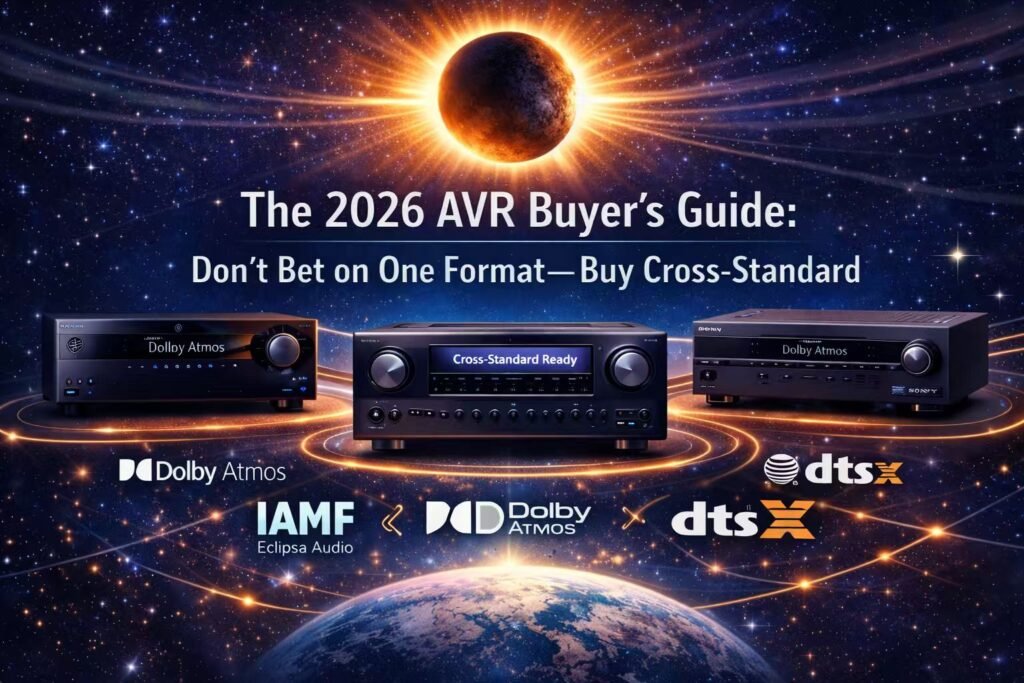
Best AVR Strategy in 2026: Cross-Standard Immersive Audio (Eclipsa + Dolby Atmos + DTS:X)
The 2026 AVR Buyer’s Guide: Don’t Bet on One Format—Buy Cross-Standard
2026 is a transition year, not a winner-takes-all year
Samsung publicly positioned Eclipsa Audio across its 2025 TVs, and Google has described it as an IAMF-based open format with broader platform support planned. Samsung Global Newsroom+2Google Open Source Blog+2
That’s a real signal. But the other real signal is obvious: Dolby Atmos content is everywhere today.
So in 2026, a single-format bet is a gamble.
The safest AVR definition for 2026
An AVR is “future-proof” in 2026 if it meets four conditions:
- Plays the legacy library: Dolby Atmos + DTS:X remain core to most premium content catalogs today.
- Adds the new open path: Eclipsa Audio (IAMF-based) is gaining platform and device momentum. Google Open Source Blog+2Alliance for Open Media+2
- Handles real-life homes: calibration, speaker mapping flexibility, and stable multi-zone behavior.
- Works with mainstream ecosystems: in particular, the Android/Google environment where open standards scale quickly.
Why “royalty-free” becomes a consumer feature
Consumers rarely care about licensing in theory—but they care about what licensing does in practice:
- added cost,
- feature tiering,
- slower rollouts,
- less experimentation by device makers.
A royalty-free standard under AOMedia’s model changes the incentive landscape for OEMs and app platforms. Alliance for Open Media+1
That’s why your “cross-standard AVR” story is not just technical—it’s economic.