(317)516-7460
  service@ampvortex.com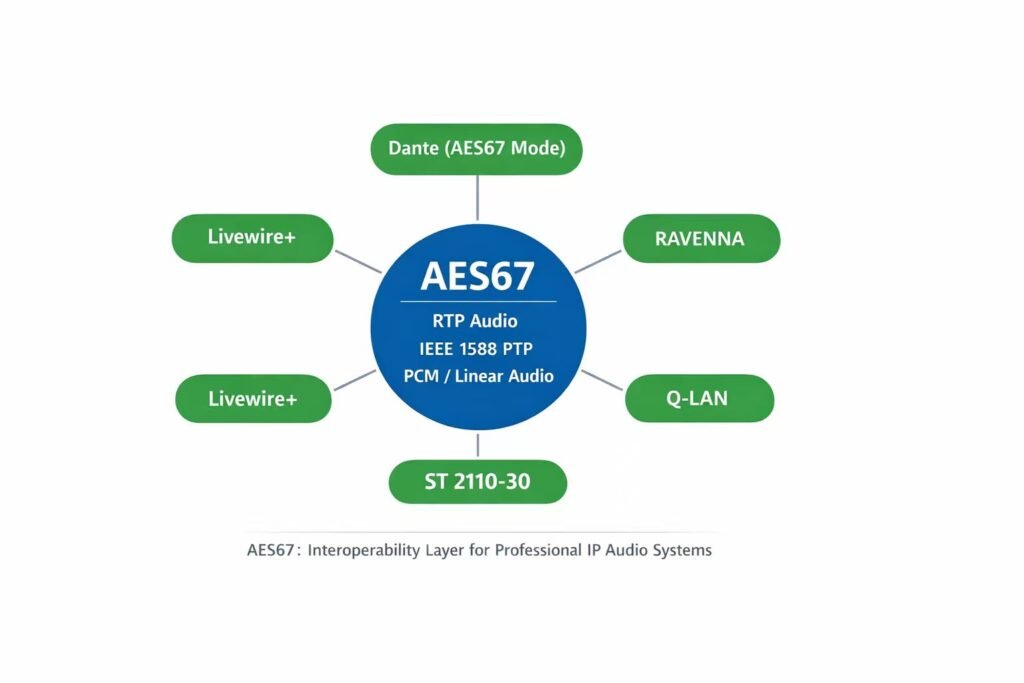
AES67 & Matter Interoperability: Bridging Professional Audio and Smart Home Ecosystems
Protocol Interoperability: The Cross-Border Integration of AES67 and Matter, Reshaping the Audio-Visual Smart Ecosystem
In an era where IP technology is sweeping across all industries, the professional audio-visual sector and the smart home domain are undergoing a profound transformation from “technical fragmentation” to “ecological interconnection”. As the interoperability benchmark for professional audio-over-IP (AoIP) transmission, AES67, and Matter, the unified standard for smart home IP connectivity, seemingly belong to different tracks, yet they share a high degree of alignment in technical core and development logic. What’s more noteworthy is that the cross-border integration of the two has taken root in commercial spaces, high-end residential scenarios, and is driving the audio-visual smart system into a new stage of “full-scenario collaboration”.
I. Homologous yet Divergent: Resonance in the Technical Genes of Two Standards
Although born out of different application scenarios, AES67 and Matter share the core technical genes of the IP interconnection era, and this underlying resonance lays a solid foundation for their integration.
(1) Open IP Architecture: The Common Cornerstone for Breaking Ecological Barriers
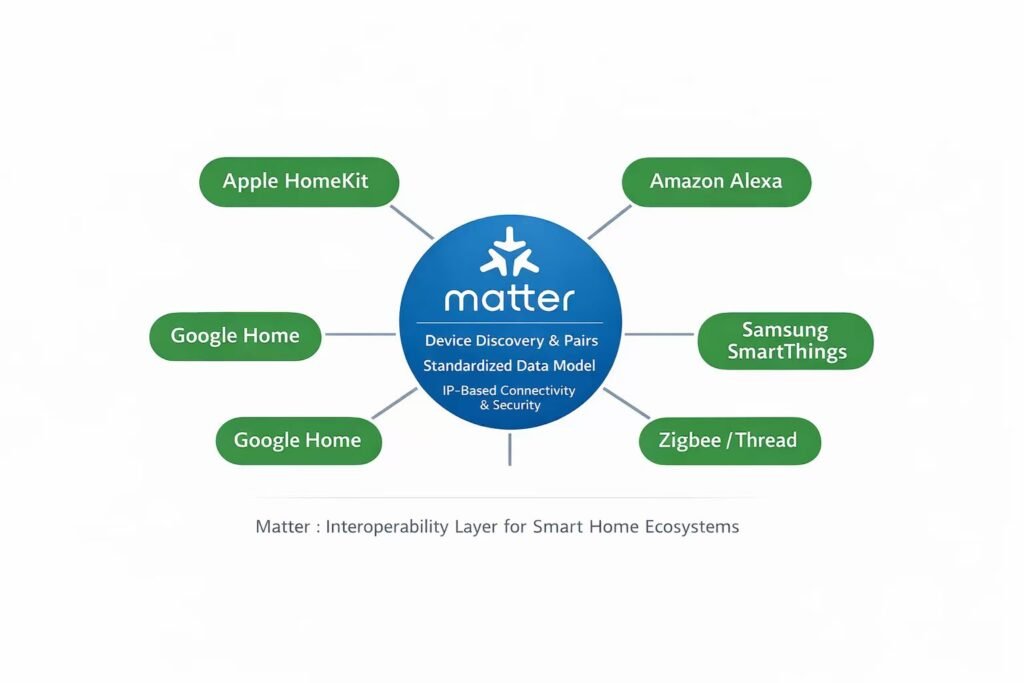
Both AES67 in the professional audio field and Matter in the smart home field take IPv4/IPv6 as the core communication protocol, completely breaking away from the limitations of proprietary bus technologies. Through standardizing key mechanisms such as RTP stream transmission and PTP clock synchronization, AES67 breaks the compatibility barriers between mainstream AoIP protocols like Dante and Ravenna, enabling seamless collaboration between professional audio devices of different brands in the same IP network, and thus becoming the “interoperability pass” in the professional audio field. On the other hand, Matter integrates fragmented smart home ecosystems such as Apple HomeKit, Google Home, and Amazon Alexa through a unified CHIP protocol stack, allowing devices such as lighting, security systems, and home appliances to achieve cross-platform linkage without relying on vendor-specific APIs, solving the long-standing problem of “ecological fragmentation” plaguing the industry. This choice of technology based on open IP not only reduces system deployment costs but also makes interconnection between cross-domain devices possible.
(2) Interoperability as the Core: A Consistent Pursuit from Professional Scenarios to Consumer Markets
Interoperability is the core design goal of both standards, albeit with different focuses on application scenarios. AES67 focuses on the high requirements of professional audio, achieving low-latency, high-precision audio stream docking between different AoIP systems by clarifying technical specifications for key links such as media clocks, session descriptions, and discovery services. Its sub-microsecond-level PTP (IEEE 1588v2) synchronization accuracy meets the stringent demands of multi-channel audio transmission in scenarios such as broadcasting, live performances, and radio and television. Targeting consumer-grade smart homes, Matter adopts a “client-server” command interaction mode. Through standardized Cluster definitions, it enables smart devices of different brands to understand unified control commands, achieving a convenient “one-time pairing, whole-house interconnection” experience that even ordinary users can easily set up smart scenarios. This shared pursuit of “breaking device silos” has created a natural technical complementarity between the two in multi-device collaboration scenarios.
(3) Modular Design: Flexible Adaptation for Compatibility and Expansion
Both standards adopt a modular architecture, which not only ensures compatibility with existing technologies but also reserves space for future expansion. Instead of attempting to replace existing AoIP protocols, AES67 exists as a “bridging standard”, allowing protocols such as Dante, WheatNet-IP, Ravenna, Q-LAN, Tesira, Aurora, and RockNet to connect through compatible modes. It also supports integration with media network standards like AVB/TSN and SMPTE ST 2110-30, meeting the requirements of more complex audio-visual synchronization needs. This modular design enables AES67 to flexibly adapt to multiple scenarios such as public address systems and intercom systems through protocol stack integration and audio algorithm optimization, supporting single-cable deployment with PoE power supply, and further reducing system complexity. Matter also boasts strong compatibility and scalability, supporting multiple connection methods such as Wi-Fi, Ethernet, and Thread, and expanding application boundaries through continuous version updates — Matter 1.5 has achieved native support for smart cameras, adding functions such as WebRTC audio-visual transmission and PTZ pan-tilt control, covering more scenarios such as security monitoring and baby monitoring. This modular design allows the two standards to be flexibly combined according to application needs, providing technical flexibility for cross-border integration.
II. Cross-Border Integration: From Technical Collaboration to Scenario Implementation
When the high-fidelity requirements of professional audio-visual meet the convenient control needs of smart homes, the integration of AES67 and Matter has moved from technical conception to real-world scenario implementation, demonstrating enormous value in commercial spaces and high-end residential fields.
(1) Key Paths for Technical Integration
The integration of the two is not a simple protocol overlay but an in-depth collaboration based on IP networks, with the core lying in the organic combination of “professionalization of audio transmission” and “unification of device control”. At the transport layer, AES67 is responsible for handling high-bandwidth, low-latency professional audio streams. Its uncompressed PCM transmission capability with a 48kHz sampling rate and 24-bit bit depth, combined with a 1.4-1.5x encapsulation coefficient design, can perfectly reproduce multi-channel audio effects such as Dolby Atmos. Even for large-scale 64-channel audio transmission, the bandwidth can be controlled at around 110Mbps, meeting the deployment requirements of gigabit networks. At the control layer, Matter takes on the role of device linkage and scenario management, enabling collaboration between audio devices and smart home systems through unified control commands — for example, when Matter detects that the user has activated the movie-watching mode, it can automatically send commands to the AES67 audio system to initiate surround sound field calibration and adjust the volume, achieving a seamless experience where “sound effects are ready as soon as the screen lights up”.
Clock synchronization collaboration is the technical key to integration. AES67’s PTP synchronization mechanism ensures precise alignment of audio streams, while Matter achieves real-time response of control commands through the time synchronization mechanism of Thread/Wi-Fi. The two avoid bandwidth competition between control data and audio streams by configuring network QoS priorities (marking audio streams as EF priority), ensuring system stability. This collaborative model of “professional transmission + unified control” not only retains AES67’s professional advantages in audio quality but also leverages Matter’s convenience in intelligent control, achieving a 1+1>2 technical effect.
To enable the seamless bridging of AES67 with diverse protocols, several key technical prerequisites must be met. First, synchronization alignment: all bridged devices must be unified under the same PTP domain (usually set to 0) to avoid audio drift caused by clock asynchrony. Second, service discovery: enable protocols such as SAP, mDNS, and NMOS to ensure that AES67 streams can be detected and recognized by other protocol systems. Third, stream identification: strictly follow the AES67 specification to mark RTP Payload Type as -22 and use multicast addresses in the 239.x.x.x/16 range, which is compatible with most AoIP systems like Dante. Fourth, QoS guarantee: reserve 70% of the link capacity for AES67 audio streams to prevent congestion during concurrent transmission of multi-protocol data.
(2) Typical Cases of Scenario Implementation
In the commercial space sector, scenarios such as hotels and exhibition halls have become pioneers in integrated applications. Professional audio solutions supporting AES67 have been widely used in public address systems and building background music in retail environments, realizing single-cable deployment with PoE power supply and reducing construction costs. Matter is responsible for integrating lighting, curtains, security systems, and other devices to form an “audio-linked scenario” — when Matter-enabled cameras in the exhibition hall detect the gathering of visitors, they can automatically trigger the AES67 audio system to play exhibit introductions while brightening the lighting in the area to enhance the visiting experience.
In the high-end residential field, professional audio-visual equipment has achieved in-depth integration of the two standards. Its built-in AVB switch chip can simultaneously connect to the Dante audio network (compatible via AES67) and the Matter smart home system, turning ultra-high-definition TVs into “audio-visual smart hubs”. Users can activate the whole-house audio-visual mode with voice commands: Matter controls the closing of curtains and dimming of lights, while the AES67 audio system automatically switches to Dolby Atmos mode, integrating professional-grade audio-visual experiences into daily home life. This integration not only enhances user experience but also upgrades UF-HDTV from a simple entertainment terminal to a linkage node for professional content distribution and intelligent control.
In professional audio-visual consumer scenarios, the combination of AES67’s multi-channel audio distribution capability and Matter’s intelligent control creates a more flexible home theater solution. Users can connect an AES67 USB sound card to their computers to distribute multi-channel audio tracks of Dolby format movies to speakers throughout the house, while Matter can automatically adjust audio effects according to the movie-watching progress — for example, reducing ambient noise during silent segments of the movie and enhancing bass performance during climactic scenes, enabling home theaters to have professional-grade adaptive sound field capabilities.
III. Challenges and Evolution: Future Outlook of the Integrated Ecosystem
Although the cross-border integration of AES67 and Matter has achieved phased results, it still faces challenges in technical collaboration and ecological improvement, and these challenges will become the driving force for the continuous evolution of the two standards.
(1) Current Core Challenges
At the technical level, there is still room for optimization in the synchronization accuracy adaptation between the two. AES67’s sub-microsecond-level synchronization is mainly aimed at professional audio transmission, while Matter’s millisecond-level synchronization meets the needs of home control. However, in scenarios of deep “audio-control” linkage, there may be slight delays between command responses and audio switching, affecting experience consistency. In addition, the bandwidth allocation mechanism still needs to be improved. When AES67 transmits multi-channel audio streams, it is necessary to reasonably allocate network bandwidth with Matter’s control data and camera video streams (a new feature of Matter 1.5) to avoid audio freezes or control delays caused by congestion.
At the ecological level, the progress of device compatibility and standard implementation needs to be accelerated. Although AES67 has gained support from mainstream AoIP vendors, some old professional audio devices still require dedicated bridges to connect to the Matter ecosystem. Moreover, Matter has a low penetration rate in the professional audio device field, and most audio vendors have not yet launched products that natively support Matter, limiting the large-scale implementation of integrated scenarios. In addition, there is a gap in the standardization of control commands between the two. AES67 focuses on audio stream transmission and lacks a unified control protocol (requiring the matching of AES70), while Matter’s control commands have not been optimized for professional audio devices, resulting in the inability to directly control some advanced audio functions through Matter.
(2) Future Evolution Trends
Technical collaboration will continue to deepen. It is expected that in the future, AES67 will further optimize the synchronization mechanism with Matter, possibly by simplifying the PTP synchronization process and adding adaptation interfaces with Matter time synchronization to achieve millisecond-level collaboration between “audio streams and control commands”. At the same time, network bandwidth management technology will be upgraded, dynamically allocating bandwidth resources for audio streams, control data, and video streams through intelligent bandwidth reservation algorithms (such as AES67’s 70% link capacity reservation principle) to ensure system stability during concurrent multi-service transmission.
Standard ecosystems will accelerate integration. The CSA Alliance may carry out more in-depth cooperation with the Audio Engineering Society (AES), adding Cluster definitions for professional audio control in the Matter standard to achieve standardized control of functions such as volume adjustment, channel switching, and sound effect modes, enabling AES67 audio devices to seamlessly connect to the Matter control ecosystem. Meanwhile, more vendors will launch cross-border products integrating the two standards, such as professional audio amplifiers supporting Matter and smart speakers compatible with AES67, enriching the types of devices in the integrated ecosystem.
Application scenarios will continue to expand. In addition to existing commercial space and high-end residential scenarios, the integration of the two will also extend to fields such as smart offices and smart education. In smart office scenarios, AES67 can realize multi-channel audio collection and transmission in conference rooms, while Matter controls the linkage of conference equipment (such as camera tracking of speakers and automatic lighting adjustment) to create an integrated smart conference system. In smart education scenarios, AES67 ensures clear transmission of classroom audio, and Matter realizes the linkage between teaching equipment and audio systems to enhance the teaching experience.
Conclusion
The cross-border integration of AES67 and Matter is essentially an inevitable trend of the civil application of professional technologies and the professionalization of consumer technologies. With open IP architecture as the link and interoperability as the core, the two perfectly combine the high-quality experience of professional audio-visual with the convenient control of smart homes, reshaping the ecological pattern of audio-visual smart systems. Although it currently faces challenges in technical collaboration and ecological improvement, with the continuous evolution of standards and the active participation of vendors, this integration will gradually move from high-end scenarios to the mass market, allowing more users to enjoy the full-scenario experience of “professional-grade sound quality + intelligent control”. In the future, when AES67’s “audio professionalism” and Matter’s “control unification” achieve deeper collaboration, a seamlessly interconnected, consistent-experience audio-visual smart new ecosystem is on the horizon.
Case Study: AmpVortex as a Practical Carrier of AES67–Matter Convergence
A representative example of this convergence can be found in modern system-level audio platforms such as AmpVortex.
AmpVortex is designed as a multi-zone, multi-channel IP audio platform that aligns closely with the architectural philosophy described above. On the audio transport layer, AmpVortex adopts professional-grade IP audio principles and can interoperate with AES67-based ecosystems, enabling high-bandwidth, low-latency, multi-channel PCM audio distribution across complex installations.
On the control and orchestration layer, AmpVortex integrates with smart home and building automation systems, making it a natural bridge between professional audio transmission and unified device control. When deployed within a Matter-enabled environment, AmpVortex can participate in scenario-based automation — responding to Matter-triggered events such as “movie mode”, “conference mode”, or “night mode”, while maintaining professional-grade audio synchronization and channel management internally.
This type of architecture demonstrates that the integration of AES67 and Matter is not merely theoretical. Instead, it is already being realized through platforms that treat professional audio transport and smart control as complementary layers within a single IP-native system. AmpVortex exemplifies how future audio-visual systems can evolve beyond isolated domains and move toward full-scenario collaboration.
Glossary:
AoIP (Audio over IP)
Audio over IP refers to the transmission of digital audio signals over standard IP networks. AoIP replaces traditional point-to-point audio cabling with packet-based Ethernet networks, enabling scalable, flexible, and synchronized multi-channel audio distribution across professional and commercial systems.
AES (Audio Engineering Society)
The Audio Engineering Society (AES) is a professional organization that develops standards, conducts research, and promotes best practices in audio technology, including digital audio, networking, and professional sound systems.
AES3
AES3 is a digital audio interface standard developed by the Audio Engineering Society for the transmission of two-channel PCM audio over balanced XLR or coaxial connections. It is widely used in professional audio equipment and is also known as AES/EBU.
AES67
AES67 is an interoperability standard defined by the Audio Engineering Society for Audio over IP systems. It specifies a common RTP-based audio transport, PTP clock synchronization, and linear PCM encoding, enabling audio-level interoperability between different AoIP ecosystems such as Dante, RAVENNA, and Livewire+.
Dante (Digital Audio Network Through Ethernet)
Dante is a proprietary Audio over IP technology developed by Audinate that enables low-latency, uncompressed digital audio transmission over standard Ethernet networks. Dante devices can interoperate with other AoIP systems through AES67 compatibility mode.
RAVENNA
RAVENNA is an open Audio over IP protocol developed by ALC NetworX, primarily used in broadcast and professional audio environments. It is one of the foundational technologies behind AES67 and provides native compatibility with AES67-based systems.
Livewire+
Livewire+ is an Audio over IP protocol developed by Telos Alliance for broadcast and radio applications. It supports high-channel-count, low-latency audio networking and includes an AES67 profile to enable interoperability with other AoIP systems.
AVB (Audio Video Bridging)
Audio Video Bridging (AVB) is a set of IEEE 802.1 standards that provide deterministic, time-synchronized audio and video transport over Layer 2 Ethernet networks. AVB later evolved into Time-Sensitive Networking (TSN) and typically requires AVB/TSN-capable switches.
SMPTE ST 2110
SMPTE ST 2110 is a suite of standards defined by the Society of Motion Picture and Television Engineers for professional media transport over IP networks. ST 2110-30 specifies the transport of uncompressed PCM audio and is based on AES67 principles.
MADI (Multichannel Audio Digital Interface)
MADI is a digital audio interface standard for transporting up to 64 channels of PCM audio over coaxial or optical links. It is commonly used in professional audio and broadcast systems and is often bridged to AoIP networks via gateways.
PTP (Precision Time Protocol)
Precision Time Protocol (IEEE 1588) is a network-based time synchronization protocol that enables devices to align their clocks with sub-microsecond accuracy. PTP is a core component of AES67 and SMPTE ST 2110, ensuring precise synchronization of multi-channel audio streams.
These terms form the technical foundation of modern IP-based audio and audio-visual systems, enabling interoperability, synchronization, and scalable system design.
References & Further Reading
- AES – AES67 Audio-over-IP Interoperability Standard
https://www.aes.org/standards/comments/aes67/ - RAVENNA Network – AES67 Interoperability
https://www.ravenna-network.com/technology/aes67/ - Connectivity Standards Alliance – Matter
https://csa-iot.org/all-solutions/matter/ - Matter Specification & Developer Resources
https://csa-iot.org/developer-resource/specifications/ - Matter 1.5 Release Notes
https://csa-iot.org/newsroom/matter-1-5/ - SMPTE ST 2110-30 Audio
https://www.smpte.org/standards/st-2110 - AMWA NMOS – Networked Media Open Specifications
https://www.amwa.tv/projects/nmos - AmpVortex – System-Level Audio Platform
https://www.ampvortex.com