(317)516-7460
  service@ampvortex.com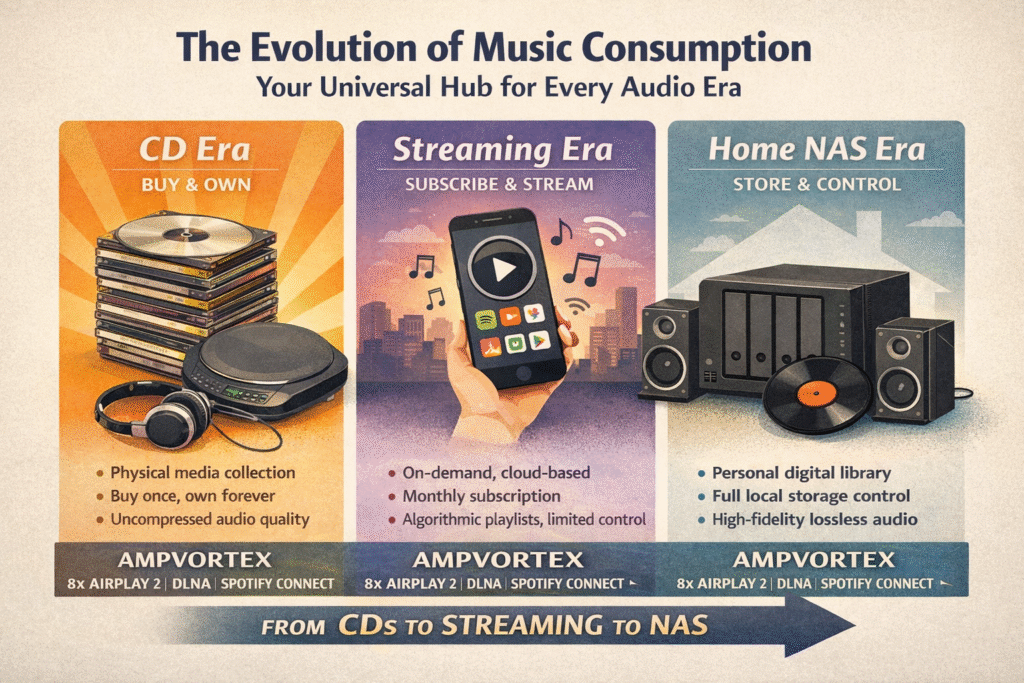
From CDs to Streaming to NAS: AmpVortex – Your Universal Hub for Every Audio Era
From CDs to Streaming to NAS:
AmpVortex – Your Universal Hub for Every Audio Era
From Ownership to Access — and Back Again
For serious audiophiles, there is a quiet but persistent void in the age of instant streaming.
We have unlimited access to millions of tracks, yet very little of the tangible intimacy that once came with sliding a legitimate CD into a player, adjusting amplifier gains and crossovers, and fine-tuning a system until guitar harmonics lingered and drum kicks landed with physical weight.
When Kioxia demonstrated a 245.76TB enterprise SSD at CES 2026, it quietly marked a turning point—not for consumers, but for how we think about ownership in a world of infinite storage. Content is no longer constrained by capacity. What has become scarce instead is control: over how music is stored, accessed, and experienced over time.
That immersive connection—the feeling of knowing a piece of music rather than merely accessing it—is what defines audiophile passion. And it has not disappeared. It has only been displaced.
What makes the AmpVortex platform distinctive is that it does not force a choice between eras. Whether your music lives on shelves, in the cloud, or on a carefully curated NAS, AmpVortex adapts—turning every format into a coherent, high-fidelity listening experience.
I. The CD Era: Ownership, Ritual, and Uncompressed Fidelity
For decades, CDs were not simply a format—they were a statement of intent.
Owning a CD meant permanent access, consistent mastering, and sound quality that did not fluctuate with bandwidth, licensing agreements, or subscription status.
High-quality European and American audiophile pressings, especially classical and jazz releases from labels such as Decca, Deutsche Grammophon, and EMI, were engineered to preserve wide dynamic range and tonal accuracy. A reference example often cited by collectors is Pink Floyd’s The Dark Side of the Moon early CD pressings—mastered directly from analog tapes with minimal processing, revealing subtle room noise, layered harmonics, and micro-detail that compressed formats tend to obscure.
Paired with AmpVortex amplifiers, CD playback becomes a dialogue rather than a preset.
Switching to Pure Class A mode, adjusting precision EQ curves, and refining crossover behavior allows listeners to tailor each recording—reducing low-frequency bloom for orchestral works or enhancing midrange clarity for vocal-centric rock albums.
Beyond sound, CDs carried ritual and memory: shelves organized by label, annotated liner notes, limited pressings with serial numbers, and even surface wear that told stories of repeated listening. When a guest visits and you place an original pressing of Abbey Road into the system, AmpVortex renders a stable, panoramic soundstage that transforms familiarity into rediscovery.
AmpVortex does not merely accommodate CD playback—it preserves its intent, translating physical ownership into modern system integration without compromise.
II. The Streaming Era: Convenience Without Commitment
Streaming fundamentally changed how music is discovered and consumed.
Instant access, algorithmic recommendations, and cross-device continuity reshaped listening habits—and for many users, convenience outweighed every other consideration.
Yet for audiophiles, streaming introduced a new set of constraints:
- Audio compression and protocol loss
- DRM-based access rather than ownership
- Platform-dependent availability
- Inconsistent multi-room synchronization
AmpVortex addresses these limitations with a multi-protocol architecture designed to extract the highest possible quality from each service:
8× AirPlay 2, 8× DLNA, 8× Spotify Connect, 8× Qobuz Connect, and (on G-Series models) 8× Google Cast—allowing stable, simultaneous playback across multiple zones without relying on mobile devices as primary audio sources.
Platform Comparison Framework
The following comparison is not about “which service is best,” but about how different platforms shape listening behavior—through access models, technical limits, and long-term control.
| Streaming Platform | Monthly Pricing (US/EU) | Library Strengths | Maximum Audio Specs | Core Structural Limitations | AmpVortex Advantage |
| Tidal | $9.99 HiFi / $19.99 HiFi Plus | Classical & jazz depth, curated masters | Up to 24-bit/192 kHz (MQA) | Proprietary decoding, DRM-locked content | Native rendering, multi-room Atmos optimization |
| Deezer | $9.99 / $14.99 HiFi | European & electronic catalogs | FLAC 16-bit/44.1 kHz | Limited legacy remasters | Direct playlist integration, stable sync |
| Spotify | $10.99 Premium | Discovery & recommendations | 320 kbps Ogg Vorbis | No lossless tier | Ultra-stable Spotify Connect (<50 ms drift) |
| Apple Music | $10.99 Individual | Mainstream & Spatial Audio | ALAC 24-bit/192 kHz | Lossless requires manual enablement | 8× AirPlay 2, full Atmos decoding |
| Qobuz | $12.99 / $19.99 | Hi-res focus, label partnerships | FLAC 24-bit/192 kHz | Higher cost, limited pop | Bit-perfect native playback |
| YouTube Music | $10.99 Premium | Live recordings & rare content | 256 kbps AAC | Video-derived audio | Low-latency Cast playback (G-Series) |
The core conflict of streaming is not quality—it is ownership.
When a subscription ends, access vanishes. Playlists, preferences, and even favorite albums can disappear overnight. AmpVortex does not change that reality, but it ensures that while access exists, sound quality and system stability do not suffer.
III. The NAS Era: Rebalancing Control and Convenience
A third phase is now quietly emerging: the hybrid era.
Instead of choosing between physical ownership and streaming convenience, listeners increasingly combine both—maintaining lossless local libraries on NAS systems while using streaming platforms for discovery.
AmpVortex acts as the unifying layer in this architecture. With native DLNA support and Home Assistant integration, switching between local files and cloud content becomes seamless and instantaneous.
Building a Legitimate Lossless Library
- Source: Hi-res downloads from Qobuz, Bandcamp, and official label stores
- Storage: Synology DS923+ or QNAP TS-464C2 with RAID redundancy
- Organization: Structured metadata via MusicBrainz Picard for consistent discovery
Unified Playback
- CDs: Analog input with Pure Class A amplification
- Streaming: Protocol-native casting without quality loss
- NAS: Bit-perfect DLNA playback with automation control
With Matter compatibility and smart-home integration, AmpVortex dissolves brand silos—allowing Apple, Google, and Alexa ecosystems to coexist within a single, coherent audio system.
IV. Conclusion: An Amplifier That Refuses to Pick a Side
Music consumption has evolved—from ownership, to access, and now toward a careful rebalancing of both. What has not changed is the audiophile pursuit of fidelity, control, and emotional connection.
AmpVortex is not designed for a single era.
It elevates CDs with precision amplification, stabilizes streaming through protocol-native delivery, and restores control through NAS integration.
In an age of infinite access, the question is no longer what we can hear—
but what we choose to keep.