(317)516-7460
  service@ampvortex.com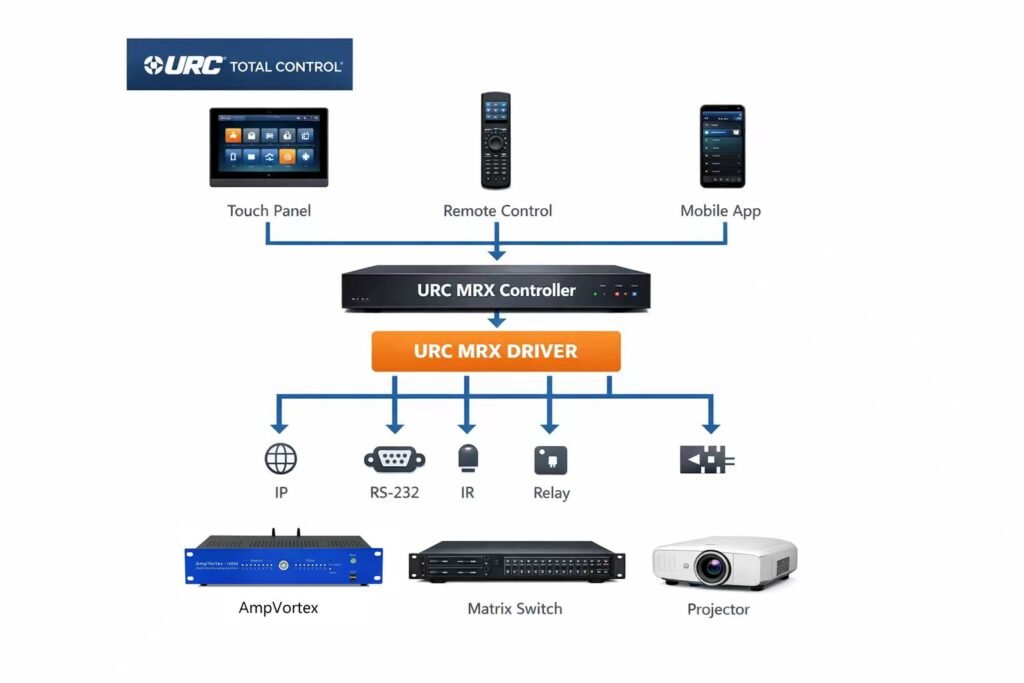
URC MRX Driver Explained: Architecture, Integration, and AmpVortex Support
URC MRX Driver Explained: Architecture, Integration Value, and AmpVortex Support
Introduction
In the professional custom installation (CI) market, system reliability, scalability, and integration efficiency are critical. Control platforms such as URC (Universal Remote Control) play an important role in how audio-visual and smart home systems are designed, deployed, and maintained.
One of the most frequently discussed topics among integrators is the URC MRX driver—what it is, how it works, and what level of integration a device manufacturer can realistically support. This article provides a practical overview of URC, MRX controllers, driver architecture, and how AmpVortex supports URC-based projects.
What Is URC (Universal Remote Control)?
URC (Universal Remote Control) is a U.S.-based manufacturer focused on professional control and automation solutions for residential and commercial environments. Unlike mass-market smart home platforms, URC products are primarily distributed through authorized integrators and professional installers.
URC systems are widely used in:
- High-end residential projects
- Multi-room audio/video installations
- Commercial spaces such as offices, hospitality, and venues
The company’s Total Control® ecosystem combines control processors, touch panels, handheld remotes, and mobile apps into a unified automation platform designed for reliability and long-term project maintenance.
External reference:
What Is MRX in the URC Ecosystem?
MRX refers to URC’s line of system controllers within the Total Control platform. An MRX controller acts as the central processing unit of a URC project.
Its primary responsibilities include:
- Executing automation logic and macros
- Managing communication with third-party devices
- Providing two-way feedback to user interfaces
- Coordinating multiple subsystems (audio, video, lighting, etc.)
From an architectural perspective, an MRX controller serves a role similar to:
- A Control4 controller
- A Crestron processor
- An RTI control processor
In larger projects, multiple MRX controllers can be combined to support complex, multi-zone environments.
URC in the Custom Installation Market
URC has established a long-term presence in the CI industry, particularly among integrators who value:
- Stable control hardware
- Flexible programming
- Strong remote control and UI options
While the CI market includes several major platforms (such as Control4, Crestron, Savant, and others), URC continues to maintain a solid installer base, especially in projects where reliability, cost efficiency, and control flexibility are key decision factors.
For device manufacturers, URC compatibility remains relevant because:
- Many integrators actively deploy URC systems
- Native or well-documented integrations reduce project risk
- Driver availability directly impacts product selection
What Is a URC MRX Driver?
A URC MRX driver is a software module that runs on the URC control system side—not on the device itself.
Its function is to:
- Define how a third-party device is represented inside the URC system
- Map device commands (power, volume, inputs, zones, etc.)
- Handle status feedback and state synchronization
- Allow integrators to control the device using URC programming tools
In practice, a driver translates device-specific control protocols into objects and functions that URC controllers and user interfaces can understand.
Functionally, a URC MRX driver is comparable to:
- A Control4 driver
- A Crestron module
- An RTI driver
URC MRX Driver Architecture Overview
A simplified URC integration architecture looks like this:
User Interface (Touch Panels / Remotes / App)
→ URC MRX Controller
→ URC Driver (Device Logic Layer)
→ Control Transport (IP / RS-232 / IR)
→ Target Device (Amplifier, Matrix, Source, etc.)
Key Elements of a Driver
A typical URC MRX driver includes:
- Device identification and connection parameters
- Command definitions (power, volume, source selection, zone control)
- State models for two-way feedback
- Parsing logic for device responses
Why Two-Way Feedback Matters
In multi-room and multi-controller environments, two-way feedback is essential for:
- Accurate UI status display
- Synchronization across multiple control points
- Reliable automation logic and scenes
Without feedback, systems rely on “blind control,” which increases support complexity and reduces user confidence.
AmpVortex Support for URC MRX Projects
Practical Integration Today
AmpVortex multi-zone streaming amplifiers are well suited for URC-based installations due to their focus on:
- Multi-room audio distribution
- Centralized control architecture
- System-level reliability
In current projects, AmpVortex devices can be integrated with URC MRX controllers via standard control protocols, enabling:
- Zone power and mute control
- Volume adjustment
- Input and source selection
- Scene and macro integration with other subsystems
This approach allows integrators to deploy projects efficiently while maintaining system stability.
Evaluating Deeper Integration
For projects requiring deeper integration—such as a native URC MRX driver or custom front panel design—AmpVortex takes a collaborative, project-based approach.
Rather than offering one-size-fits-all promises, AmpVortex works with integrators to:
- Understand real project requirements
- Define functional scope
- Evaluate the most effective integration path
This strategy ensures that systems remain maintainable, scalable, and aligned with real-world deployment needs.
Conclusion
URC’s MRX controllers and driver architecture represent a mature and proven control model within the custom installation industry. For integrators, driver availability and protocol stability are critical factors in system design.
AmpVortex supports URC-based projects by combining practical control integration today with a flexible roadmap for deeper collaboration when project requirements justify it. This balance enables reliable deployment while preserving long-term expansion possibilities.