(317)516-7460
  service@ampvortex.com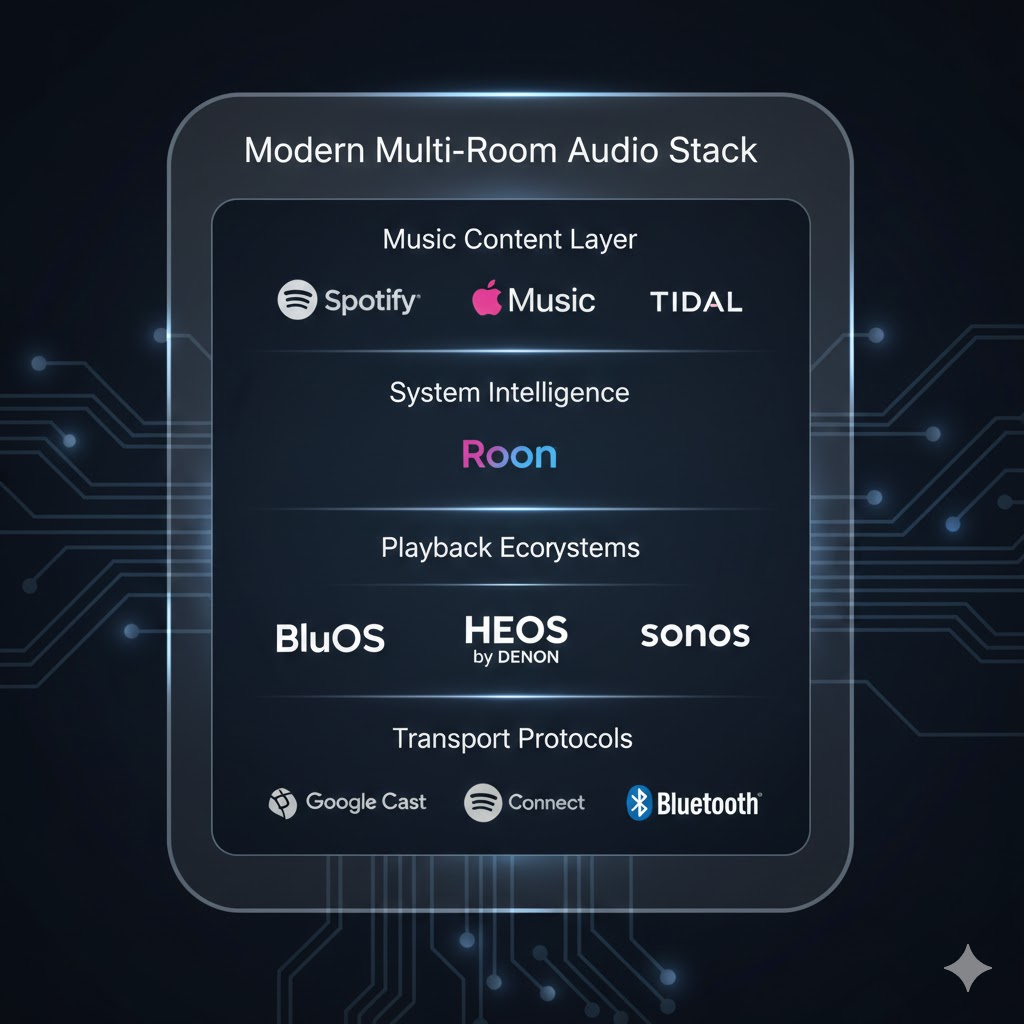
Understanding the Modern Music System Stack: Roon, Sonos, BluOS, HEOS, and Streaming Protocols Explained
Understanding the Modern Music System Stack:
Why Content, Intelligence, Ecosystems, and Protocols Must Be Separated**
In today’s home audio and smart home environments, music playback is often discussed as if it were a single function: open an app, select a song, and press play. In reality, modern music systems are composed of multiple distinct layers, each solving a fundamentally different problem.
Confusion arises when these layers are mixed together—when a playback protocol is treated as a platform, or when a brand ecosystem is mistaken for system intelligence. To understand why platforms like Roon, BluOS, HEOS, Sonos, Spotify, and Google Cast feel similar on the surface yet behave so differently, we need to look at the music system as a layered architecture.
The Four Layers of a Modern Music System
Each layer exists for a reason. Problems occur not because one layer is “bad,” but because a solution designed for one layer is forced to solve problems belonging to another.
1. Music Content Layer: Ownership of Music, Not Playback
The music content layer is where music actually lives. Platforms like Spotify, Apple Music, TIDAL, and Qobuz own licenses, catalogs, recommendation algorithms, and social graphs. Their responsibility is content discovery, personalization, and distribution rights—not audio transport or device control.
This explains why content platforms aggressively protect their ecosystems. APIs are limited, DRM is enforced, and playback behavior is tightly controlled. From their perspective, consistency and brand experience matter more than system-level flexibility.
Crucially, content platforms are not playback systems. They decide what you listen to, not how it travels through your home.
2. System Intelligence Layer: Orchestrating the Entire Audio Environment
The system intelligence layer is where Roon uniquely operates.
Rather than competing with music services, Roon sits above them. It does not replace Spotify or TIDAL; instead, it organizes music—local and streamed—into a coherent system. This includes:
- Unified library management
- Deep metadata relationships
- Device discovery and routing
- Precise clock synchronization
- Optional DSP and signal processing
Roon treats music playback as a distributed system problem, not a UI problem. This is why its architecture separates the Core, Control interfaces, and Endpoints, and why its RAAT protocol prioritizes timing accuracy over convenience.
In this layer, the question is no longer “Which app do I use?” but rather:
Where should this audio go, at what quality, under what timing constraints?
Few platforms attempt to answer this question. Roon exists specifically to do so.
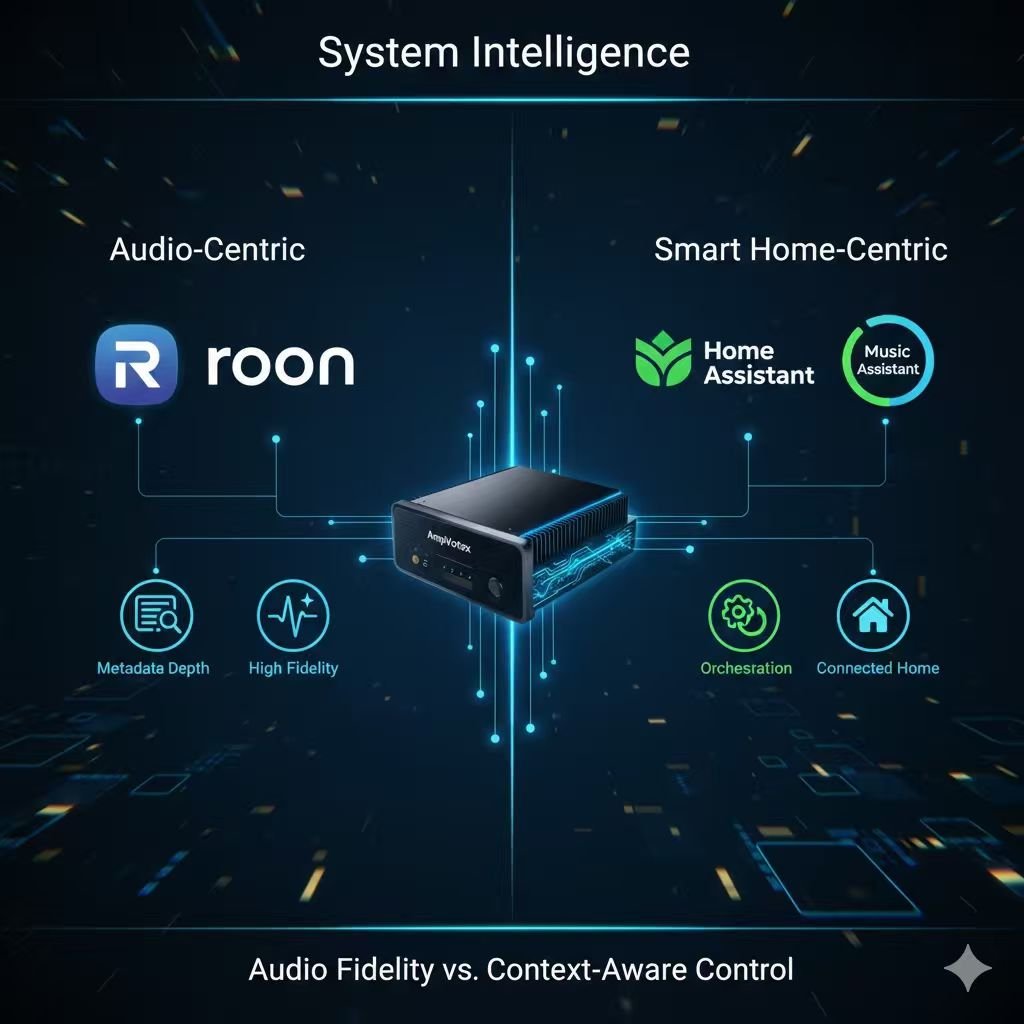
System Intelligence: Audio-Centric vs Smart Home-Centric
While Roon is the most prominent example of a system intelligence platform focused on audio quality and playback precision, it is not the only approach at this layer.
Projects such as Music Assistant, typically deployed within Home Assistant, also operate at the system intelligence level—but with a different priority. Rather than optimizing for audiophile-grade playback and metadata depth, Music Assistant focuses on orchestration, automation, and integration with the broader smart home environment.
This distinction highlights an important nuance:
the system intelligence layer is not monolithic. It can be oriented toward audio fidelity, as in Roon, or toward context-aware control, as in smart home–centric platforms.
In advanced systems, these approaches are often complementary rather than competitive, with hardware endpoints supporting both high-quality playback engines and automation-driven control layers.
3. Playback Ecosystem Layer: Brand-Centered Convenience
BluOS, HEOS, and Sonos all operate in the brand playback ecosystem layer.
These systems are designed around a clear goal:
How do devices from the same brand play music together reliably?
To achieve this, they provide:
- A unified app
- Simplified device grouping
- Integrated access to music services
- Minimal configuration
This approach works well for single-brand households and mainstream users. However, it comes with trade-offs:
- Limited cross-brand integration
- Shallow metadata
- Tight coupling between hardware and software
- Difficulty integrating with automation systems
These platforms are not “inferior” to system-level solutions—they are simply optimized for a different problem: brand cohesion rather than system intelligence.
4. Transport Protocol Layer: How Audio Moves
At the bottom lies the transport protocol layer: Google Cast, AirPlay, and Spotify Connect.
Protocols define how audio is transmitted, not how it is managed. They are intentionally lightweight, stateless, and application-driven. Their strengths are:
- Broad compatibility
- Low friction
- Familiar user interfaces
Their limitations are equally clear:
- Limited synchronization precision
- Minimal system awareness
- Dependency on the source app
Protocols are excellent entry points, but they are not systems. They answer how audio moves, not how audio should behave across an environment.
Why Confusion Persists
From a user’s perspective, all these layers can “play music.” This surface similarity masks deep architectural differences. When a protocol is expected to manage a system, or when a brand ecosystem is expected to scale like an operating system, frustration follows.
This confusion also leads to poor product decisions—such as building proprietary apps to replace content platforms, or forcing closed ecosystems into open smart home environments.
The Direction of Modern Audio Systems
The industry is gradually converging on a clearer separation of responsibilities:
- Content platforms focus on discovery and licensing
- Transport protocols provide universal access
- System intelligence coordinates complex environments
- Playback ecosystems optimize brand experiences
Rather than converging into a single monolithic platform, modern systems increasingly rely on coexistence between layers.
What This Means for Open Platforms
For modern audio platforms and multi-room AVRs, the goal is no longer to “win” every layer. Instead, success comes from choosing the correct layer to operate in, while remaining compatible with the others.
Supporting multiple protocols, enabling system-level intelligence, and avoiding ecosystem lock-in allows platforms to adapt as content services, devices, and user expectations continue to evolve.
Mapping the Stack: Representative Platforms at Each Layer
To avoid confusion, it is important to identify the representative platforms operating at each layer of the modern music system stack.
At the music content layer, services such as Spotify, Apple Music, TIDAL, and Qobuz control catalogs, licensing, discovery algorithms, and user relationships.
At the system intelligence layer, Roon stands apart as a platform designed to manage music as a distributed system, rather than as a single-device playback experience.
The playback ecosystem layer is dominated by brand-centered platforms including Sonos, BluOS, and HEOS, each optimizing multi-room playback within tightly controlled hardware ecosystems.
Finally, the transport protocol layer includes technologies such as Spotify Connect, Apple AirPlay, and Google Cast, which define how audio is transmitted from apps to devices but do not manage the system as a whole.
Why Platforms Like AmpVortex Choose a Layered, Open Approach
As modern music systems become increasingly complex, platforms face a strategic choice:
control every layer of the stack, or design for interoperability.
AmpVortex chooses the latter.
Rather than attempting to replace music services, protocols, or system intelligence platforms, AmpVortex is designed around a layered, open architecture that respects the distinct roles of each part of the modern audio ecosystem.
At the content layer, users are free to choose their preferred music services—Spotify, Apple Music, TIDAL, Qobuz, or others—without being locked into a proprietary catalog or recommendation system.
At the transport protocol layer, AmpVortex supports widely adopted standards such as Spotify Connect, Apple AirPlay, and Google Cast, allowing users to control playback directly from the apps they already use and trust.
At the system intelligence layer, platforms like Roon can be integrated to provide advanced music management, precise multi-room synchronization, and audiophile-grade playback for users who demand deeper control and higher fidelity.
Crucially, AmpVortex does not attempt to replace playback ecosystem platforms with yet another closed brand app. Experience has shown that proprietary, app-centric ecosystems age poorly, struggle to integrate with smart home platforms, and ultimately limit user choice.
By separating concerns and embracing coexistence between layers, AmpVortex remains adaptable as technologies evolve. New content services, new protocols, and new system-level platforms can be supported without redesigning the entire product architecture.
This approach reflects a broader industry shift: from monolithic platforms toward modular systems. In an environment defined by rapid change and ecosystem fragmentation, openness is not a compromise—it is a long-term strategy.
Conclusion: Architecture Matters More Than Apps
Music playback is no longer a single feature—it is a system. Understanding where each platform belongs in the stack clarifies why some solutions feel flexible while others feel restrictive, and why no single layer can—or should—do everything.
The future of audio will not be decided by the most polished app, but by architectures that respect separation of concerns while enabling seamless collaboration across layers.