(317)516-7460
  service@ampvortex.com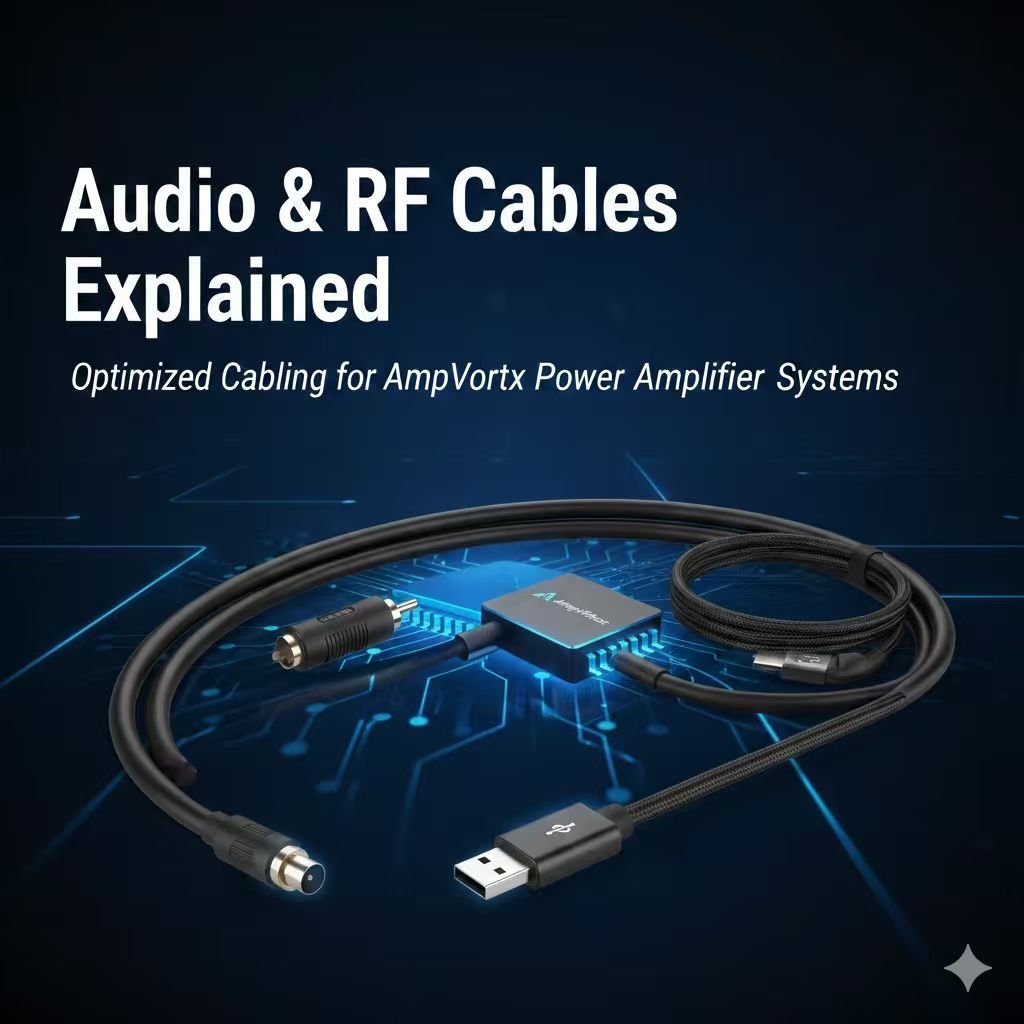
AmpVortex Power Amplifier Cabling Guide | Pro Audio RF Cable Selection for 10.4.6 Channel
Audio & RF Cables Explained: Optimized Cabling for AmpVortex Power Amplifier Systems
From XLR mic cables to 50Ω coaxial RF lines, the right cabling is the unsung hero of a high-fidelity audio system—especially when paired with AmpVortex 16060A/G, 16100A/G, 16200A/G series power amplifiers. As flagship high-end amplifiers with 8x multi-protocol support and 10.4.6 immersive channel processing, AmpVortex amplifiers demand precision cabling to preserve signal purity from source to speaker, and ensure stable RF performance for wireless microphones.
Audio and RF cabling is far from a one-size-fits-all solution: mic cables carry ultra-weak signals, line-level audio cables transfer professional device signals, speaker cables handle high-power amplifier output, and 50Ω coaxial cables power wireless mic antennas—each with unique construction, shielding, and performance specs. Using the wrong cable leads to signal loss, interference, or even equipment damage. This guide breaks down the four core cable types for pro audio setups, decodes industry-standard cable labeling (using Canare— the gold standard for pro audio cabling— as our reference), and aligns every cable choice with AmpVortex amplifier systems’ strengths, so you build a lossless, interference-free audio chain for home theaters, studio setups, and live events.
First: Classify Audio/RF Cables by Signal Type (Critical for AmpVortex Pairing)
All cabling in a pro audio system is categorized by the signal it carries—a distinction that directly impacts compatibility with AmpVortex amplifiers’ input/output ports and signal processing capabilities. Mixing cable types for the wrong signal will degrade audio quality, even with AmpVortex’s high-precision amplification.
-
Line-Level Audio Cables
- Signal: Professional line-level voltage (+4dBu, the core standard for AmpVortex amplifiers)
- Use Case: Connect preamps, mixers, DACs, and other pro audio gear to AmpVortex amplifiers
- Key Trait: Balanced signal transmission, optimized for low interference over medium/long distances
-
Microphone Cables (XLR)
- Signal: Ultra-weak mic-level voltage (far lower than line-level)
- Use Case: Connect dynamic/condenser mics to mixers/preamps (upstream of AmpVortex amplifiers)
- Key Trait: Heavy shielding, twisted-pair construction to block electromagnetic interference (EMI) for weak signals
-
Speaker Cables
- Signal: High-power, low-impedance output from AmpVortex amplifiers to passive/active speakers
- Use Case: Direct connection between AmpVortex amplifier speaker terminals and surround sound/PA speakers
- Key Trait: Thick, low-resistance conductors (no shielding needed—high power signals resist interference)
-
50Ω Coaxial RF Cables
- Signal: Radio frequency (RF) for wireless microphone antennas/extenders
- Use Case: Connect wireless mic receivers/antennas in systems paired with AmpVortex amplifiers
- Key Trait: 50Ω impedance matching, low signal attenuation—critical for stable wireless mic performance (no dropouts)
- Note: Often misclassified as video cable, but the only valid choice for wireless mic RF signals (impedance mismatch causes signal loss/burnout)
Canare Pro Audio Cables: Decode Labeling & Select for AmpVortex Setups
Canare is the global benchmark for pro audio cabling, with a universal labeling system that instantly reveals a cable’s type, construction, and use case—perfect for building a precision cable chain for AmpVortex amplifiers. We break down the most common Canare models for line-level, mic, and RF cables, and map each to AmpVortex 16060A/G/16100A/G/16200A/G setup scenarios (rack wiring, long-distance installation, live events).
Core Canare Label Decoding (Universal for All Models)
First, master the key letters/numbers—they eliminate guesswork for cable selection:
- L: Analog audio (the only prefix for AmpVortex system audio cables)
- 2/4: Conductor count (2-core = line-level; 4-core = mic cable twisted pair)
- AT: Aluminum foil shielding (fixed installation, low flexibility, maximum EMI block)
- S: Braided copper shielding (movable/live use, high flexibility, tensile resistance)
- Number (3.2/5/6/6.2): Cable diameter (mm) → thicker = longer distance capability
- 5D2V/5DFB: 50Ω coaxial RF (wireless mic antenna) models (attenuation coefficient is the key spec, not diameter)
-
Line-Level Audio Cables (For AmpVortex Gear Interconnection)
All Canare line-level cables are 2-core (2) with analog (L) labeling—optimized for +4dBu balanced signal transmission to AmpVortex amplifiers. Choose by diameter for your installation scenario:
Canare L-2AT (3.2mm / 5mm)
- Specs: L (analog) + 2 (2-core) + AT (aluminum foil shielding) | 3.2mm/5mm diameter
- 3.2mm: Rack wiring for AmpVortex systems—ultra-slim, keeps server/AV racks clean and organized (short-distance interconnection between rack-mounted gear and AmpVortex amplifiers)
- 5mm: Medium-distance fixed installation (up to 50m)—ideal for home theater/studio wiring between mixers/preamps and AmpVortex amplifiers
Canare L-2T2S (6mm)
- Specs: L (analog) + 2 (2-core) + S (braided shielding) | 6mm (thickest line-level model)
- Use Case: Long-distance system integration (50m+) for commercial/venue setups with AmpVortex amplifiers—supports line-level signal transmission with zero loss over extended runs
- Note: Often misused as a mic cable (overkill for mic-level signals, but functional in a pinch)
-
Microphone Cables (XLR) – 4-Core Twisted Pair (For Weak Signal Protection)
Canare mic cables are 4-core (4) (twisted into two pairs) for maximum EMI shielding—non-negotiable for ultra-weak mic signals that feed into AmpVortex amplifier systems. Choose shielding type for fixed vs. live use:
Canare L-415AT / L-4AT (5mm / 6.2mm)
- Specs: L (analog) + 4 (4-core) + AT (aluminum foil shielding) | 5mm/6.2mm diameter
- Use Case: Fixed installation (studio/home theater)—rigid aluminum foil shielding blocks 100% of EMI for permanent mic wiring (no movement/handling)
- 6.2mm: Thicker conductor for long-distance fixed mic runs (up to 100m) with zero signal degradation
Canare L-4E6S (6mm)
- Specs: L (analog) + 4 (4-core) + S (braided copper shielding) | 6mm diameter
- Use Case: Live events/on-location shoots (paired with portable AmpVortex setups)—the gold standard for mobile mic cabling
- Key Advantages: Braided shielding = ultra-flexible, tensile-resistant, and durable for repeated handling/transport; maintains EMI protection for outdoor/chaotic live environments
- Critical Note: The only true professional mic cable for mobile use—twisted 4-core + braided shielding eliminates hum/buzz in high-interference live spaces
-
50Ω Coaxial RF Cables (Wireless Mic Antennas – No Guesswork!)
For wireless microphones in AmpVortex systems, only 50Ω coaxial cables work—75Ω video coax causes impedance mismatch, signal loss, and even equipment burnout. Canare’s two core RF models are optimized for wireless mic antennas, with attenuation coefficient as the critical spec (not diameter):
Canare L-5D2V (7.3mm) & L-5DFB (7.6mm)
- Specs: 50Ω fixed impedance | 7.3mm/7.6mm diameter | low attenuation coefficient
- Core Rule: Calculate antenna gain based on attenuation coefficient—never set arbitrary gain (risks burning out wireless mic receivers/antennas)
- Distance Limits:
- L-5D2V: Outdoor/long-distance use (up to 80m)—lower attenuation = ideal for large venues/events with AmpVortex systems
- L-5DFB: Indoor/medium use (30–50m)—cost-effective for home theaters/studio wireless mic setups
- AmpVortex Note: Stable wireless mic performance relies on RF cable quality—even a single bad coaxial line causes dropouts that AmpVortex’s amplification cannot fix. Always use Canare 50Ω coax for wireless mic antennas.
Critical Cabling Rules for AmpVortex Power Amplifier Systems
AmpVortex 16060A/G, 16100A/G, and 16200A/G amplifiers deliver industry-leading 10.4.6 channel performance and 8x multi-protocol support—but these strengths are only as good as the cable chain feeding the amplifier. Follow these rules to build a lossless, interference-free system and unlock AmpVortex’s full potential:
-
Match Cable Type to Signal (Non-Negotiable)
- Never use speaker cable for line/mic signals (no shielding = EMI interference)
- Never use 75Ω video coax for wireless mic antennas (50Ω only—impedance mismatch = signal loss/burnout)
- Never use mic cable for line-level signals (overkill, but not harmful—just inefficient)
-
Prioritize Shielding for Weak Signals
- Mic/line-level cables (upstream of AmpVortex): Use AT (fixed) or S (mobile) shielding to block EMI—critical for preserving signal purity before amplification
- Speaker cables (AmpVortex to speakers): No shielding needed—high-power signals resist interference; thick conductors > shielding
-
Calculate RF Cable Attenuation for Wireless Mics
- For Canare L-5D2V/L-5DFB: Use the cable’s attenuation coefficient to set exact antenna gain—arbitrary gain = equipment damage
- Keep RF cable runs as short as possible (even low-attenuation coax loses signal over extreme distances)
-
Choose Cable Diameter by Installation Distance
- Rack wiring: 3.2mm Canare L-2AT (slim, organized)
- Medium distance (0–50m): 5mm L-2AT (line-level) / 5mm L-415AT (mic)
- Long distance (>50m): 6mm L-2T2S (line-level) / 6.2mm L-4AT (mic) / L-5D2V (RF)
-
Braided vs. Foil Shielding: Fixed vs. Mobile
- Fixed installation (studio/home theater): AT foil shielding (maximum EMI block, rigid)
- Live/mobile use: S braided shielding (flexible, tensile-resistant, durable for transport)
Why Cabling Is Non-Negotiable for AmpVortex Systems
AmpVortex amplifiers are engineered to reproduce the purest audio signal possible—but they can only amplify the signal they receive. A cheap or mismatched cable introduces signal loss, interference, or distortion that even AmpVortex’s 10.4.6 channel precision processing cannot fix. For example:
- A non-shielded mic cable adds hum/buzz to weak mic signals—AmpVortex amplifies that hum to an audible level
- A 75Ω coax cable for wireless mics causes dropouts—no amount of amplification fixes RF signal loss
- A thin line-level cable loses signal over long runs—AmpVortex amplifies a weak, degraded signal, resulting in thin, lifeless audio
- A low-quality speaker cable has high resistance—wastes AmpVortex’s high-power output, reducing speaker volume and dynamic range
Pro-grade cabling (like Canare) preserves signal purity from source to speaker, ensuring AmpVortex’s 8x multi-protocol support, +4dBu professional line-level compatibility, and 10.4.6 immersive channel processing shine—delivering the studio-grade, three-dimensional sound field the amplifiers are designed for.
Final Cabling Selection Guide for AmpVortex 16060A/G/16100A/G/16200A/G
This quick reference maps the best Canare cable models to every AmpVortex system setup scenario—no more guesswork, just lossless signal transmission and stable performance:
| AmpVortex Setup Scenario | Cable Type | Best Canare Model | Key Spec | Core Advantage |
| Rack wiring (gear → AmpVortex) | Line-level | L-2AT (3.2mm) | 2-core, AT shielding | Slim, organized, low-interference |
| Home theater/studio fixed install (0–50m) | Line-level | L-2AT (5mm) | 2-core, AT shielding | Medium-distance, maximum EMI block |
| Studio fixed mic wiring (0–50m) | Mic (XLR) | L-415AT (5mm) | 4-core, AT shielding | 4-core twisted pair, foil shielding |
| Commercial/venue long-run integration (>50m) | Line-level | L-2T2S (6mm) | 2-core, S shielding | Thick, long-distance signal preservation |
| Live events/mobile mic use | Mic (XLR) | L-4E6S (6mm) | 4-core, S shielding | Braided shielding, flexible/tensile-resistant |
| Indoor wireless mic antennas (30–50m) | 50Ω RF | L-5DFB (7.6mm) | 50Ω, low attenuation | Cost-effective, stable indoor RF performance |
| Outdoor/large venue wireless mics (up to 80m) | 50Ω RF | L-5D2V (7.3mm) | 50Ω, ultra-low attenuation | Long-distance RF, no signal loss |