(317)516-7460
  service@ampvortex.com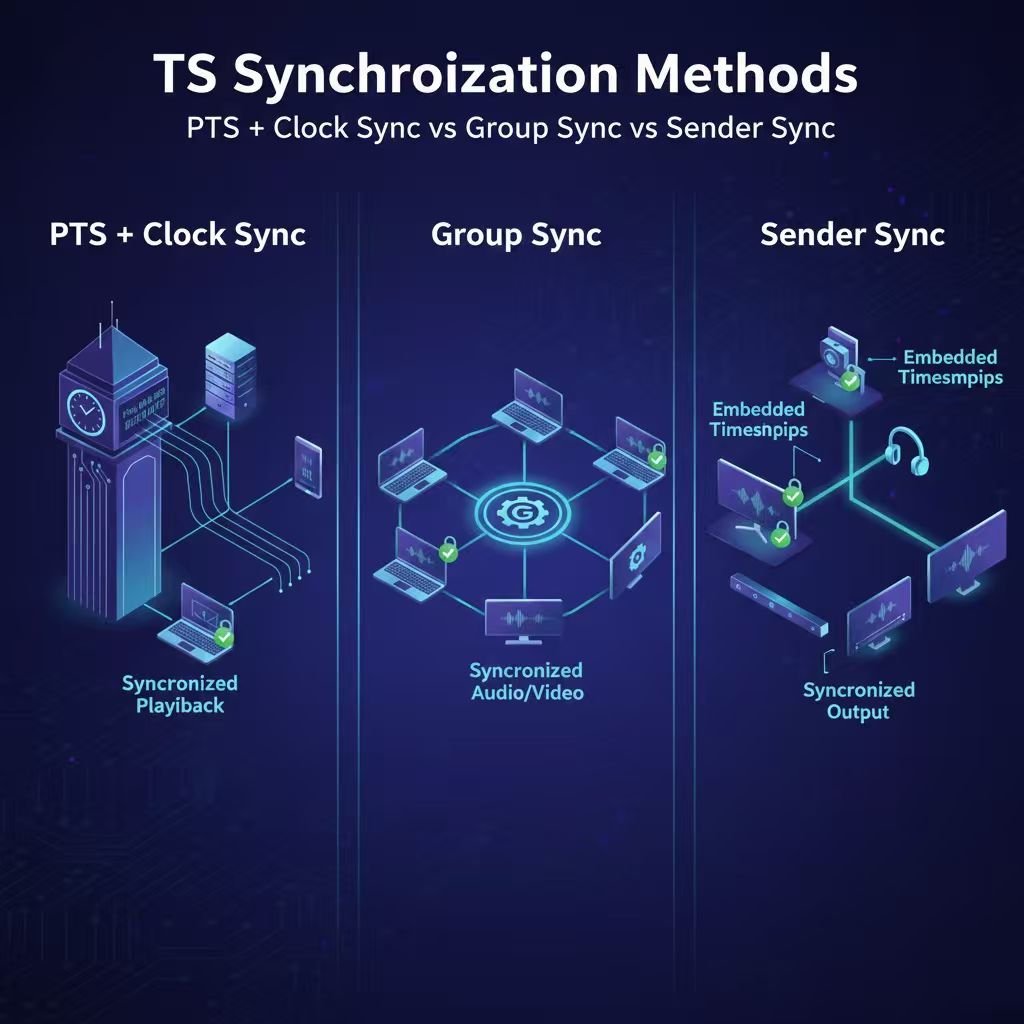
PTS + Clock Sync vs Group Sync vs Sender Sync
Three Synchronization Architectures in Modern Multi-Room Audio Systems
Modern multi-room audio systems may look similar on the surface, but underneath they rely on different synchronization architectures.
Most systems can be categorized into three major models:
- PTS + Clock Synchronization
- Group Synchronization (Receiver-Coordinated)
- Sender Synchronization (Sender-Driven)
Each model answers a different fundamental question:
Who decides when audio should be played?
Understanding these architectures explains why some systems scale better, some feel simpler, and some place heavier demands on phones or controllers.
1. PTS + Clock Synchronization (Timestamp-Based Model)
Core Idea
Audio packets carry Presentation Time Stamps (PTS) that indicate the exact moment they should be played.
Each device:
- Receives packets
- Reads PTS
- Buffers data
- Plays audio when its local clock matches the PTS
Synchronization happens because:
👉 All devices share approximately synchronized clocks.
Architecture
Audio Stream with PTS
|
v
Device Buffer
|
Compare PTS ↔ Local Clock
|
Play When Equal
Key Characteristics
- Time-based scheduling
- Local playback decisions
- Independent buffering per device
PTS defines when, clocks define what time it is.
Strengths
- Extremely scalable
- Network jitter tolerant
- Works across wired and wireless networks
Limitations
- Requires clock synchronization layer
- Slight drift must be corrected continuously
Common Usage
- RTP streaming
- DLNA / UPnP
- Professional AV networks
- Internals of AirPlay, Google Cast, Sonos, etc.
Conceptual Summary
“Every packet knows its own playback time.”
- Group Synchronization (Receiver-Coordinated Model)
Core Idea
Devices form a playback group and coordinate timing among themselves.
One device (or a logical group clock) acts as timing reference.
Devices:
- Exchange timing information
- Adjust buffers and clocks
- Stay aligned as a cluster
Architecture
Media Source
|
—————–
| | |
Speaker A Speaker B Speaker C
(Coordinator/Follower Model)
↔ Timing Exchange ↔
Key Characteristics
- Synchronization happens inside the group
- Sender only starts playback
- Group manages alignment
Strengths
- Excellent scalability
- Low sender workload
- Designed for whole-home systems
Limitations
- Requires group management logic
- More complex firmware
Common Usage
- Google Cast Speaker Groups
- Sonos Groups
- Some proprietary multi-room systems
Conceptual Summary
“Speakers synchronize with each other.”
3. Sender Synchronization (Sender-Driven Model)
Core Idea
The sending device (phone, tablet, computer) sends separate streams to each receiver and attempts to keep them aligned.
Sender acts as master clock.
Architecture
Phone / Computer
| | |
v v v
Speaker A Speaker B Speaker C
Key Characteristics
- Multiple unicast streams
- Sender distributes timestamps
- Sender monitors alignment
Strengths
- Simple receiver implementation
- Easy to deploy
Limitations
- Sender CPU/network load increases with device count
- Limited scalability
- More sensitive to network quality
Common Usage
- AirPlay Multi-Select
- Some Bluetooth multi-output solutions
Conceptual Summary
“Phone keeps everyone together.”
4. Architectural Comparison
| Dimension | PTS + Clock Sync | Group Sync | Sender Sync |
| Who schedules playback | Each device | Speaker group | Sender |
| Sync control location | Local device | Group | Phone / PC |
| Scalability | Very High | High | Low–Medium |
| Network tolerance | Excellent | Excellent | Moderate |
| Sender workload | Low | Very Low | High |
| Receiver complexity | Medium | High | Low |
| Typical latency | Configurable | Low | Higher |
| Used by | Pro AV, streaming cores | Cast, Sonos | AirPlay Multi-Select |
5. How These Models Relate
Important reality:
👉 Group Sync and Sender Sync almost always still rely internally on PTS.
PTS + Clock Sync is the foundation.
Group Sync and Sender Sync are control-layer architectures built on top of timestamp-based playback.
Think of it as layers:
PTS + Clock Sync (Timing Foundation)
↑
Group Sync OR Sender Sync (Control Architecture)
6. Why Different Models Exist
No single model is “best” for all scenarios.
- Sender Sync → simplicity, fast deployment
- Group Sync → scalable consumer multi-room
- PTS + Clock Sync → professional-grade backbone
Design choice depends on:
- Target scale
- Network environment
- Hardware capability
- Product positioning
7. Practical Implications for Users
- Small multi-room setups: Sender Sync is usually fine
- Whole-home audio: Group Sync preferred
- Large or professional systems: PTS + Clock Sync backbone required
8. Practical Implications for System Designers
Well-designed systems:
- Use PTS internally
- Add group coordination when scaling
- Minimize sender workload
Poorly designed systems:
- Depend only on sender timing
- Lack proper clock discipline
- Accumulate drift
Conclusion
PTS + Clock Sync defines when audio should play.
Group Sync defines how speakers cooperate.
Sender Sync defines who tries to keep devices aligned.
They are not competitors — they are layers and strategies.
Understanding these three architectures reveals why multi-room audio systems behave differently and why synchronization quality is primarily an architectural decision, not a codec or hardware specification.
👉 https://www.ampvortex.com/enable-accurate-audio-playback-across-devices/
👉https://www.ampvortex.com/multi-room-audio-synchronization-airplay-vs-google-cast/