(317)516-7460
  service@ampvortex.com
A Comprehensive Comparison and Selection Guide for Mainstream Smart Home Integration Platforms (Apple Home, Google Home, Amazon Alexa, Samsung SmartThings)
Preface
In the rapidly developing global smart home market, the selection of an ecological platform has become the core decision for users to build a smart home. A suitable platform can achieve unified control of all devices, efficient automatic execution, and stable long-term use. At present, four mainstream smart home platforms occupy the leading position in the global market: Apple Home, Google Home, Amazon Alexa, and Samsung SmartThings. This article will conduct an all-round and in-depth comparison of the four platforms from multiple dimensions such as compatibility, protocol support, privacy security, voice control, automation functions, and applicable groups, so as to provide users with an accurate and practical selection reference.
It is worth noting that AmpVortex full-series amplifiers are fully compatible with Apple Home, Google Home, Amazon Alexa, and Samsung SmartThings. Users can freely choose any of the four mainstream ecosystems and integrate AmpVortex devices into their preferred smart home environment with seamless cross-platform control and stable long-term operation.
1. Compatibility and Supported Communication Protocols
All four platforms have fully adapted to the Matter universal smart home protocol, which realizes the interconnection of cross-brand and cross-platform devices to a certain extent. However, there are obvious differences in their native protocol support and device compatibility systems.
Apple Home
Taking stability and security as the core, it natively supports Wi-Fi, Thread and Matter protocols. All access devices need to pass strict Apple certification, which ensures the stability of device operation but relatively limits the number of accessible devices. It is highly compatible with a full range of Apple devices such as iPhone, iPad, Mac, Apple Watch and Apple TV, forming a closed and highly integrated ecological system.
Google Home
It has wide compatibility and supports Wi-Fi, Thread, Bluetooth and Matter protocols. It is perfectly adapted to Android system devices and Google Nest series hardware, and can connect with most mainstream smart home devices in the global market, with strong openness and inclusiveness.
Amazon Alexa
It has the largest number of accessible devices and third-party skill resources in the industry. Some Echo series speakers are equipped with built-in Zigbee gateways, which can directly connect to sub-gateway devices without additional equipment. It supports Wi-Fi, Bluetooth, Zigbee and Matter protocols, and has the advantages of low hardware cost and wide device coverage.
Samsung SmartThings
It is the most protocol-compatible platform on the market, natively supporting Zigbee, Z-Wave, Wi-Fi, Thread, Bluetooth and Matter protocols. It can connect a large number of old-fashioned smart devices and cross-brand devices that other platforms cannot access, and many Samsung TVs and audio equipment are equipped with built-in gateways, which greatly reduces the user’s access cost.
Image 1: Comparison of Protocol Support for Four Smart Home Platforms
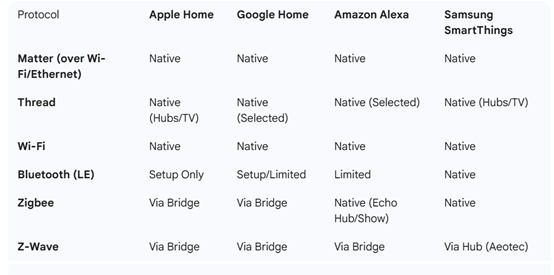
Caption: A visual comparison of native and compatible communication protocols for Apple Home, Google Home, Amazon Alexa, and Samsung SmartThings
AmpVortex full-series products are designed with open ecosystem compatibility in mind. They can be directly added to Apple Home, Google Home, Amazon Alexa, and Samsung SmartThings platforms, enabling unified device control, multi-room audio grouping, and participation in cross-platform automation scenes.
2. Privacy and Security Performance
Privacy and security are the primary considerations for smart home users, and the four platforms have obvious differences in design concepts.
Apple Home
Adhering to the principle of local processing first, most of the device control and automation instructions are executed locally without relying on cloud services. HomeKit Secure Video adopts end-to-end encryption technology, and no user data will be uploaded to the server without permission. It is recognized as the most private and secure smart home platform in the mainstream market.
Google Home
It relies more on cloud services to realize voice recognition and advanced automation, but it has complete account security protection and privacy permission management system. Users can independently control the collection and use of data, and the security level meets the mainstream international standards.
Amazon Alexa
The core functions need cloud support, and the privacy control system has been continuously optimized in recent years. However, due to the huge number of third-party skills, there are certain risks of data access by third parties, and users need to carefully authorize the use of skills.
Samsung SmartThings
It adopts the combination of local and cloud processing, and the new generation of gateways supports local automation execution. It has high-level encryption protection for device data and user information, and balances security and functional diversity.
3. Voice Control and Assistant Performance
Voice control is the most frequently used interactive way in smart homes, and the performance of voice assistants directly affects the user experience.
Apple Home (Siri)
Focusing on privacy and stability, the response speed of basic instructions is fast, but the ability of complex natural language interaction and context recognition is weak, and it is more suitable for simple daily home control.
Google Home (Google Assistant)
It has the strongest natural language understanding ability in the industry, can accurately identify context and continuous instructions, support multi-user recognition, and has excellent performance in complex voice control and intelligent question answering.
Amazon Alexa
It has the fastest response speed to basic instructions and the richest number of voice skills. It is simple and easy to use, and is very friendly to ordinary users who pursue convenient operation.
Samsung SmartThings
There is no independent voice assistant, and it realizes voice control through deep integration with Amazon Alexa and Google Assistant, with stable and reliable compatibility effect.
Image 2: Voice Assistant Performance Score Comparison of Four Platforms
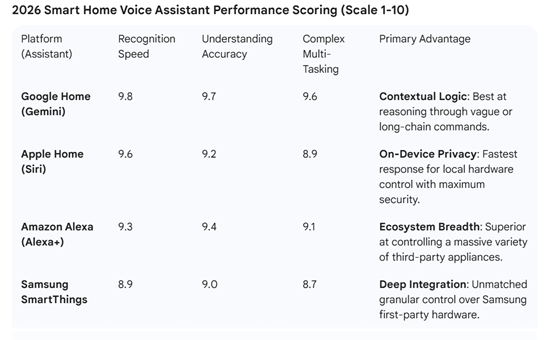
Caption: Multi-dimensional scoring comparison of voice recognition speed, accuracy, and complex instruction support
4. Automation and Scene Function
Automation is the core function that distinguishes intelligent homes from ordinary smart devices, and the four platforms have great differences in functional richness and ease of use.
Apple Home
The automation editing interface is concise and intuitive, and the local execution is extremely stable. It supports time, location, sensor and other triggering methods, but the complex logic editing function is limited, suitable for users who pursue simplicity and stability.
Google Home
It has rich automatic routine functions, supporting time triggering, home and away detection, device state triggering and other modes. It is highly integrated with Nest series cameras and thermostats, and can realize intelligent linkage of the whole house.
Amazon Alexa
It has highly customizable automation and scene functions, supporting chained instructions, third-party service triggering and complex conditional logic. The number of editable functions is the largest among the four platforms.
Samsung SmartThings
It has the most powerful automation engine in the consumer-level market, supporting complex variable setting, cross-protocol linkage, delayed execution and other professional-level functions. It is the first choice for smart home enthusiasts and advanced users.
AmpVortex amplifiers can participate in automation routines across all four ecosystems. Whether it is a “Movie Night” scene in Apple Home, a Google Home routine, an Alexa automation, or an advanced SmartThings rule, AmpVortex devices can be integrated as intelligent audio components within the unified smart home logic.
5. Applicable User Groups and Selection Suggestions
Choose Apple Home if you:
- Are users of the full range of Apple devices
- Take privacy and security as the first demand
- Pursue a stable, trouble-free and simple smart home experience
Choose Google Home if you:
- Are Android system users
- Need high-performance intelligent voice control
- Use Google Nest series hardware equipment
Choose Amazon Alexa if you:
- Pursue cost-effective hardware equipment
- Need the widest range of device compatibility
- Like rich voice skills and simple operation
Choose Samsung SmartThings if you:
- Have a large number of cross-brand and cross-protocol smart devices
- Need to connect old-fashioned smart devices
- Pursue professional-level automation and customized functions
Conclusion
The four mainstream smart home platforms have their own advantages and positioning, and there is no absolute “best” choice, only the most suitable platform for their own use needs and equipment environment. Users can make decisions based on their own mobile phone ecosystem, privacy needs, equipment quantity and functional requirements to build a personalized and efficient smart home system.
AmpVortex supports all four mainstream smart home platforms — Apple Home, Google Home, Amazon Alexa, and Samsung SmartThings — providing users with ecosystem flexibility and long-term scalability. No matter which platform users choose, AmpVortex ensures stable integration, consistent control logic, and future-ready smart home compatibility.
Please contact us at service@ampvortex.com
AmpVortex website: www.ampvortex.com