(317)516-7460
  service@ampvortex.com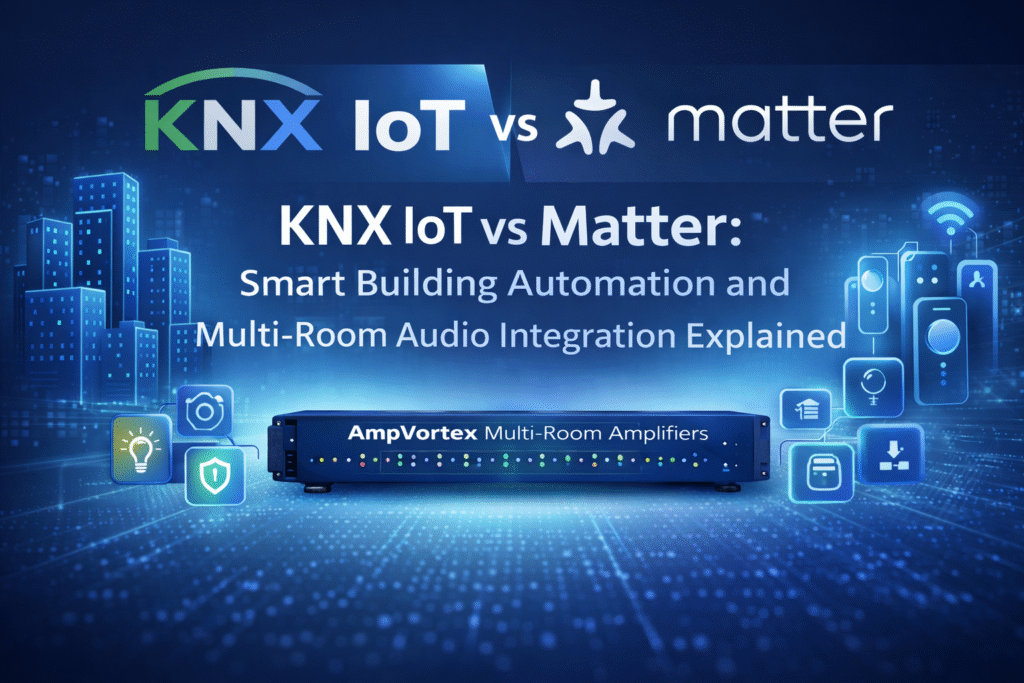
KNX IoT vs Matter: Smart Building Automation and Multi-Room Audio Integration Explained
The smart building and smart home industries are evolving rapidly. As connected devices become standard in residential and commercial environments, interoperability and reliable communication protocols are becoming critical.
Two technologies currently attracting attention are KNX IoT and Matter. Both aim to improve device interoperability, but they serve different purposes and ecosystems.
Understanding how these standards work helps system integrators, installers, and manufacturers design future-proof smart environments.
The KNX Ecosystem in Building Automation
The KNX Association maintains one of the most widely adopted standards for professional building automation. KNX has been used globally for more than 30 years in projects such as:
- commercial buildings
- hotels
- offices
- hospitals
- luxury residential homes
KNX systems traditionally use technologies like KNX TP or KNXnet/IP to manage devices controlling:
- lighting systems
- HVAC systems
- shading and blinds
- security systems
- energy management
However, the growth of IP networking and IoT devices has pushed the KNX ecosystem to evolve. This evolution has led to the development of KNX IoT, which enables building automation devices to operate using modern IP-based technologies.
What Is KNX IoT?
KNX IoT is designed to extend KNX communication into modern IP and cloud environments.
Instead of relying solely on fieldbus communication, KNX IoT introduces modern API-based device communication models that allow easier integration with cloud platforms and software systems.
Typical benefits of KNX IoT include:
- native IP communication
- easier cloud integration
- standardized APIs
- improved interoperability with software platforms
This evolution allows building automation systems to integrate more easily with modern applications and connected services.
Matter and the Consumer Smart Home Ecosystem
At the same time, the consumer smart home market has moved toward Matter, an interoperability standard designed to simplify device compatibility across multiple smart home ecosystems.
The Matter smart home standard is supported by major technology companies including Apple, Google, and Amazon.
Matter is commonly used for consumer smart home devices such as:
- smart lights
- smart plugs
- smart thermostats
- smart speakers
- sensors
Matter focuses primarily on simplifying device onboarding and ensuring compatibility across different consumer ecosystems.
While Matter works well for residential smart homes, professional building automation environments often require more scalable and structured infrastructure.
Architecture Comparison
Matter Architecture
Typical Matter ecosystem structure:
Smart Home App
│
Matter Controller
│
Matter Devices
KNX IoT Architecture
KNX IoT ecosystem structure:
Building Automation System
│
KNX IoT
│
Lighting HVAC Audio Sensors
KNX IoT allows large-scale building systems to communicate through IP-based infrastructure while maintaining the reliability expected in professional installations.
The Growing Importance of Multi-Room Audio in Smart Buildings
Modern buildings increasingly incorporate audio systems as part of the overall automation experience.
Multi-room audio allows different areas of a building to play synchronized or independent audio content. This capability is particularly useful in environments such as:
- hotels
- restaurants
- retail stores
- offices
- residential smart homes
Instead of deploying separate AV systems, integrators are increasingly integrating distributed audio into building automation platforms.
AmpVortex Multi-Room Streaming Amplifiers
Modern IP-based amplifiers allow audio distribution systems to integrate seamlessly into smart building infrastructure.
The AmpVortex multi-room streaming amplifiers are designed to provide scalable audio distribution for professional installations.
The AmpVortex product family includes several models optimized for multi-zone audio environments:
These amplifiers provide powerful multi-room audio distribution and support modern streaming technologies suitable for both residential and commercial environments.
In smart building projects, these systems allow integrators to create flexible audio experiences across multiple rooms while maintaining centralized control.
Multi-Room Audio Integration in Smart Buildings
When integrated into building automation systems, distributed audio can interact with other building systems.
Examples include:
- music synchronized with lighting scenes
- scheduled audio playback in retail environments
- occupancy-based audio control in office spaces
Such integrations enhance the overall user experience while allowing building operators to manage multiple systems from a centralized platform.
The Future of Smart Building Connectivity
Smart buildings are expected to integrate multiple communication standards rather than relying on a single protocol.
Matter will likely continue to expand within consumer smart homes, while KNX IoT will play an important role in professional building automation environments.
For manufacturers and integrators, understanding how these technologies interact will be key to building scalable and future-ready systems.
The combination of building automation, IP networking, and distributed audio technologies will define the next generation of intelligent environments.
FAQ
What is KNX IoT?
KNX IoT is a modern extension of the KNX building automation standard that enables IP-based communication and easier integration with cloud and software systems.
Is Matter replacing KNX?
Matter focuses mainly on consumer smart home devices, while KNX remains a dominant protocol for professional building automation.
Can multi-room audio integrate with KNX systems?
Yes. Modern IP-based amplifiers such as AmpVortex multi-room streaming amplifiers can integrate with building automation environments to provide distributed audio across multiple zones.