
 (317)516-7460
  service@ampvortex.com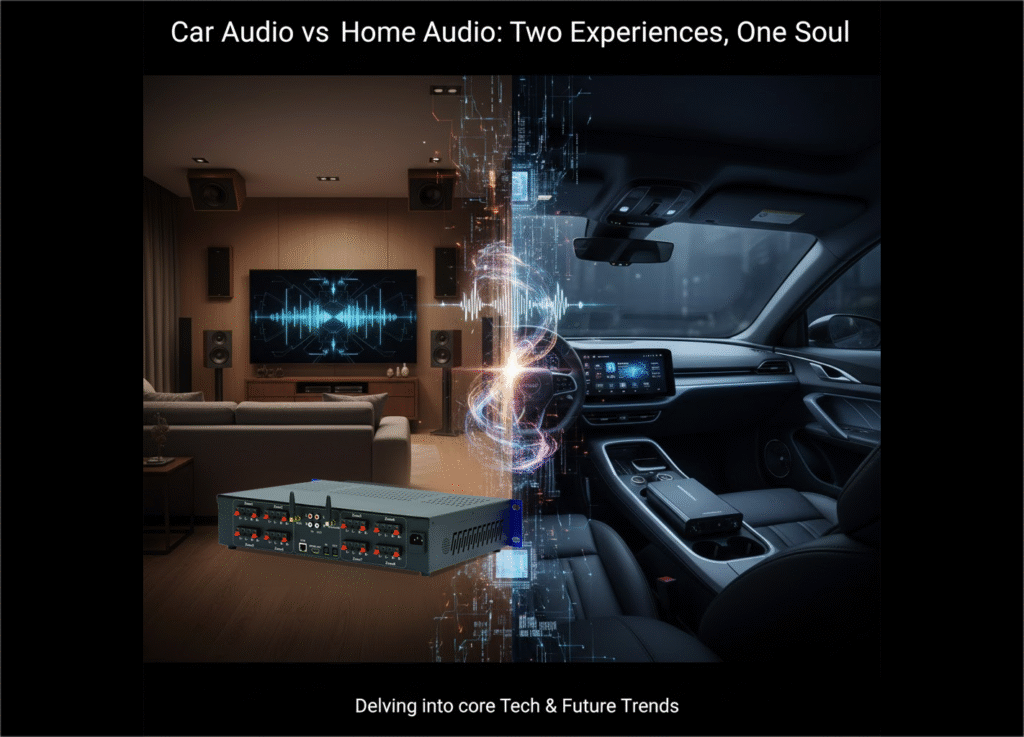
Car Audio vs. Home Audio: Two Experiences, One Soul – Delving into Core Tech & Future Trends
In modern life, music is an indispensable companion. Whether commuting or relaxing at home, we yearn to immerse ourselves in beautiful melodies. However, when we talk about car audio and home audio, we’re discussing not just playback devices, but two distinct auditory experiences, technical considerations, and ecosystems. What are their differences? And where do they connect?
I. Car Audio vs. Home Audio: Inherent Differences – Environment & Core Challenges
While both aim to play music, car audio and home audio face fundamentally different challenges from their inception, leading to significant distinctions across various dimensions.
1. Listening Environment: The Most Critical Variable & Acoustic Hurdles
- Car Environment (The Battleground):This presents the greatest challenge for car audio.
Confined & Irregular Space: The car’s interior is small and irregularly shaped, drastically affecting sound reflection, refraction, and diffraction. This makes it difficult to achieve an ideal soundstage and often leads to standing waves and sound coloration.
Ubiquitous Noise Interference: Engine noise, road noise, wind noise, and tire noise are constant and variable, acting as primary sound quality killers. Car audio systems must possess strong anti-interference capabilities and noise cancellation technologies (e.g., active noise cancellation).
Power Fluctuations & EMI: Automotive power is not constant, voltage is unstable, and numerous electronic devices inside the car create complex electromagnetic interference, demanding higher standards for the audio system’s power supply and signal purity.
- Home Environment (The Sanctuary):A relatively ideal and controllable listening space.
High Spatial Malleability: Rooms are typically larger and can be acoustically treated (e.g., sound-absorbing panels, diffusers, bass traps) to optimize the soundstage and reduce unwanted reflections.
Controllable Noise: Indoor noise levels are relatively lower and easier to manage, allowing for better reproduction of musical details.
Stable & Clean Power: Mains electricity is relatively stable and can be further purified with power conditioners, providing a cleaner power supply environment for audio systems.
2. Equipment Composition & Design Philosophy: Integration vs. Modularity
● Car Audio:
High Integration: Typically integrates the head unit (player, radio, navigation, infotainment system), amplifier, and speakers into a confined space, or distributes them throughout the vehicle.
Durability & Safety: Must withstand vibration, high/low temperatures, humidity, and other harsh in-car conditions, while complying with stringent automotive safety standards and EMI/EMC requirements.
Human-Machine Interface: Designed for intuitive, convenient, and blind operation with driving safety in mind, often featuring physical buttons, large touchscreens, voice control, or steering wheel controls.
Sound Quality Goal: Primarily aims to deliver clear, powerful, and impactful sound in a complex environment, rather than ultimate detail retrieval. Its tuning philosophy focuses on providing a balanced and easily perceptible listening experience on the move.
- Home Audio:
Modular Composition: Typically consists of independent components such as source devices (CD players, streamers, turntables), pre-amplifiers, power amplifiers, speakers (a pair or more, including Hi-Fi speakers, home theater speakers), and cabling.
Sound Quality Priority: Design goal is to pursue ultimate sound reproduction, wide soundstage, precise imaging, and rich detail.
Aesthetics & Space Considerations: As part of the home, aesthetic design and placement are also important considerations.
Customization & Upgradeability: Users can flexibly combine different brands of equipment according to personal preferences, budget, and room size, building a bespoke Hi-Fi or home theater system that is easy to upgrade.
II. Deep Dive into Technical Details: Interfaces, Formats, and Immersive Audio
1. Transmission Interfaces & Connection Protocols
- Home Audio:
HDMI: Virtually the core of home audio-video systems. Transmits high-definition video and multi-channel audio via a single cable, supporting ARC/eARC, CEC, and other features, making it the standard for connecting TVs, Blu-ray players, AV receivers, and game consoles.
Optical/Coaxial: Common digital audio transmission interfaces for connecting CD players, digital streamers to DACs or amplifiers.
RCA (Analog): Traditional analog audio interface used for connecting analog sources (e.g., turntables), pre-amplifiers to power amplifiers, etc.
XLR (Balanced): Professional balanced analog interface commonly used in high-end Hi-Fi systems for superior interference rejection.
USB Audio: Connects computers, smartphones as audio sources to DACs.
Network Interfaces (Ethernet/Wi-Fi): Used for streaming media playback and multi-room audio systems.
- Car Audio:
USB/Bluetooth: Primary digital audio input methods for connecting smartphones, USB drives. Bluetooth is also used for hands-free calling and wireless audio streaming.
AUX (3.5mm): Traditional analog audio input, but with limited sound quality.
Optical (TOSLINK) / Coaxial: In high-end car audio modifications, these digital interfaces are sometimes used to connect DSP processors or independent amplifiers for cleaner digital signals.
Automotive-specific Bus (e.g., CAN bus): Used for internal communication between various modules of the infotainment system, not directly for audio signal transmission.
RCA (Pre-out): In modified audio systems, used to connect the head unit to independent amplifiers for low-level signal output.
HDMI: Rarely found in factory-installed head units, occasionally seen in rear-seat entertainment systems. The car environment poses extreme demands on HDMI’s stability and vibration resistance, making widespread adoption challenging.
2. Audio Formats & Immersive Audio Processing
- Home Audio:
High-Resolution Audio: Supports playback of lossless and high-sampling-rate formats such as FLAC, WAV, DSD.
Multi-channel Formats: Widely supports standard multi-channel encodings like Dolby Digital, DTS, LPCM.
Immersive Audio: Dolby Atmos and DTS:X are standard in home theaters. Home AV receivers typically feature full decoding and passthrough capabilities, allowing these object-based audio streams to be fully transmitted and rendered to dozens of speakers, including overhead channels, creating a three-dimensional soundstage.
- Car Audio:
Mainstream Formats: Primarily plays lossy formats like MP3, AAC, and lossless formats like FLAC, WAV.
Multi-channel: Most car audio systems remain in traditional 5.1 or 7.1 channel configurations, often utilizing DSP for virtual surround processing.
Immersive Audio (e.g., Dolby Atmos): While some luxury car brands have recently begun to advertise support for Dolby Atmos or similar 3D sound effects, their implementation differs fundamentally from home systems.
- No Passthrough:Vehicles typically do not passthrough original Atmos bitstreams to independent amplifiers for decoding. Instead, the head unit or integrated DSP performs real-time rendering and adaptation. This means that the audio stream (usually LPCM or another encoding), after entering the head unit, undergoes specific in-car DSP algorithms to “adapt” it to the vehicle’s speaker layout (including some overhead units), simulating a three-dimensional effect.
- Algorithmic Optimization:Car-based Atmos focuses more on complex algorithms (e.g., sound field reconstruction, delay compensation, EQ adjustment) to counteract in-car acoustic deficiencies and create a sense of three-dimensionality, rather than directly decoding and driving independent physical channels like home systems.
- Content Limitations:Supported Atmos content sources in cars are also relatively limited, often consisting of pre-loaded music or prompts integrated with navigation and voice assistants.
III. Car Audio & Home Audio: Bloodlines Connected – Interplay of Technology & Philosophy
Despite their significant differences, car audio and home audio are not entirely separate. They share a passion for music and have close ties in technology and philosophy.
1. Common Core Technical Principles
Electro-acoustic Conversion: Whether in a car or at home, sound generation is based on the fundamental principle of electrical energy being converted into mechanical vibration, which then moves air to create sound waves. The function and role of core components like amplifiers, speakers, and cables are common.
Digital Audio Processing: Modern audio systems rely on technologies such as DAC (Digital-to-Analog Converter) and DSP (Digital Signal Processor) to optimize audio signals and reduce distortion. Automotive DSPs are particularly adept at handling complex environments.
Acoustic Principles: Acoustic phenomena like standing waves, reflections, and diffractions exist in both environments, differing only in their manifestation and complexity of treatment.
2. Shared Pursuit of “Good Sound”
Clarity & Detail: Ability to clearly distinguish instruments and vocals, reproducing minute musical details.
Balance & Accuracy: Balanced distribution of high, mid, and low frequencies, accurately reproducing sound.
Dynamic Range & Impact: Ability to present the full range of musical dynamics, from soft to loud, with sufficient energy.
Low Distortion: Minimizing sound coloration and artificiality.
Immersion & Spatiality: Creating an immersive listening experience, accurately reproducing the soundstage and instrument placement.
3. Mutual Learning & Convergence of Innovative Technologies
Active Noise Cancellation/Acoustic Management: The automotive sector pioneered active noise cancellation and acoustic management systems to combat noise, which are now increasingly applied in high-end headphones and some home audio systems.
Streaming & Wireless Technologies: Bluetooth, Wi-Fi, DLNA, AirPlay, and various streaming services are widely used in both car and home audio, greatly enhancing user convenience.
AI & Smart Connectivity: Voice assistants, smart home integration, and personalized recommendations are gradually permeating both audio systems, enhancing user experience and hinting at the convergence of in-car systems with smart home ecosystems.
High-Resolution Audio: With technological advancements and rising user demand, more car systems are beginning to support high-resolution audio playback, aiming to match home Hi-Fi standards.
IV. Breaking Boundaries: Ampvortex – The Super Hybrid Audiophile Monster
In today’s continuously evolving and converging landscape of car and home audio, innovators are striving to break down technical barriers between the two, creating “super monsters” capable of mastering complex environments while pursuing ultimate sound quality.
Take our Ampvortex series as an example:
The home device, AmpVortex-16060A, is not just an ordinary amplifier; it’s a flagship product that integrates multi-room streaming amplifier functionalities with advanced AVR (Audio/Video Receiver) capabilities. It effortlessly handles various high-resolution audio formats, supports complex immersive audio decoding, and wirelessly delivers high-quality music to every corner of your home. Its powerful processing capabilities and precise amplification circuitry make it the core of building a top-tier home audio-video system.
And Ampvortex-Car is precisely the ultimate transplantation of this home “super monster” into the automotive domain. It’s not merely about cramming home technology into a car; it involves profound optimization and redesign specifically for the harsh challenges of the car environment. Ampvortex-Car seamlessly integrates the powerful multi-room streaming capabilities, top-tier audio processing, and core AVR architecture of the home 16060A into the automotive setting. This means that inside your car, you can enjoy an immersive soundstage akin to a home theater (achieved through DSP rendering optimized for in-car acoustics), along with unparalleled clarity and dynamic range, elevating the car audio experience to an unprecedented level. It shatters the performance limitations of traditional car audio, bringing the essence of Hi-End home audio into the mobile space, truly realizing the vision of “Hi-Fi in the car, a moving theater.”
V. How to Choose: Your Scene, Your Ears, Your Pursuit
Understanding the differences and connections between car and home audio, as well as the deeper technical disparities, makes choosing the right system clearer.
If you spend most of your time on the road: A meticulously tuned car audio system (potentially including an independent DSP and amplifier) can significantly enhance your commute quality and driving pleasure. Focus on its noise handling capabilities, soundstage optimization, and integration with the vehicle’s infotainment system.
If you enjoy your time at home more: Investing in a suitable home audio system can bring you an unparalleled auditory feast. From entry-level desktop Hi-Fi to high-end living room cinemas, choices are diverse, potential is limitless, and it can fully leverage advanced technologies like HDMI and Dolby Atmos.
If you pursue the ultimate in both: Many audiophiles own two or more systems to suit different listening scenarios. For the dedicated enthusiast, these two experiences are distinct yet complementary. In the car, you seek an experience that remains moving despite the complex environment; at home, you can fully relax and enjoy pure, unblemished musical details.
Whether in a speeding car or a tranquil living room, the allure of music remains constant. By understanding the differences between car and home audio, respecting their respective engineering challenges and design philosophies, and embracing the trend of technological convergence, we can better enjoy the pleasure and emotion that music brings, discovering our own high-fidelity sound world.
Visit us at www.ampvortex.com – Dedicated to high-quality audio equipment, whether for car or home, we have professional solutions to help you listen to the truest sound.