
 (317)516-7460
  service@ampvortex.com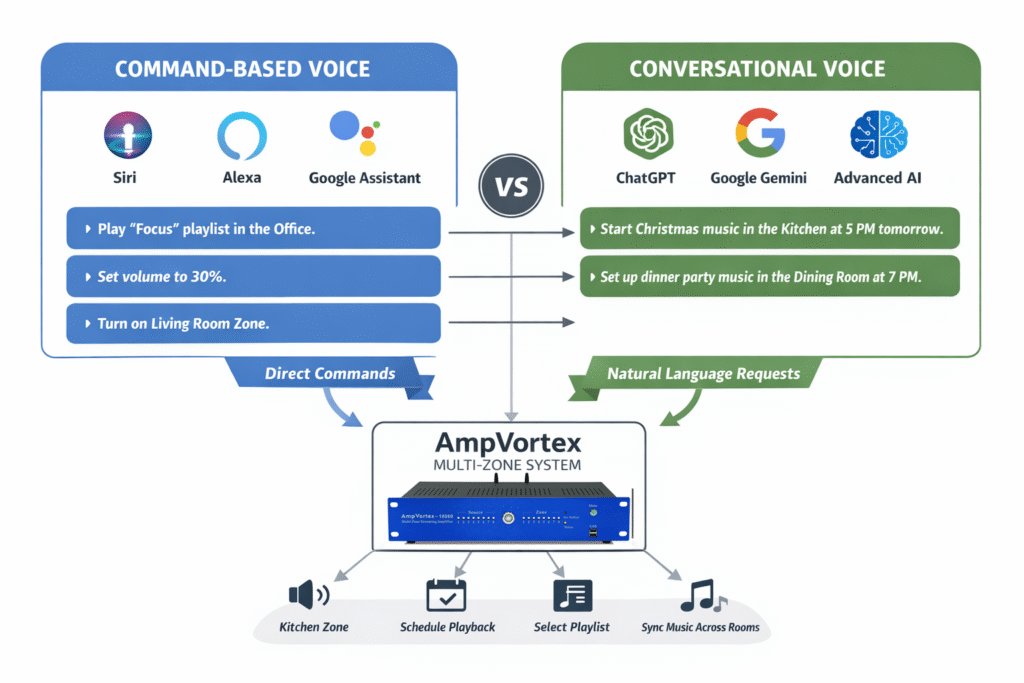
Command-Based vs. Conversational Voice: The Future of Smart Audio with AmpVortex
In the world of smart homes and multi-room audio, voice control is one of the most intuitive ways to interact with devices. However, not all voice interactions are the same. Two primary paradigms exist: command-based (imperative) voice and conversational (declarative) voice. Understanding their differences, connections, and applications is crucial for maximizing the capabilities of advanced multi-room streaming amplifiers like AmpVortex.
-
Defining the Two Paradigms
Command-Based Voice:
Users give explicit, direct commands such as “Turn on the living room lights,” “Play jazz in the kitchen,” or “Increase volume by 10%.” These are precise and deterministic, mapping directly to device actions.
Conversational/Declarative Voice:
Users express intentions or requests in a natural, contextual way, for example: “I’m hosting a party tonight; start upbeat music in the living room at 7 PM,” or “Play something relaxing in the bedroom.” This requires AI understanding context, planning, and executing multiple steps.
-
Comparison Table
| Aspect | Command-Based | Conversational / Declarative |
| Precision | High—maps directly to specific actions | Medium—requires interpretation and reasoning |
| Complexity of Tasks | Simple or sequential | Multi-step, contextual, time-based |
| User Effort | Low cognitive load but rigid | Higher cognitive load but flexible |
| Error Handling | Easy to debug—exact action requested | Harder—AI may misinterpret context |
| Integration Potential | Works with almost any smart device | Requires advanced AI, contextual awareness |
| Typical Examples | Siri, Alexa, Google Assistant short commands | ChatGPT, Google Gemini, AI assistants handling multi-step instructions |
-
Connections Between the Paradigms
Command-based actions act as atomic building blocks, while conversational voice orchestrates these blocks into multi-step workflows. For instance, a request like:
“Prepare background music for dinner in the dining room at 7 PM”
can internally trigger several command-based actions:
- Select zone (dining room)
- Choose playlist or streaming source
- Set volume and crossfade
- Schedule playback
This combination allows precision + flexibility.
-
AmpVortex Case Study
AmpVortex multi-zone streaming amplifiers can leverage both paradigms:
- Command-Based Integration:
Short, precise commands control zones, sources, and volume. Example:
“Play Spotify playlist ‘Focus’ in the office.”
- Conversational Integration:
AI interprets multi-step, contextual requests and executes them across zones. Example:
“Tomorrow is Christmas Eve; start 10 Christmas songs in the kitchen at 5 PM.”
This involves scheduling, zone selection, source choice (Apple Music, Spotify, or Qobuz), and synchronized playback, which a command-based system alone cannot handle efficiently.
-
Future Outlook
The trend is increasingly toward conversational voice, driven by AI:
- Personalization: Understanding individual preferences, moods, and routines.
- Cross-Device Orchestration: Multi-zone systems like AmpVortex coordinating music, lighting, and other smart devices.
- Proactive Assistance: AI may anticipate needs, e.g., “It’s 5 PM, your evening playlist is ready in the living room.”
Yet, command-based voice remains essential for immediate control, reliability, and error recovery.
-
Recommendations for AmpVortex Users
- Hybrid Approach:
Use command-based voice for immediate, precise control and conversational voice for complex, scheduled, or contextual automation. - AI Bridges:
Integrate AmpVortex with ChatGPT, Google Gemini, or other AI platforms to translate natural language into zone-specific commands. - Contextual Awareness:
Store playlists, routines, and user preferences to ensure smooth multi-zone orchestration. - Future-Proofing:
Prepare the system for both explicit commands and nuanced conversational instructions.
Conclusion
Command-based voice ensures precision and reliability, while conversational voice unlocks creativity, flexibility, and orchestration potential. For AmpVortex users, the optimal strategy is hybrid: maintain command precision for immediate tasks, and leverage AI-driven conversational voice for multi-zone, context-aware experiences. As AI technology evolves, these paradigms will converge, making smart audio systems both responsive and anticipatory.