
 (317)516-7460
  service@ampvortex.com
Control4 Ecosystem Explained: Snap One Architecture and Multi-Room Audio Integration
Introduction
In the professional smart home and commercial automation market, Control4 has become one of the most widely deployed platforms for integrated control. From luxury homes to hotels and high-end commercial installations, Control4 enables seamless management of lighting, climate, security, entertainment, and multi-room audio systems.
Over the past decade, the Control4 ecosystem has evolved significantly through mergers, acquisitions, and technological development. Today, it operates within the broader platform of Snap One, which was later acquired by Resideo Technologies.
This article explains the Control4 ecosystem, its historical development, system architecture, and how modern multi-room streaming amplifiers can integrate into Control4 installations.
The History of Control4
Control4 was founded in 2003 with the goal of simplifying smart home control through a unified automation platform. The system quickly gained popularity among professional AV installers and system integrators due to its powerful yet flexible architecture.
Unlike consumer-focused smart home solutions, Control4 was designed specifically for custom installation (CI) projects, enabling integrators to combine multiple technologies into a single control interface.
Typical Control4 deployments include:
- Smart lighting systems
- HVAC automation
- Security and surveillance
- Multi-room audio distribution
- Home theater control
- Commercial AV automation
Over time, Control4 became a central hub for many professional smart building installations worldwide.
SnapAV → Snap One → Resideo
In 2019, Control4 was acquired by SnapAV, a major supplier of professional AV hardware for custom integrators.
Following the acquisition, the companies merged and rebranded as Snap One, forming one of the largest ecosystems in the professional AV and smart home market.
Snap One brought together multiple product categories under one platform, including:
- Networking infrastructure
- AV distribution
- power management
- automation controllers
- custom speakers and amplifiers
In 2024, Snap One was acquired by Resideo Technologies, further expanding its reach in building technology and automation solutions.
This evolution created a much broader ecosystem in which Control4 acts as the automation platform, while Snap One provides hardware and infrastructure products.
Control4 System Architecture
Control4 installations typically follow a centralized architecture built around a Control4 controller.
A simplified architecture looks like this:
Control4 Controller
│
│
Automation Network
│
┌───────────────┬───────────────┬───────────────┐
Lighting HVAC Security
│
│
Audio System
│
Multi-Room Amplifier
│
Speakers in each zone
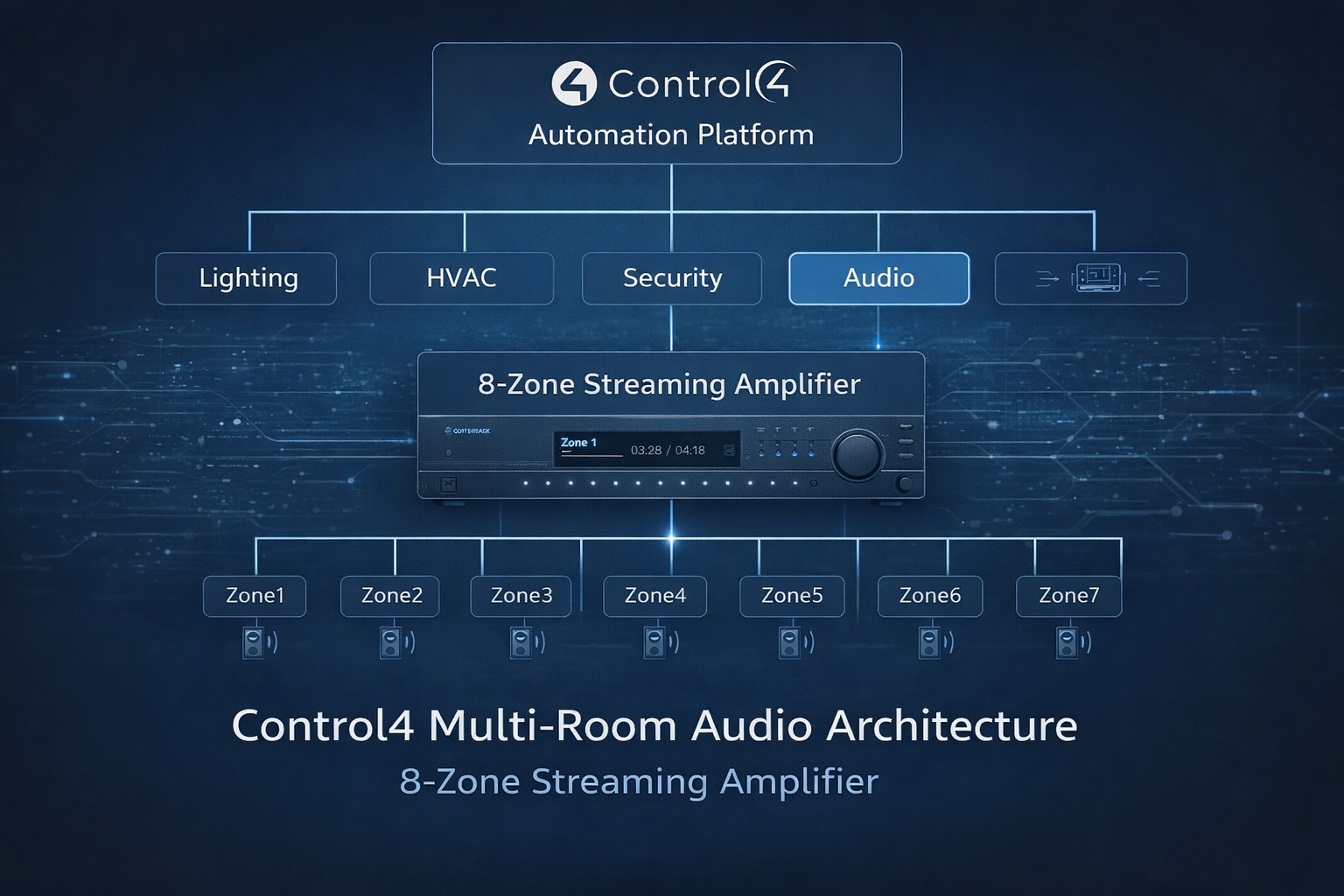
The Control4 controller communicates with connected devices using:
- IP networking
- Zigbee
- serial or driver-based integrations
This architecture allows integrators to control multiple subsystems through a single interface such as:
- wall touch panels
- mobile apps
- automation scenes
- voice control integrations
Control4 and Multi-Room Audio
Audio distribution has always been a critical part of the Control4 ecosystem.
In a typical Control4 installation, audio is delivered through multi-room amplification systems that distribute sound across different zones in a building.
Typical audio zones may include:
- Living room
- Kitchen
- Bedrooms
- Outdoor areas
- Commercial spaces such as restaurants or retail environments
Traditionally, Control4 systems relied on matrix audio distribution or proprietary amplifiers. However, the growing popularity of network streaming technologies has created demand for more flexible audio solutions.
Modern installations increasingly require support for:
- AirPlay streaming
- Spotify Connect
- network audio distribution
- independent playback in multiple zones
This is where network-based multi-room streaming amplifiers become highly relevant.
The Role of Multi-Room Streaming Amplifiers
Multi-room streaming amplifiers combine several important capabilities into a single device:
- multiple audio zones
- network streaming support
- centralized amplification
- flexible audio source routing
Instead of using separate streaming devices and amplifiers, a streaming amplifier integrates both functions into one system.
Advantages include:
- simplified installation
- fewer devices and cables
- better synchronization across zones
- improved integration with automation platforms
These devices can act as the audio backbone of modern smart homes and commercial spaces.
Integrating AmpVortex with Control4
The AmpVortex multi-room streaming amplifier is designed to work seamlessly in professional automation environments.
Key capabilities include:
- multiple independent audio zones
- network streaming integration
- compatibility with modern smart building platforms
- flexible audio source distribution
When integrated into a Control4 installation, the amplifier can provide centralized audio distribution across multiple rooms while remaining fully controllable through the automation system.
For integrators, this enables:
- easier deployment of multi-room audio systems
- scalable architecture for larger installations
- integration with other building automation platforms such as KNX or Matter
This combination makes streaming amplifiers an increasingly important component of the modern Control4 ecosystem.
Conclusion
The Control4 platform has evolved significantly from its early days as a standalone smart home automation system. Through the formation of Snap One and its acquisition by Resideo, it has become part of a much broader technology ecosystem.
At the same time, the demand for flexible, scalable audio distribution continues to grow.
Modern multi-room streaming amplifiers offer a powerful solution that complements Control4 installations by delivering high-quality audio across multiple zones while maintaining compatibility with professional automation systems.
As smart homes and smart buildings continue to expand, the integration of automation platforms with network-based audio systems will play an increasingly important role in the future of connected environments.