
 (317)516-7460
  service@ampvortex.com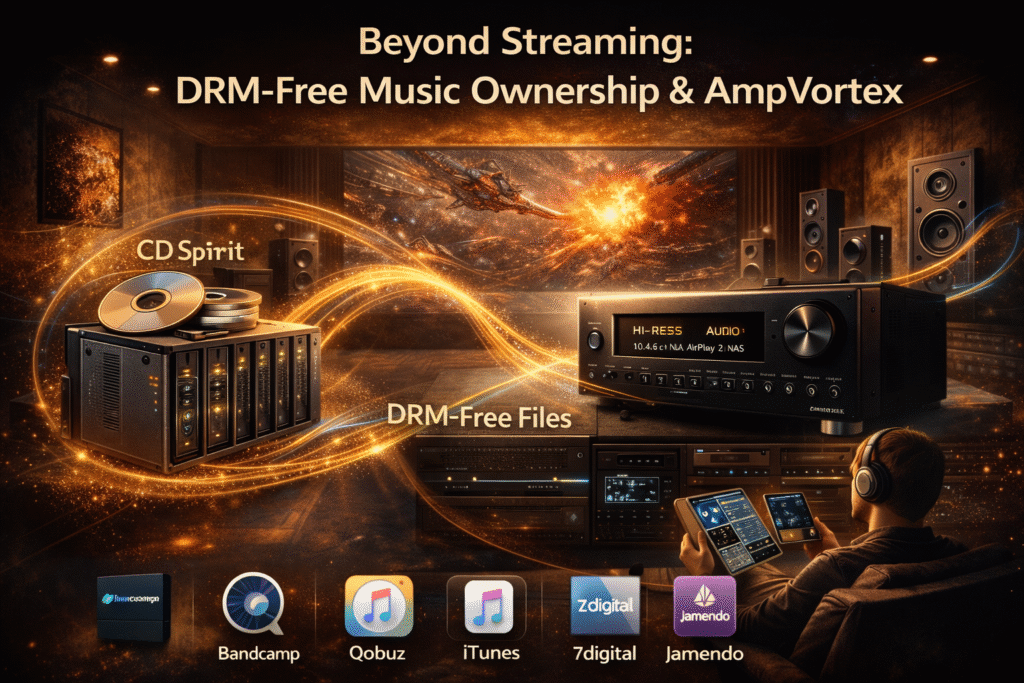
Beyond Streaming: DRM-Free Music Ownership & AmpVortex Audio Systems
Beyond Streaming: How DRM-Free Digital Ownership Is Reviving the “CD Spirit” for Music Lovers
In an era dominated by streaming subscriptions where “access” trumps “ownership”, music fans are increasingly grappling with a frustrating reality: pay monthly for years, and you’ll never truly own a single track. When your subscription lapses, your carefully curated playlist vanishes; when a platform removes a song due to licensing disputes, your favorite tune is gone without warning. This “rental model” fatigue is sparking a quiet revolution: the rise of DRM-free digital ownership, a movement that brings back the core appeal of CDs—permanent, offline, personal control—for the digital age.
The CD Spirit: Why Ownership Matters More Than Access
The CD’s enduring legacy lies in its simplicity: buy once, own forever. Slip it into any player, copy it to your computer, lend it to a friend, or store it on a shelf for decades—its music is yours, no strings attached. For years, digital music abandoned this ethos, hiding behind DRM (Digital Rights Management) walls that locked files to specific devices or accounts. Even “purchased” tracks on early platforms were little more than glorified rentals, vulnerable to platform shutdowns or license expirations. But today, a new wave of DRM-free platforms is bridging the gap between digital convenience and physical ownership, giving music lovers the best of both worlds.
Leading Platforms: Where DRM-Free Ownership Comes to Life
DRM-free digital ownership isn’t a one-size-fits-all solution—platforms cater to different audiences, from indie music collectors to audiophile purists. Below is a breakdown of the top players, their strengths, and who they’re perfect for:
| Platform | Core Strengths | Supported Formats | Ideal For | Key Limitations |
| Bandcamp | Indie-focused, artist-friendly, unlimited downloads, low entry prices | FLAC, WAV, ALAC, MP3 (up to 24bit/192kHz) | Independent music fans, collector communities | No official track resale or gifting features |
| Qobuz | Hi-Res audio specialist, CD-quality & lossless catalog, classical/jazz focus | FLAC, WAV (16bit/44.1kHz–24bit/192kHz) | Audiophiles, high-fidelity system users | Premium pricing, smaller mainstream pop catalog |
| iTunes Store | Seamless Apple ecosystem integration, family sharing, mainstream pop/rock focus | AAC, ALAC (256kbps–lossless) | Apple users, casual mainstream music fans | Limited Hi-Res options, tied to iOS/macOS ecosystem |
| 7digital | Cross-platform compatibility, diverse format support, large mainstream catalog | MP3, FLAC, WAV, ALAC | Windows/Android users, format flexibility seekers | Lower artist royalty rates vs. Bandcamp |
| Jamendo | Royalty-free music, commercial licensing options, independent creator focus | MP3, OGG (128–320kbps; select Hi-Res) | Content creators, podcast/video producers | Mixed audio quality, limited major label content |
Bandcamp: The Indie Haven for Music Collectors
Leading the charge is Bandcamp, the indie musician’s haven and a favorite among collectors. Here, artists sell tracks and albums in lossless formats at prices they set themselves, often starting at just $1 for a single or $5 for an album. Crucially, every purchase comes with unlimited DRM-free downloads. You can save the files to your hard drive, back them up on a NAS (Network-Attached Storage), or transfer them to any device—no internet connection, no account login, no restrictions. It’s digital music that behaves like a CD: yours to keep, even if Bandcamp disappears tomorrow. For independent artists, this model is a lifeline too—they pocket 85% of sales, far more than the meager streaming royalties that barely cover studio costs.
Qobuz: The Audiophile’s Choice for Hi-Res Sound
For audiophiles chasing the ultimate sound quality, Qobuz is the gold standard. The French platform offers DRM-free downloads of CD-quality and Hi-Res tracks, spanning classical, jazz, and mainstream releases. Unlike streaming services that compress audio to save bandwidth, Qobuz delivers uncompressed sound that rivals the warmth and detail of a physical CD. And because the files are DRM-free, you can store them offline, play them on any high-fidelity system, and back them up as you see fit. It’s a love letter to sound purists who refuse to sacrifice quality for convenience.
Mainstream Players: iTunes & 7digital Bridge the Gap
Mainstream players are also catching on. The iTunes Store (now part of Apple Music) has long offered DRM-free AAC and ALAC downloads, allowing users to own their favorite pop and rock hits. With Apple’s Family Sharing feature, up to six people can access purchased tracks—echoing the way families once shared CD collections. Meanwhile, 7digital caters to the cross-platform crowd, supporting formats that work seamlessly on Windows, Android, and iOS devices. Its DRM-free library spans millions of tracks, proving that ownership doesn’t have to mean sacrificing choice.
Jamendo: DRM-Free for Creators & Commercial Use
Even niche platforms are carving out a space for DRM-free ownership. Jamendo focuses on independent and royalty-free music, letting users buy tracks for personal use or license them for commercial projects—all without DRM restrictions. For creators who need background music for videos or podcasts, it’s a one-stop shop for legal, owned content that avoids the red tape of streaming licenses.
The Fine Print: DRM-Free Isn’t Exactly a CD Replica
Of course, DRM-free digital ownership isn’t a perfect replica of the CD experience. Legal constraints still apply: the “first-sale doctrine”, which lets you resell physical CDs, doesn’t extend to most digital files, so you can’t resell your downloaded tracks. And while DRM-free files are free to copy for personal use, commercial distribution is still prohibited—protecting artists from piracy while preserving user freedom. This balance is key: DRM-free ownership isn’t about “free for all” piracy; it’s about fair compensation for creators and permanent rights for consumers.
As DRM-free ownership returns to the center of music culture, one practical question quickly follows: how do you actually listen to the music you now own—across rooms, devices, and formats—without giving up the convenience of streaming?
This is where systems like AmpVortex become essential. Rather than locking users into a single ecosystem, the AmpVortex platform is designed to unify local files, NAS libraries, and streaming services into one coherent listening experience.
The AmpVortex-16060 and 16060G models focus on multi-room playback and streaming flexibility, supporting AirPlay 2, Spotify Connect, DLNA, and Google Cast for everyday listening. For users who want to combine ownership with immersive cinema sound, the AmpVortex-16060A adds full Dolby Atmos decoding, bridging high-resolution music libraries with home theater systems.
Power users and large installations can step up to the AmpVortex-16100 series. The 16100, 16100G, and 16100A models offer higher output and expanded headroom, making them ideal for demanding speakers, larger spaces, and hybrid scenarios where DRM-free music libraries coexist with multi-zone streaming and immersive surround sound.
In short, AmpVortex doesn’t replace streaming—it contextualizes it. Streaming becomes a discovery tool, while DRM-free files stored locally or on a NAS become a permanent, controllable collection. The result feels remarkably familiar to longtime music lovers: a modern system that quietly restores the spirit of the CD era—ownership first, convenience second.
The Future of Music: Streaming and Ownership Can Coexist
The shift toward DRM-free ownership isn’t just a nostalgia play—it’s a rejection of the streaming model’s inherent instability. As streaming services hike prices, remove content, and flood playlists with algorithmic filler, music lovers are remembering what it means to own music: to have a collection that grows with you, that survives platform changes, that feels like a personal treasure rather than a temporary rental. It’s the CD spirit, reborn for the digital age.
In the end, the future of music isn’t about choosing between streaming and ownership—it’s about having both. Streaming will always have a place for casual listening and discovery, but for the music we love—the tracks that soundtrack our lives—the desire to own, to hold, to keep forever, will never fade. DRM-free digital ownership isn’t killing streaming; it’s saving music from becoming just another subscription bill. It’s giving music back to the fans.