
 (317)516-7460
  service@ampvortex.com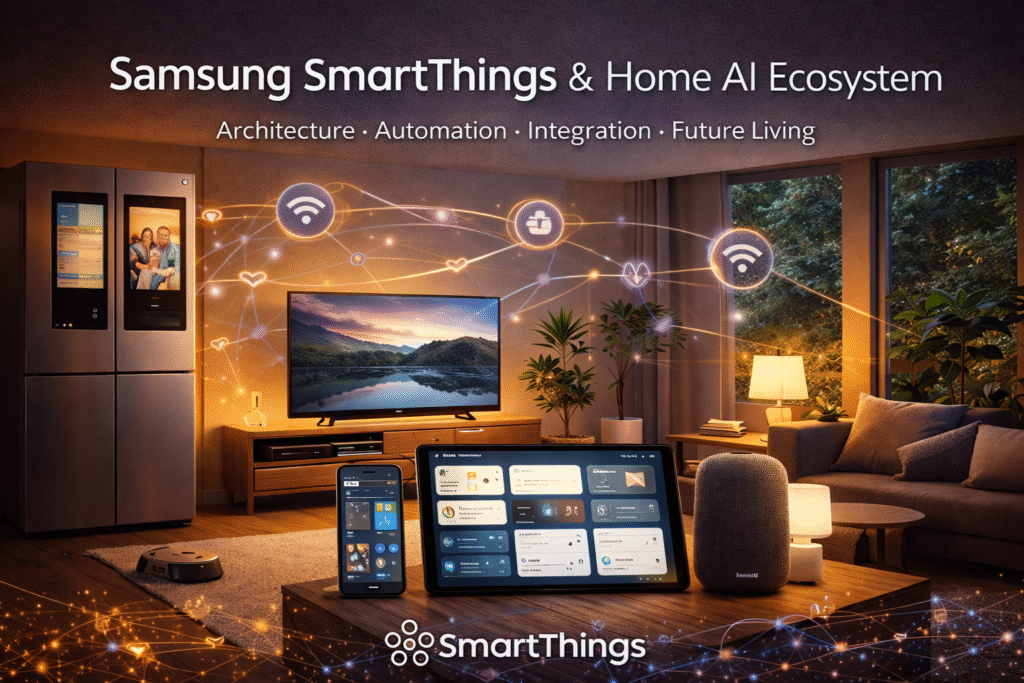
Hands-On Review: Samsung SmartThings – Does It Truly Unify Your Smart Home?
Preface
In the field of smart home platforms, Samsung SmartThings has always been known as the “universal hub” by enthusiasts. With its ultra-high protocol compatibility and powerful automation functions, it can connect almost all smart devices on the market. After actual testing and long-term use, this article will conduct a comprehensive hands-on evaluation of Samsung SmartThings from compatibility, hardware, automation, user experience and other dimensions, to verify whether it can really realize the full interconnection of the smart home.
1. Core Advantage: Ultra-Wide Protocol Compatibility
The biggest core competitiveness of SmartThings is its almost omnipotent protocol support, which is unmatched by all other consumer-level platforms:
- Zigbee: Connect a large number of low-power smart sensors and switches
- Z-Wave: Compatible with old-fashioned smart devices that most platforms cannot access
- Wi-Fi: Adapt to mainstream high-bandwidth smart home appliances
- Thread: New generation low-power mesh network protocol
- Bluetooth: Quick connection of small smart devices
- Matter: Universal cross-platform protocol for new devices
This high compatibility allows SmartThings to connect all old and new, cross-brand and cross-protocol smart devices in the home, truly realizing the “unified control” of the whole house.
2. Built-in Gateway Hardware Advantage
Different from other platforms that need to purchase an additional gateway, Samsung has built a SmartThings gateway into a variety of household appliances, greatly reducing the user’s use cost:
- Samsung smart TVs (2022 and later models)
- Samsung soundbars and audio equipment
- Samsung Family Hub smart refrigerators
Users do not need to purchase additional gateway equipment, as long as they have the above Samsung hardware, they can directly build a smart home control center, which is convenient and cost-effective.
3. Actual Device Compatibility Test
After actual testing, SmartThings can perfectly connect the following types of devices:
- Old-fashioned Zigbee and Z-Wave sensors, switches, locks
- Mainstream Matter-certified smart lights, curtains, sockets
- Samsung’s full range of smart home appliances (refrigerators, washing machines, air conditioners)
- Third-brand smart cameras, thermostats, air purifiers
Almost no device has compatibility problems, and the connection speed is fast, and the operation is stable after connection.
4. Automation Function: Professional-Level Customization
SmartThings has the most powerful automation engine in the consumer-level market, far exceeding other platforms:
- Support complex conditional logic editing (if…else…)
- Support variable setting and state tracking
- Support cross-protocol device chained linkage
- Support delayed execution and cyclic execution
- Support sensor data triggering (temperature, humidity, light intensity)
For smart home enthusiasts, this professional-level automation function can realize all imagined intelligent scenes, and the customization degree is extremely high.
5. Voice Control Integration
SmartThings does not have an independent voice assistant, but it has realized deep integration with the two mainstream voice assistants in the world:
- Amazon Alexa
- Google Assistant
Users can control all SmartThings-connected devices through voice commands of Alexa or Google Assistant, with stable compatibility and fast response speed.
6. Pros and Cons Summary of Actual Experience
Advantages of Actual Use:
- The strongest protocol compatibility, connecting almost all devices
- Built-in gateway, no need to purchase additional equipment
- Professional-level automation, high customization degree
- Stable operation, few disconnections and malfunctions
- Perfect adaptation to Samsung home appliances
- Support old-fashioned devices, high utilization rate of old equipment
Disadvantages of Actual Use:
- The operation interface is complex, and the threshold for getting started is high
- Privacy protection is weaker than Apple HomeKit
- The automation setting is cumbersome and requires a certain learning cost
- No independent voice assistant, relying on third parties
-
Who Is Most Suitable for SmartThings?
- Users with a large number of cross-brand and cross-protocol smart devices at home
- Users who have old-fashioned Zigbee/Z-Wave devices and need to continue to use them
- Smart home enthusiasts who pursue professional automation and customization
- Users who use Samsung TVs, refrigerators and other hardware
- Users who want to realize true full-house device interconnection
Conclusion
After actual hands-on testing, Samsung SmartThings has fully verified its strength as a “universal smart home hub”. It does have the ability to unify all smart devices in the home, breaking all ecological and protocol barriers. Although it has a high threshold for getting started, for users who need multi-device interconnection and professional functions, it is undoubtedly the best smart home platform on the market.
Please contact us at service@ampvortex.com
AmpVortex website: www.ampvortex.com