(317)516-7460
  service@ampvortex.com
Detailed Explanation of HDR Standards: HDR10, Dolby Vision, and HDR10+ — Which One Is Better?
Detailed Explanation of HDR Standards: HDR10, Dolby Vision, and HDR10+ — Which One Is Better?
For years, the HDR debate has been framed as a simple question:
HDR10 or Dolby Vision — which one is better?
This way of thinking is understandable, but it fundamentally misses the point.
In reality, modern HDR is not about choosing a single winner.
It is about understanding why multiple HDR standards exist, how they evolved from the same technical foundation, and why coexistence—not replacement—is shaping the future of the HDR ecosystem.
In recent years, several HDR standards with different characteristics have emerged in the market. HDR10 holds a leading position due to its first-mover advantage, but it now faces increasing competition. In 2017, Dolby Vision began to gain wider adoption, and Samsung’s HDR10+ became another strong contender. Other formats such as Hybrid Log-Gamma (HLG) and Technicolor/Philips SL-HDR1 have also made progress.
HDR Standards Competition Overview
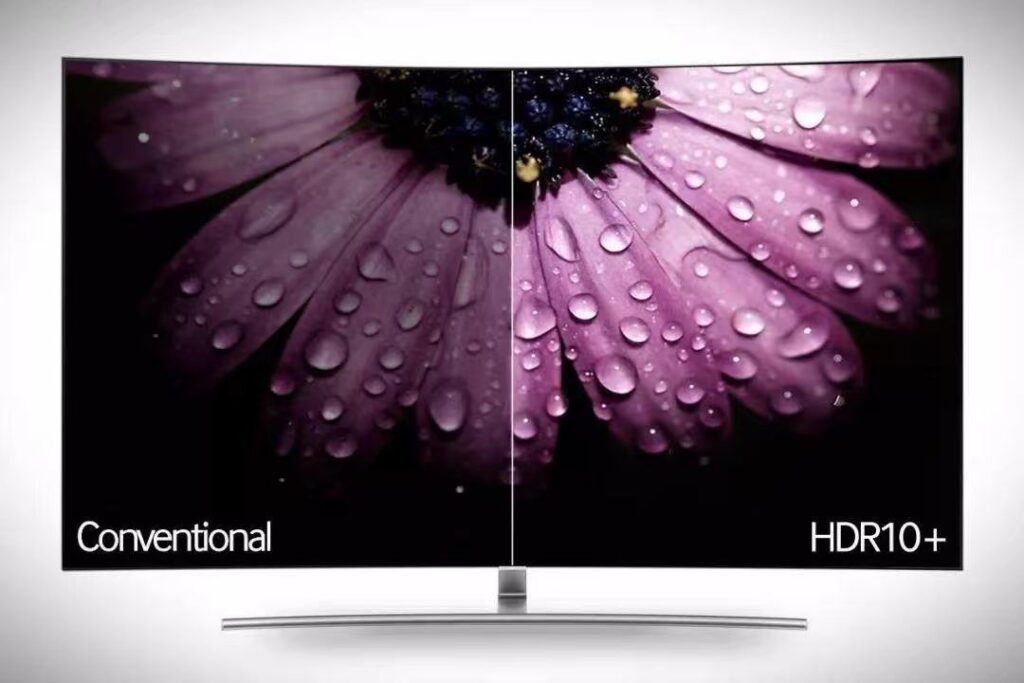
Among the many HDR standards available, HDR10 initially seized leadership in both content and consumer products. However, Dolby Vision’s popularity grew significantly starting in 2017, with more devices supporting it over time. Samsung’s HDR10+, which also uses dynamic metadata like Dolby Vision, has been gaining traction as a patent-free alternative.
The Advanced Television Systems Committee (ATSC) has included HLG and HDR10 as optional standards in the ATSC 3.0 broadcast specification. It has also elevated SL-HDR1 and the Dolby-based SMPTE 2049-10 to candidate standards, which could be adopted in future ATSC 3.0 deployments.
HDR10 — The Free and Open Baseline
As the designated HDR technology for Ultra HD Blu-ray, HDR10 was adopted early and widely across devices. Many major TV manufacturers — including Samsung, LG, Sony, and Vizio — have offered HDR10-enabled sets, making it the default HDR format supported on most Ultra HD platforms.
All major OTT streaming services except one (Vudu, which exclusively supports Dolby Vision) deliver HDR10 content. Platforms like Amazon Prime Video and Netflix support both HDR10 and Dolby Vision formats.
Dolby Vision — Hollywood Color and Dynamic Metadata
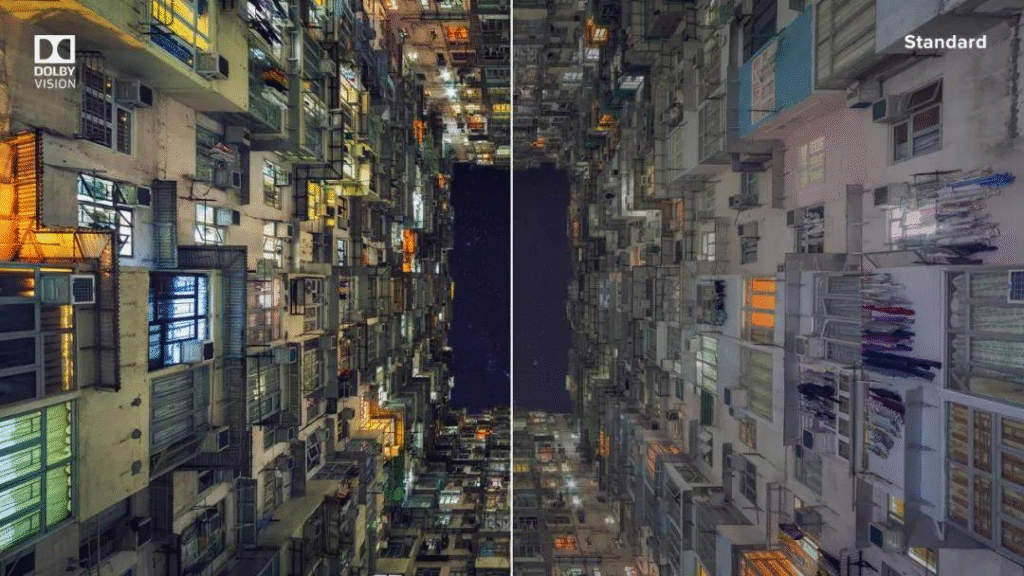
Dolby Vision enhances HDR performance by using dynamic metadata to adjust picture characteristics on a scene-by-scene or frame-by-frame basis. After relatively slow early adoption, more manufacturers began supporting Dolby Vision by 2017, and a greater number of content titles and playback devices now offer it.
Some manufacturers, including Hisense, Philips, TCL, and others that originally focused on HDR10, added Dolby Vision compatibility to their product lineups, increasing the format’s ecosystem support.
HDR10+ — Samsung’s Open Rival
HDR10+ also uses dynamic metadata and serves as a competitive, patent-free alternative to Dolby Vision. Backed by Samsung and supported in Amazon HDR10+ content libraries, HDR10+ is expanding its presence in consumer TVs.
Its compatibility with standard HDR10 decoders allows broader device support and encourages adoption across multiple platforms. Some industry observers have questioned whether HDR10+ is truly patent-free in all respects, but its proponents emphasize its open approach.
DisplayHDR — VESA’s HDR Standard for PC Monitors
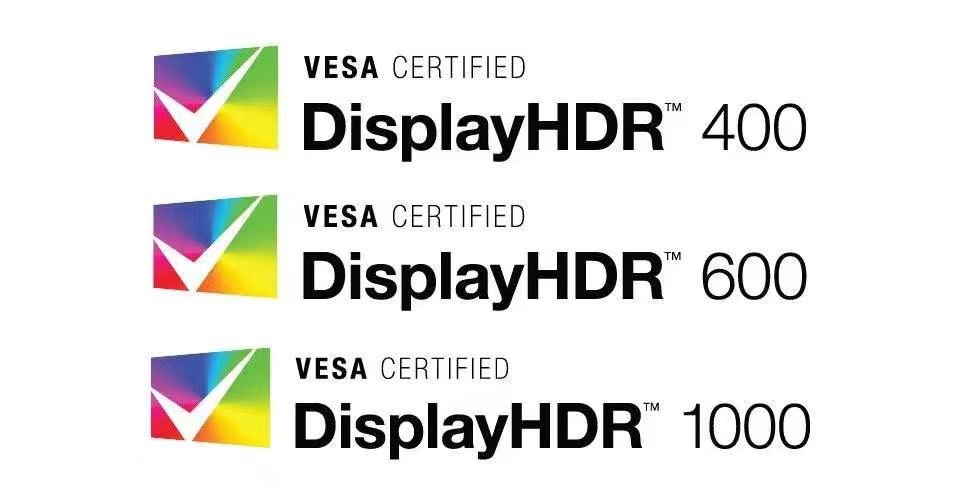
DisplayHDR is an HDR certification standard developed by VESA (Video Electronics Standards Association) specifically for PC monitors.
In its initial DisplayHDR 1.0 specification, the standard is divided into three tiers based on key performance metrics such as peak brightness (luminance), color gamut coverage, color depth, and response time:
- DisplayHDR 400
- DisplayHDR 600
- DisplayHDR 1000
At present, the DisplayHDR certification program is limited to LCD-based displays and does not apply to OLED panels. Unlike content-driven HDR formats such as HDR10 or Dolby Vision, DisplayHDR focuses solely on the hardware capabilities of the display itself, rather than metadata processing or content mastering workflows.
Introduced in late 2017, DisplayHDR was designed to provide clearer, more transparent performance benchmarks for PC monitor users. As adoption continues, more display manufacturers are expected to support this standard, particularly in the gaming and professional monitor markets.
However, it is important to note that DisplayHDR does not define an end-to-end HDR ecosystem. It does not address content creation, dynamic metadata, or playback processing, and therefore serves as a hardware certification standard rather than a complete HDR delivery format.
Other HDR Options — HLG and SL-HDR1
Hybrid Log-Gamma (HLG) is gaining traction as a free broadcast HDR option and is supported in ATSC 3.0. HLG doesn’t require dynamic metadata and therefore simplifies production and delivery workflows compared to more complex HDR formats.
SL-HDR1, developed by Technicolor and Philips, offers an end-to-end SDR-to-HDR conversion workflow and has been tested by various broadcasters as an additional HDR candidate for future deployments.
SMPTE Standards as the Foundation of HDR Evolution and Coexistence
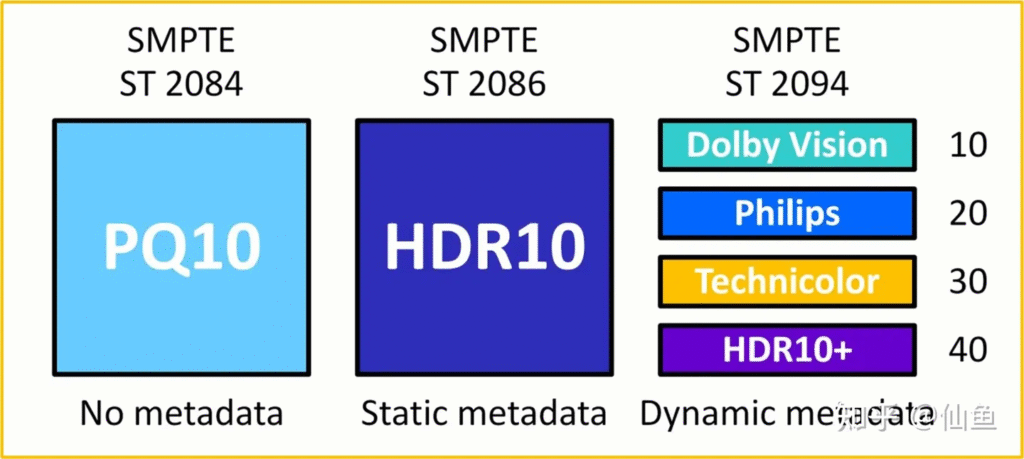
The diagram above highlights how SMPTE standards form the technical backbone of modern HDR, while also revealing the broader evolutionary trend and coexistence of multiple HDR formats.
At the core is SMPTE ST 2084 (PQ), which defines the perceptual transfer function for HDR luminance. As a foundational standard, PQ focuses solely on how brightness is mapped to human vision and does not include any metadata, making it the common baseline shared by nearly all HDR formats.
Building on this foundation, SMPTE ST 2086 introduced static metadata, enabling displays to understand the mastering characteristics of HDR content. This specification underpins HDR10, which applies a single set of metadata parameters across the entire program. While effective as an entry-level HDR solution, static metadata lacks the flexibility to adapt to varying scene brightness and contrast.
The evolution continues with SMPTE ST 2094, a family of standards designed for dynamic metadata. Rather than defining a single proprietary format, ST 2094 provides a framework that allows different implementations to coexist. Within this framework, multiple HDR ecosystems have emerged:
- Dolby Vision, using proprietary dynamic metadata
- Philips and Technicolor, each contributing their own dynamic metadata approaches
- HDR10+, offering an open, royalty-free implementation of dynamic metadata
This SMPTE-based structure demonstrates that modern HDR development is not a zero-sum competition between formats. Instead, it reflects a layered and interoperable ecosystem, where different HDR technologies address distinct market needs while remaining technically compatible at the standards level.
In this context, SMPTE standards do more than define signal parameters—they enable coexistence, allowing licensed and open HDR formats to evolve in parallel while sharing a common technical foundation. This is why contemporary HDR systems increasingly support multiple formats, ensuring broader compatibility across content, devices, and viewing environments.
📊 Market Outlook
Decisions about which HDR formats to support are driven by multiple stakeholders in the ecosystem — including TV manufacturers, content distributors, and production studios. Manufacturers often support multiple HDR formats to avoid committing to a single “winner,” while content creators and distributors evaluate format support based on market penetration and playback compatibility.
Comparison of Major HDR Standards
| HDR Standard | Governing Body / Owner | Metadata Type | SMPTE Reference | Target Devices | Key Characteristics | Typical Use Cases |
| HDR10 | CTA / UHD Alliance | Static metadata | SMPTE ST 2084 (PQ) SMPTE ST 2086 |
TVs, projectors, AVRs | Open and royalty-free; uses static metadata applied to entire content; baseline HDR format | UHD Blu-ray, streaming platforms, general HDR compatibility |
| Dolby Vision (DV) | Dolby Laboratories | Dynamic metadata (proprietary) | SMPTE ST 2084 (PQ) SMPTE ST 2094-10 |
TVs, projectors, mobile devices | Proprietary system; dynamic tone mapping per scene or frame; strong studio and Hollywood adoption | Premium streaming, cinema-grade home theater |
| HDR10+ | HDR10+ Technologies (Samsung-led) | Dynamic metadata (open) | SMPTE ST 2084 (PQ) SMPTE ST 2094-40 |
TVs, AVRs, streaming devices | Open and royalty-free dynamic metadata; designed for broad ecosystem adoption; flexible tone mapping | Streaming platforms, bright living rooms, open HDR ecosystems |
| HLG (Hybrid Log-Gamma) | BBC / NHK | No metadata | ARIB STD-B67 | TVs, broadcast receivers | Metadata-free HDR; backward compatible with SDR displays; simplified production workflow | Live broadcast TV, sports, news |
| DisplayHDR | VESA | No content metadata | Not content-based (hardware certification) |
PC monitors (LCD) | Hardware capability certification; focuses on peak brightness, color gamut, and response time; not a content delivery format | PC monitors, gaming displays, professional monitors |
Key Technical Takeaways
- SMPTE ST 2084 (PQ) is the common luminance foundation for HDR10, Dolby Vision, and HDR10+
- Static vs Dynamic Metadata is the key differentiator between HDR10 and next-generation HDR formats
- Dolby Vision and HDR10+ both rely on SMPTE ST 2094 dynamic metadata, but differ in licensing and ecosystem strategy
- HLG prioritizes broadcast simplicity and backward compatibility over metadata-driven optimization
- DisplayHDR is not an HDR format, but a display hardware certification standard, primarily for PC monitors
This comparison highlights that modern HDR standards are not mutually exclusive, but rather optimized for different content workflows, devices, and viewing environments—which explains why contemporary AV systems increasingly support multiple HDR formats simultaneously.
Why Multi-HDR Support Matters for AVRs Like AmpVortex
In real-world home cinema systems, HDR performance is not determined by a single format, but by how well the entire signal chain can adapt to multiple HDR ecosystems simultaneously. Content providers, streaming platforms, broadcast standards, and display manufacturers do not converge on one universal HDR format, making multi-HDR support a practical necessity rather than a feature upgrade.
An AVR sits at the center of this ecosystem. It must correctly pass through, interpret, and preserve HDR metadata while coordinating video processing with immersive audio playback. Limiting an AVR to a single HDR format risks compatibility issues, tone-mapping inconsistencies, or forced format conversion—each of which can compromise image fidelity.
This is where multi-HDR capability becomes critical. By supporting formats such as HDR10, Dolby Vision, HDR10+, and HLG, an AVR ensures seamless interoperability across different content sources and display technologies. Whether the content uses static metadata, dynamic metadata, or no metadata at all, the system remains transparent and predictable.
For platforms like AmpVortex, multi-HDR support aligns with a broader design philosophy: avoiding ecosystem lock-in while preparing for future standards. As HDR continues to evolve within the SMPTE framework—balancing proprietary and open implementations—AVRs must remain format-agnostic at the transport level while maintaining high bandwidth, low latency, and precise signal integrity.
Ultimately, multi-HDR support is not about choosing a “winner” among formats. It is about ensuring that the best possible HDR experience is delivered regardless of how the content was mastered, allowing users to focus on the viewing experience rather than compatibility constraints.
HDR Standards in Real-World Home Cinema Systems
While discussions around HDR formats often focus on displays and content distribution, real-world performance ultimately depends on how audio-visual systems are integrated and processed end-to-end within the home.
Modern home cinema installations increasingly demand a unified platform that can handle both advanced video standards and immersive multi-channel audio, without fragmenting the system into separate devices.
This is where integrated solutions such as AmpVortex A-Series come into play.
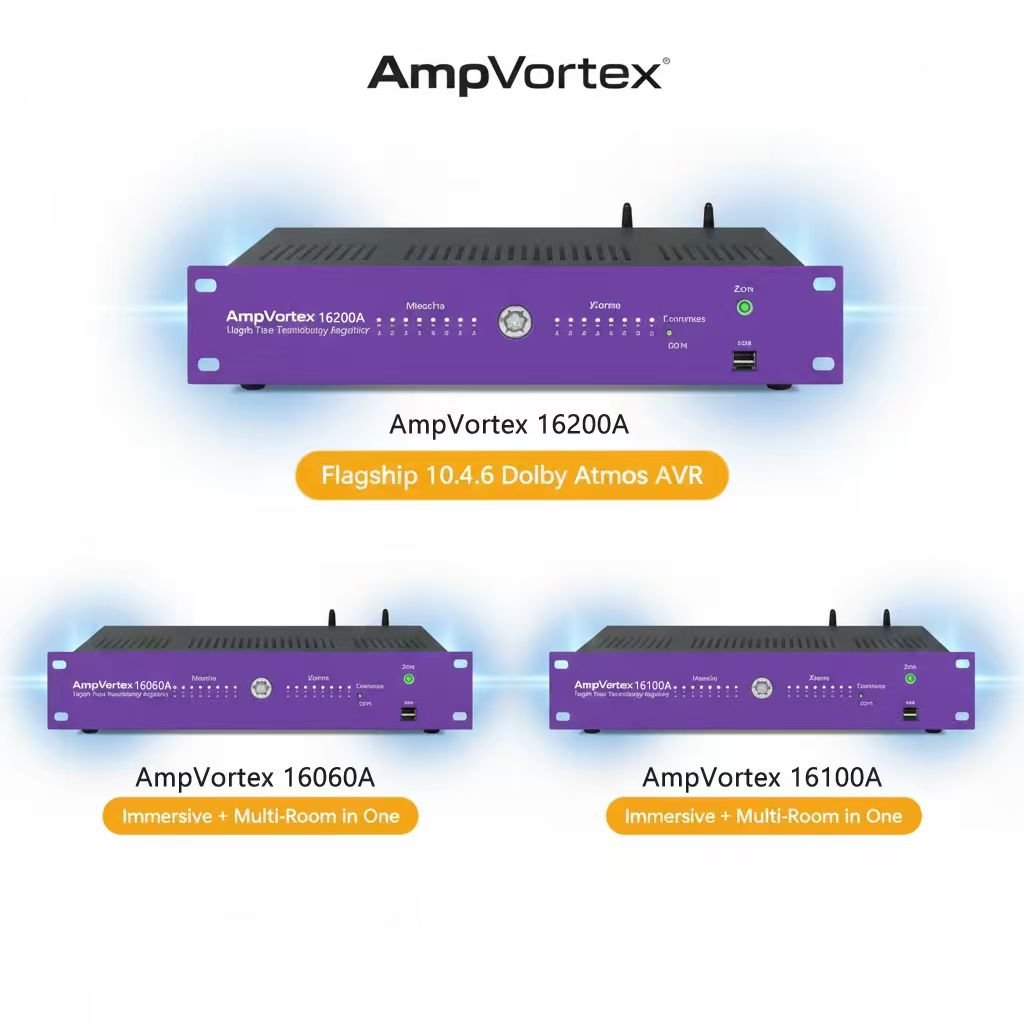
The AmpVortex-16060A, 16100A, and 16200A are designed as a true combination of a multi-room streaming amplifier and a high-performance AVR. Rather than separating whole-home audio from cinema playback, these models unify both roles into a single platform.
On the audio side, all three models support Dolby Atmos 10.4.6, enabling reference-grade immersive surround sound for dedicated home theaters, while also being fully prepared for next-generation open standards such as IAMF / Eclipsa Audio 10.4.6.
On the video side, AmpVortex A-Series supports a wide range of modern HDR formats, including Dolby Vision 2 and HDR10+ Advanced, allowing the system to adapt to different content ecosystems, display technologies, and viewing environments.
By supporting both licensed cinematic standards and open, future-oriented formats, AmpVortex provides a flexible foundation for evolving HDR and immersive audio workflows—whether in dedicated theaters, bright living rooms, or whole-home smart audio installations.
In this sense, the debate between HDR10, Dolby Vision, and HDR10+ is no longer just about which format is “better,” but about which platforms are capable of supporting all of them seamlessly, without locking users into a single ecosystem.
Learn more at https://www.ampvortex.com
Ultimately, the future of HDR will not be decided by a single logo on the box or a single format winning the market. It will be defined by how well platforms, devices, and systems can adapt to an increasingly fragmented and multi-standard ecosystem, delivering consistent visual experiences regardless of how content is mastered or distributed.