
 (317)516-7460
  service@ampvortex.com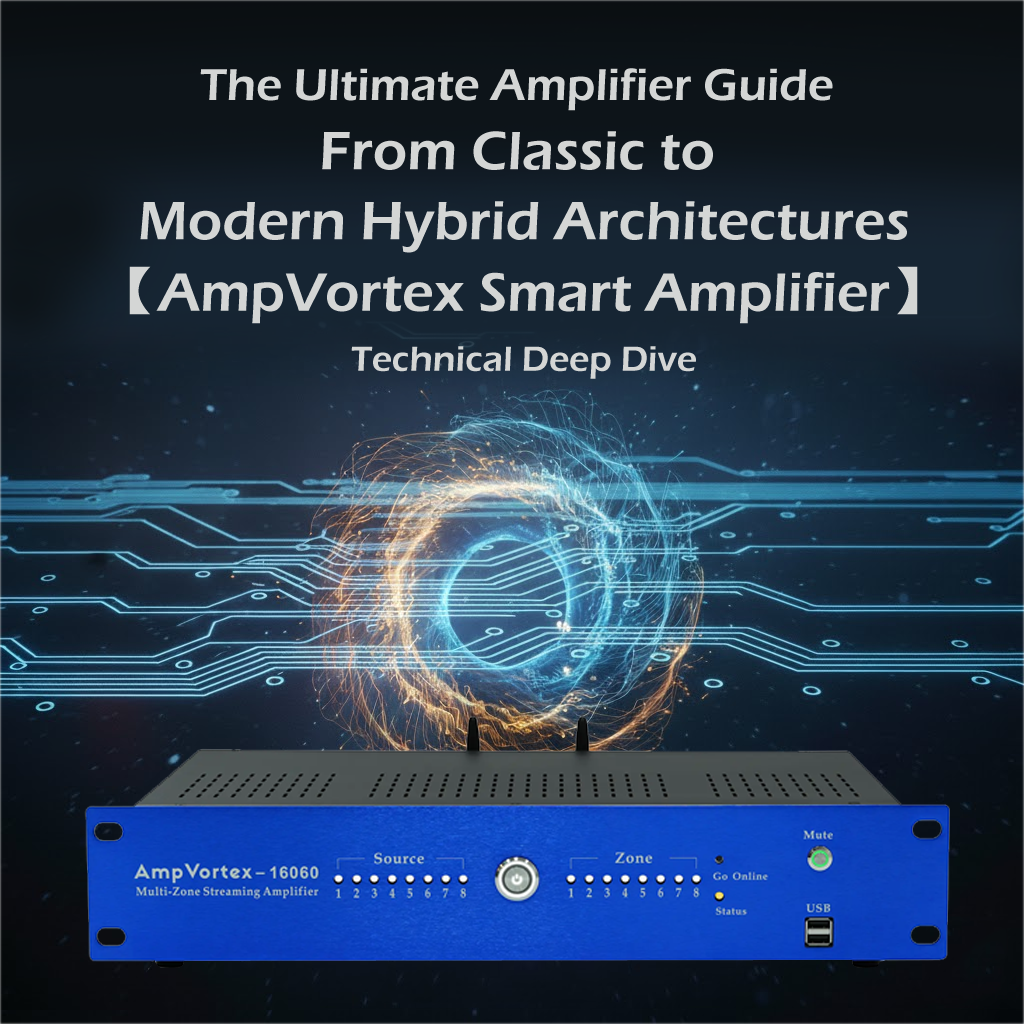
The Ultimate Amplifier Guide: From Classic to Modern Hybrid Architectures【AmpVortex Smart Amplifier】Technical Deep Dive
Keywords: Amplifier Classes Comparison, Class B Crossover Distortion, Class D Principles, THD+N Formula, Damping Factor Calculation, Closed-Loop Feedback
The Power Amplifier (Amp) is the nerve center of any high-performance audio system. An amplifier’s operating mode (Class) and technical specifications determine its final sonic characteristics, energy efficiency, heat output, and size.
For a modern, multi-channel smart amplifier like AmpVortex, selecting the correct architecture is paramount. This article provides an in-depth analysis of the six major amplifier classes and three core technical metrics.
1. The Six Major Amplifier Classes and Operating Modes
Amplifier classification is primarily based on the conduction angle of the transistors, but modern systems include optimized architectures for efficiency.
|
Amp Class |
Conduction Angle (θ) |
Operating Principle |
Efficiency (Theoretical) |
Key Characteristics |
|
Class A |
360° |
Pure linear amplification |
< 25% |
Best linearity, extremely low distortion, massive heat generation. |
|
Class B |
180° |
Push-Pull Half-Cycle |
≈78.5% |
High efficiency, but severe crossover distortion. |
|
Class AB |
180°<0< 360° |
Slight bias eliminates distortion |
≈50%-60% |
Classic Hi-Fi standard, balance of quality and efficiency. |
|
Class D |
Switching mode |
Pulse Width Modulation (PWM) |
> 90% |
Small size, ultra-high efficiency, ideal for multi-channel integration. |
|
Class G |
Dynamic Rail |
Multi-rail power supply |
Varies dynamically with signal |
Maintains Class AB quality, improves average efficiency. |
|
Class H |
Dynamic Rail |
Continuous tracking power supply |
Varies dynamically with signal |
Higher complexity, better efficiency for high-power applications. |
2. Classic Analog Amplifier Technology: The Evolution from A to AB
Analog amplifiers rely on transistors operating in the linear region for signal amplification.
A. Class A: The Paradox of Purity and Waste
- Principle:The transistor remains fully conductive (360° conduction angle) at all times.
- Pros & Cons:Achieves the lowest theoretical distortion, resulting in a warm, natural sound. However, it consumes near-maximum power even at idle, leading to extremely low efficiency (< 25%) and massive heat generation.
B. Class B: Efficiency Gains, Crossover Losses
- Principle:Typically uses a push-pull configuration where one transistor amplifies the positive half-cycle and the other amplifies the negative half-cycle. Each conducts for exactly 180°. No quiescent current is drawn, leading to significantly higher efficiency (≈78.5%).
- Fatal Flaw—Crossover Distortion:At the zero-crossing point where the signal switches from positive to negative (and vice-versa), both transistors momentarily cut off due to the “dead band” voltage (e.g., 0.7V for silicon). This causes a measurable non-linear distortion at the zero point, making Class B unsuitable for high-fidelity audio alone.
C. Class AB: The Standard Hi-Fi Solution
- Principle:An improvement on Class B. A slight bias current is applied, causing both transistors to conduct simultaneously for a brief period near the zero-crossing (conduction angle slightly greater than 180°).
- Advantage:This overlap effectively eliminates the crossover distortion of Class B, achieving excellent linearity while maintaining good efficiency (≈50%-60%).
3. Modern Switching and Hybrid Amplifiers
A. Class D: The Breakthrough in Efficiency
Class D uses switching amplification to achieve ultra-high efficiency, making it the essential technology for compact, multi-channel systems like AmpVortex.
- Core Principle: PWM Modulation: The analog audio signal is converted into a high-frequency Pulse Width Modulation (PWM) signal.

The output transistors operate in a fully ON/fully OFF mode, minimizing power loss.
- Audio Quality Assurance—Closed-Loop Negative Feedback:Modern Class D designs (adopted by AmpVortex) incorporate high-precision closed-loop feedback circuitry. This circuit samples the output after the filter, compares it with the input, and feeds the error back to the modulator for real-time correction. This ensures that despite the switching nature, the THD+N remains extremely low.
B. Hybrid Optimization: Class G and Class H
These architectures enhance the efficiency of analog amplification (like Class AB) by managing power supply rails:
- Class G: Uses a multi-rail power supply. The amp operates on a lower voltage rail for most audio (high efficiency) and only switches to a higher voltage rail for momentary peak power demands.
- Class H: Uses a dynamic or tracking power supply rail. The voltage rail continuously tracks the input signal, staying slightly above the required level. This minimizes the voltage drop across the output transistors, thus boosting efficiency.
4. The Critical Metrics: Technical Specifications Deep Dive
When selecting a high-performance amplifier, the following three metrics are paramount:
A. Total Harmonic Distortion Plus Noise (THD+N)
THD+N measures the purity and linearity of the amplifier’s output signal.

- Meaning:The ratio of the power of all spurious signals (harmonics and noise) to the power of the original fundamental signal.
- Benchmark:High-quality Class D amplifiers can achieve 0.005% or lower. The lower the THD+N, the more faithful the sound reproduction.
B. Signal-to-Noise Ratio (SNR)
SNR measures the purity of the amplifier’s background noise floor.

- Benchmark:High-fidelity amplifiers typically require over 100 dB. AmpVortex ensures a high SNR, guaranteeing that no unwanted hiss or hum is audible during quiet passages.
C. Damping Factor (DF)
The Damping Factor measures the amplifier’s control over the speaker cone’s movement.

- Meaning:A higher DF (lower output impedance) means the amplifier is better able to absorb the speaker’s back-EMF (unwanted residual cone movement). This results in a tighter, cleaner, and better-controlled bass response.
- Benchmark: A DF above 100 is typically considered excellent control.
Summary: The AmpVortex Technology Path
The AmpVortex Smart Amplifier is built on an advanced Class D architecture to successfully balance ultra-high efficiency (> 90%), compact size, and superior audio quality. By utilizing high-performance closed-loop feedback technology, AmpVortex ensures that critical metrics (extremely low THD+N and high Damping Factor) meet Hi-Fi standards, making it the ideal solution for modern smart homes demanding high integration, energy efficiency, and uncompromised performance.
Would you like me to start generating the six cover images for these platforms now?
For more information, please visit www.ampvortex.com