(317)516-7460
  service@ampvortex.com
Matter Versions Explained: From Matter 1.0 to 1.5 and What Comes Next
Understanding Matter Versions: How the Smart Home Standard Is Evolving — and Why It Matters
As the smart home industry matures, Matter has emerged as the most important unifying protocol of the decade. Backed by the Connectivity Standards Alliance (CSA), Matter aims to enable seamless interoperability across Apple, Google, Amazon, Samsung, and hundreds of device manufacturers.
Rather than being a single milestone, Matter is an evolving standard. Each release reflects a shift in priorities—from basic device interoperability to system-level coordination, media awareness, and increasingly, whole-home experience orchestration.
Understanding how Matter versions differ is essential for manufacturers, integrators, and advanced users building complex smart home systems.
Matter 1.0: Interoperability Comes First (October 2022)
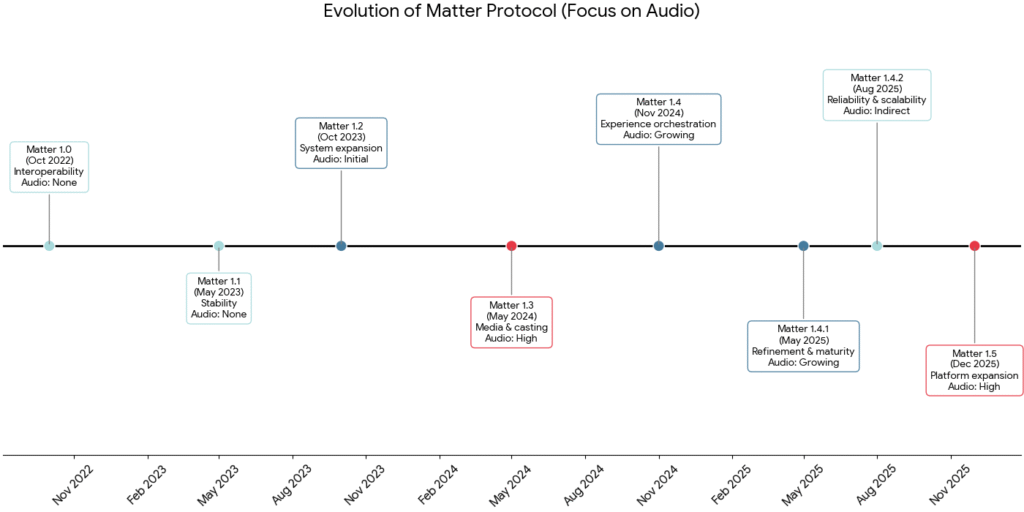
Matter 1.0, officially released in October 2022, marked the public launch of the standard.
Its primary goal was to establish a shared, IP-based foundation using Wi-Fi and Thread, allowing devices from different ecosystems to communicate reliably. Core concepts such as Node, Endpoint, Cluster, and Fabric were formally defined.
Supported device types were intentionally limited to essentials such as lights, switches, plugs, door locks, and basic sensors. Media, audio, and advanced automation scenarios were explicitly out of scope.
Matter 1.0 proved ecosystem alignment—not feature completeness.
Matter 1.1: Stability and Clarification (May 2023)
Released in May 2023, Matter 1.1 focused on improving engineering reliability rather than expanding functionality.
This version clarified specification language, improved commissioning robustness, and reduced inconsistencies across vendor implementations. While it introduced no new device categories, it significantly improved production readiness for manufacturers.
Matter 1.1 was about making Matter dependable at scale.
Matter 1.2: The System Starts to Grow (October 2023)
Matter 1.2, released in October 2023, represented a meaningful expansion of scope.
New device categories such as large home appliances and robot vacuums were introduced. More importantly, Matter Cast appeared for the first time—signaling that media and content delivery were entering the Matter ecosystem.
This release marked Matter’s transition from simple device control toward system-level behavior, laying the groundwork for audio and media use cases.
Matter 1.3: Media Becomes Real (May 2024)
Released in May 2024, Matter 1.3 is the most relevant version today for audio and AV manufacturers.
It significantly expanded Matter Cast capabilities, clarified models for media sources and receivers, and improved support for TVs, streaming devices, and multi-room scenarios. While Matter is not a low-level audio transport protocol, Matter 1.3 defines the control, routing, and session semantics required for coordinated playback.
This version makes scalable, standards-based multi-room audio systems viable.
Matter 1.4: Experience Orchestration Begins (November 2024)
Matter 1.4, published in November 2024, marked a clear shift from individual device capabilities toward experience orchestration.
This version emphasized richer automation semantics, improved coordination between heterogeneous devices, and better system-level behavior across large installations. Whole-home scenarios—where lighting, media, sensors, and automation interact as a cohesive system—became a first-class design goal.
Matter 1.4 positioned Matter not just as a control protocol, but as a framework for orchestrating complex smart home experiences.
Matter 1.4.1: Refinement and Ecosystem Maturity (May 2025)
Released in May 2025, Matter 1.4.1 was an incremental update focused on refinement rather than expansion.
It addressed edge cases discovered in real-world deployments, improved behavioral consistency across platforms, and strengthened backward compatibility. No major new device categories were introduced, but overall ecosystem reliability improved noticeably.
Matter 1.4.1 reflects Matter’s transition from rapid expansion toward long-term stability.
🆕 Matter 1.4.2: Reliability, Networking, and Scale (August 2025)
Matter 1.4.2 continues the 1.4.x refinement path, with a strong emphasis on network reliability, scalability, and commissioning robustness.
Key themes include improved behavior in large installations, more predictable device onboarding, and enhanced consistency across IP networks. This release is particularly relevant for professional and semi-professional deployments where dozens or hundreds of devices must operate reliably over time.
Matter 1.4.2 does not redefine user-facing experiences, but it significantly strengthens Matter as infrastructure.
🆕 Matter 1.5: Expanding Matter’s Reach (Late 2025)
Matter 1.5 represents the next major expansion of the standard.
This release introduces entirely new device classes—including cameras, closures (such as blinds and garage doors), and additional environmental sensors—bringing previously excluded categories into the Matter ecosystem.
It also emphasizes enhanced data transport capabilities and deeper system integration, making Matter suitable for more data-intensive and experience-driven use cases.
With Matter 1.5, the standard moves decisively beyond control and coordination into a broader smart home platform capable of supporting rich, interactive, and media-heavy environments.
Matter Versions at a Glance
|
Matter Version |
Release Date |
Core Focus |
Audio Relevance |
Industry Impact |
|
Matter 1.0 |
Oct 2022 |
Interoperability |
None |
Ecosystem alignment |
|
Matter 1.1 |
May 2023 |
Stability |
None |
Production readiness |
|
Matter 1.2 |
Oct 2023 |
System expansion |
Initial |
Media enters roadmap |
|
Matter 1.3 |
May 2024 |
Media & casting |
High |
Multi-room scenarios become viable |
|
Matter 1.4 |
Nov 2024 |
Experience orchestration |
Growing |
Whole-home intelligence |
|
Matter 1.4.1 |
May 2025 |
Refinement & maturity |
Growing |
Ecosystem stabilization |
|
Matter 1.4.2 |
Aug 2025 |
Reliability & scalability |
Indirect |
Infrastructure-strengthening release |
|
Matter 1.5 |
Late 2025 |
Platform expansion |
High (future-facing) |
New device classes & richer experiences |
Note: Release dates refer to official CSA specification announcements rather than device availability.
Why Matter Versions Matter for Smart Home Audio(微调)
Matter was not originally designed for audio—but audio has become a driving force in its evolution.
Multi-room sound requires coordination across endpoints, session awareness, predictable networking behavior, and cross-ecosystem consistency. As Matter matures through versions 1.3 to 1.5, audio systems increasingly shift from peripheral devices to core infrastructure components of the smart home.
For practical examples of how Matter integrates into real-world systems, visit our Home Automation solutions page.
Conclusion(更新)
Each Matter release reflects a clear progression in the smart home industry’s priorities:
- Matter 1.0 unified ecosystems
- Matter 1.2 introduced system expansion
- Matter 1.3 enabled real media and multi-room scenarios
- Matter 1.4.x strengthened orchestration and reliability
- Matter 1.5 expands Matter into new categories and richer experiences
Matter is no longer only about devices talking to platforms.
It is becoming the language that defines how homes behave, coordinate, and deliver experiences.