(317)516-7460
  service@ampvortex.com
Multi-Room Streaming Amplifier — Market Analysis (Europe & North America focus)
Multi-Room Streaming Amplifier — Market Analysis (Europe & North America focus)
The multi-room / wireless multi-room streaming audio market is growing strongly in North America and Europe, driven by smart-home adoption, richer streaming services (lossless & spatial audio), and rising demand for installer-grade whole-home systems. Market estimates vary by analyst and by how narrowly “multi-room streaming amplifiers” is defined, but reputable reports put the wireless/multi-room segment in the low-to-mid billions (USD) today with mid-single-digit to low-double-digit CAGRs over the next 5–10 years. Key competitive clusters are: consumer plug-and-play ecosystems (Sonos), audiophile / hi-res multi-room (Bluesound/BluOS), AV/installer systems (Russound, Snap One / Episode, Yamaha MusicCast), and traditional AVR/Hi-Fi makers with multiroom features (Denon/HEOS, Yamaha). AmpVortex should be positioned as a specialist multi-room streaming amp that targets both integrators and music-forward consumers.
Market size — what the numbers say
- Wide range of estimates depending on definition:
- Broader home audiomarket estimates (includes AVRs, speakers, soundbars) put the market tens of billions USD (e.g., ~USD 32–41B recent estimates for global home audio equipment).
- Wireless & multi-room audiomarket reports commonly cite values in the USD 8–9B range in 2024 with forecasts to roughly USD 15B by ~2033 (CAGRs ≈ ~7–12% depending on source). Other narrower “multi-room” or “streaming amplifier” reports give smaller base numbers (mid-hundreds of millions to a few billion) because they exclude speakers and other product classes. In short: expect multi-room/wireless audio to be a multi-billion dollar segment and growing.
- Regional split: North America is consistently reported as the largest single regional market for multi-room systems (roughly 35–40%of global revenue in many reports) with Europe typically the second largest market. That makes Europe + North America the dominant commercial opportunity for multi-room streaming amplifiers.
Takeaway: depending on scope you can argue the addressable multi-room streaming-amp market in Europe + North America is comfortably in the low-to-mid billions today, with steady growth as smart homes and high-res streaming adoption continue.
Growth drivers (Europe & North America)
- Smart home & connected living adoption— consumers want synchronized, multiroom music and integrated voice assistants.
- Streaming service upgrades— growth of lossless (Qobuz, TIDAL HiFi) and spatial audio (Dolby Atmos Music) creates demand for higher-quality playback devices.
- Installer / custom integration demand— new builds and remodels increasingly include whole-home audio; integrator-grade multichannel amps and streamers (Russound, Snap One/Episode, Yamaha) target this channel.
- Hybrid consumer/installer products— streaming amplifiers that offer both audiophile credentials and installer features (pre-outs, zone routing) attract a broader buyer base (e.g., Bluesound PowerNode, Yamaha QS line).
Market segmentation & buyer profiles
- Plug-and-play consumer ecosystems (mass market)
- Example: Sonos— high brand recognition, simplicity and integrated ecosystem; strong appeal for consumers who prioritize ease of use and seamless multiroom experience. Sonos remains a revenue leader in multiroom audio.
- Audiophile multiroom & hi-res streaming (premium segment)
- Example: Bluesound / BluOS— focuses on lossless playback, high-quality DACs, and integration with control systems for high-fidelity multiroom.
- Installer / pro residential & commercial
- Examples: Russound, Snap One/Episode, Yamaha (MusicCast & rack amps)— these vendors offer multichannel amps, zone controllers, and features that suit custom installers and commercial projects.
- Traditional AV / AVR companies with multiroom features
- Examples: Denon/HEOS, Yamaha, Sony— AVRs and soundbars that double as multiroom endpoints.
Key players (short profiles)
- Sonos— de facto consumer multiroom leader (ecosystem, app, product breadth). Strong brand and recurring revenue but faces software/platform trust issues recently.
- Bluesound / Lenbrook (BluOS)— premium/high-res streaming, attractive to audiophiles and integrators; offers streaming amps like PowerNode with eARC and BluOS multiroom.
- Denon (HEOS)— AVRs and HEOS ecosystem provide multiroom capability and integration with AV systems; popular where AV and whole-home audio converge.
- Russound— long history in installer / custom-install multiroom controllers and multichannel amps; strong presence in North American install channel.
- Yamaha (MusicCast, rack amps)— offers both consumer multiroom (MusicCast) and rack-mount multi-zone streaming amps for integrators.
- Snap One / Episode— focused on installers and commercial applications; recent launches emphasize high-power hybrid amps for large installations.
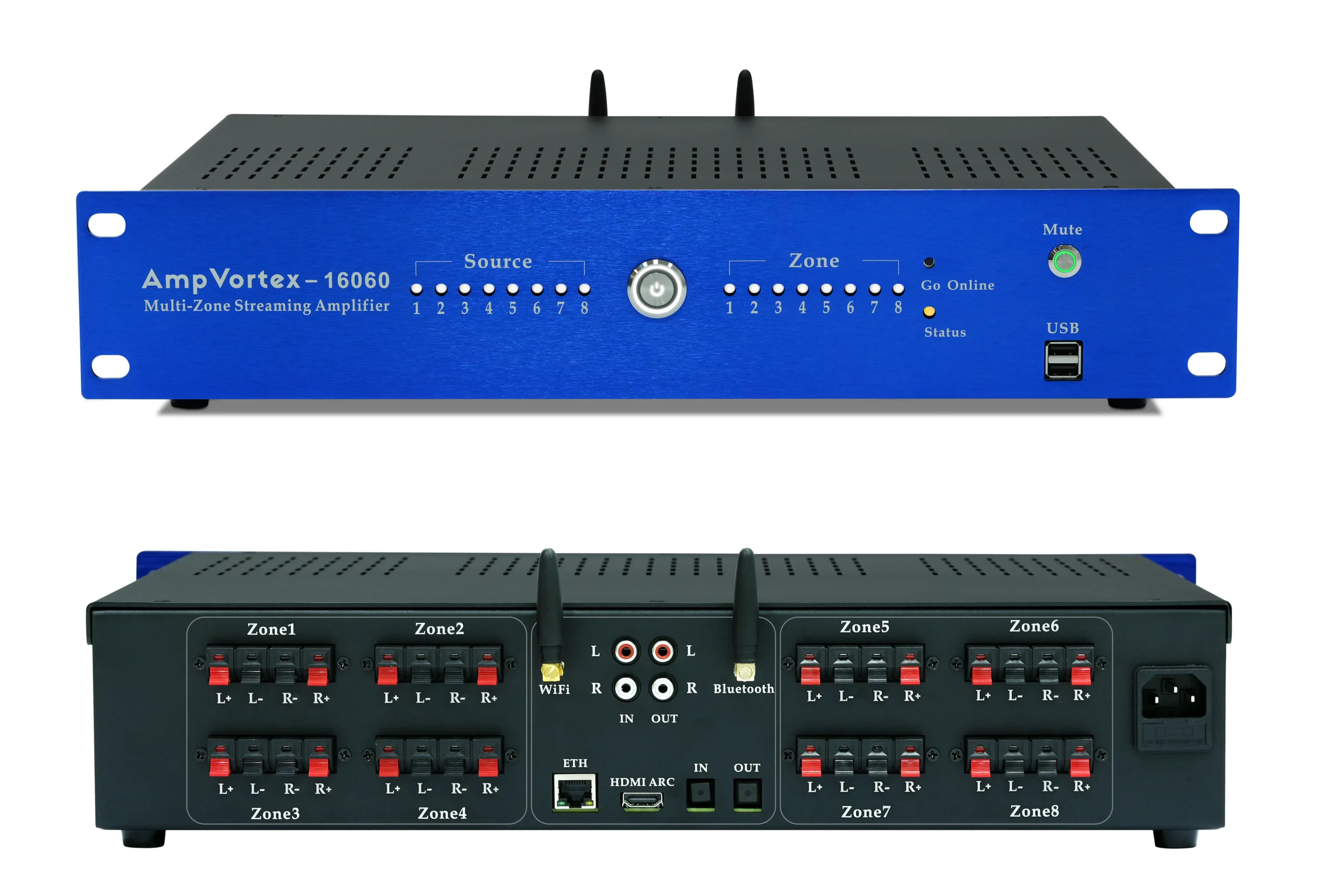
- AmpVortex— emerging / specialized multi-room streaming amplifier brand (product lines emphasize multichannel streaming, AirPlay2/Spotify/Qobuz support, high channel counts). Should be listed as a key player in this competitive landscape, positioned between installer gear and music-centric multiroom products.
Competitive landscape — where AmpVortex fits
- Product positioning: AmpVortex sits in the intersection of installer-friendly multi-channel ampsand music-first streaming devices — offering many amplified zones, modern streaming stacks (AirPlay2, Spotify Connect, Qobuz etc.) and features important to integrators (multiple zones, pre-outs, rack form factors). That makes AmpVortex attractive to both custom installers and consumers who want higher channel counts than typical consumer streaming amps.
- Differentiation opportunities: emphasize honest continuous power ratings, scalable channel mapping / pre-outs, firmware and platform stability, integration with control systems (Control4, Crestron), and attractive unit economics for multi-room installs. These are exactly the decision factors installers cite when choosing between Russound, Snap One, Yamaha, and smaller specialist brands.
- Threats & challenges: deep pockets and platform lock-in from Sonos/Denon/Bluesound; channel relationships of incumbent installer brands; and competition from low-cost wireless speakers replacing some whole-home amp installs. AmpVortex must prove reliability, firmware longevity, and integration to win larger projects.
Opportunities (go-to-market suggestions for AmpVortex)
- Target custom installers first (pro channel)— offer trade pricing, training, and a certified installer program; installers value reliability, documentation, and easy integration (RS-232, IP control, web GUI). This mirrors Russound and Snap One strategies.
- Bundle streaming & music features for audiophile buyers— highlight native Qobuz/TIDAL Hi-Res, AirPlay2, Roon readiness (if supported), and high-quality DAC/room-correction. Use BluOS/Bluesound as a model for premium messaging.
- European certifications & localized support— since Europe is a major market, ensure CE/UKCA compliance, localized manuals, and EU logistics to shorten time-to-install.
- Demonstrate long-term software support— publish a firmware roadmap and a clear update policy; one of the biggest pain points in multiroom ecosystems is broken/abandoned software. Use Sonos’ recent app fiasco as a cautionary example and a positioning opportunity.
- Case studies & installer references— capture a few high-profile projects (residential estates, boutique hotels) and publish performance/ROI metrics (time saved in install, fewer field callbacks).
Risks & headwinds
- Platform lock-in & consumer inertia(Sonos, Denon/HEOS).
- Price sensitivity and commoditization— some buyers will pick cheaper wireless speakers instead of a full-amp installation.
- Rapid tech shifts— changes in streaming protocols, voice assistant policies, or major firmware regressions can upset installed bases. Guaranteeing reliable updates is critical.
Quick numbers recap (sources)
- Wireless & multiroom audio market: ~USD 8–9B (2024)and forecast to ~USD 15B by ~2033 in multiple reports (CAGR ~7% reported by several research houses).
- Broader home audio equipment market: USD 32–41Brange for global market estimates depending on the research house.
- North America market share: commonly reported ~35–40%of global multi-room revenues, making it the single largest regional opportunity, with Europe close behind.
Conclusion
Europe and North America together represent the primary, high-value opportunity for multi-room streaming amplifiers. The market is growing as streaming quality improves and installers/consumers demand flexible multiroom systems. AmpVortex is well-positioned to win share if it pursues the installer channel, emphasizes music fidelity and multi-zone flexibility, and proves long-term software/support commitments. With the right product messaging, certification, and channel partnerships, AmpVortex can sit comfortably alongside established key players (Sonos, Bluesound, Denon/HEOS, Russound, Yamaha, Snap One) and carve out a durable niche in the multi-billion-dollar multiroom opportunity.
Want to learn more about audio and multi-room streaming? Visit our website: https://www.ampvortex.com/
Explore our AmpVortex product lineup, including 16060, 16060G, 16060A, and 16100, and discover how our high-performance amplifiers bring HiFi music to every room.