
 (317)516-7460
  service@ampvortex.com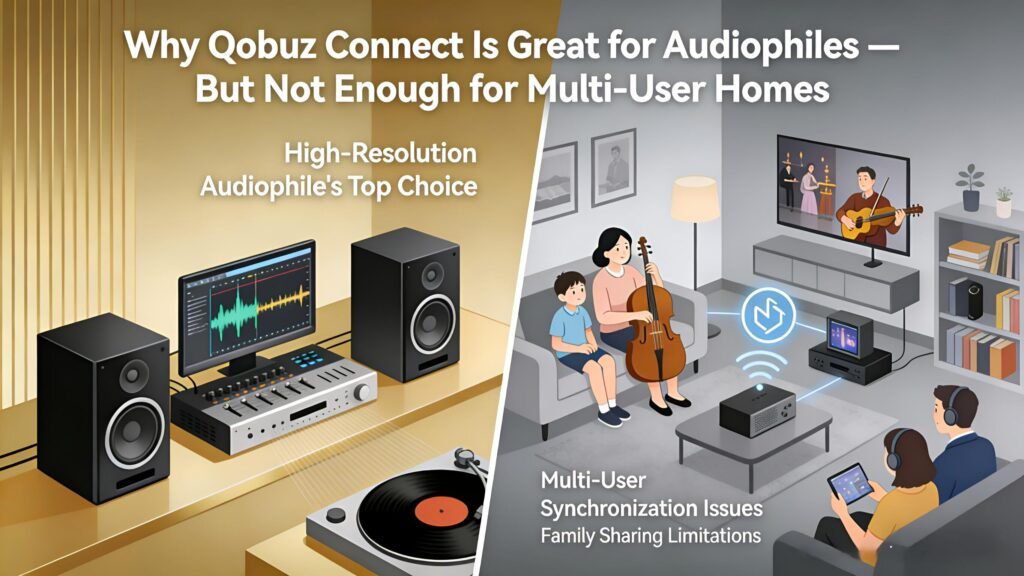
Why Qobuz Connect Is Great for Audiophiles — But Not Enough for Multi-User Homes
In the high-fidelity streaming world, Qobuz is the gold standard for many audiophiles. With its focus on lossless, 24-bit Hi-Res audio, the recent rollout of Qobuz Connect was met with much fanfare. For a single-user listening room, it is nearly perfect.
However, when designing a modern, multi-user home audio system, the hardware needs to be more than just a “high-end player.” It needs to be a multi-stream powerhouse. Here is a sharp, logical comparison between the intimacy of Qobuz Connect and the architectural scalability of Google Cast within the AmpVortex-16060G and 16100G.
The Audiophile’s Dream: Qobuz Connect
Qobuz Connect allows users to cast music directly from the Qobuz app to compatible hardware. Its strengths are undeniable:
- Pure Path: It ensures the highest possible resolution (up to 24-bit/192kHz) is delivered to your DAC.
- Discovery: Users can browse the world’s most curated Hi-Res catalog in its native environment.
- Direct Control: It provides a seamless experience for those who prioritize audio quality above all else.
The Logic Gap: Why It Stumbles in a “Full House”
While Qobuz Connect is a fantastic feature, it is not a complete ecosystem for a 8-zone household. Here is why Google Cast remains the primary backbone for AmpVortex systems:
1. The Exclusive Session vs. The Concurrent Matrix
Qobuz Connect (like Spotify Connect) is generally designed for a single active session per account.
- The Problem: If the father is using Qobuz Connect in the study, and the daughter tries to stream a different track to the kitchen using the same account, the sessions often clash.
- The AmpVortex Solution: Because the AmpVortex-16100G and 16060G feature 8 independent Google Cast nodes, they allow for true concurrency. One user can be on Qobuz, another on Tidal, and another on YouTube Music—simultaneously—without ever seeing a “Device in Use” error.
2. Protocol Maturity and Handover
Google Cast has spent a decade refining its “Handover” logic. In a large home, moving a stream from the Kitchen to the Patio requires a robust network handshake.
- Google Cast is built into the Android and iOS system layers, making “Discovery” and “Zoning” instantaneous.
- Qobuz Connect is still an app-level protocol. In a high-density 8-zone environment, relying on app-level discovery for every room can lead to slower response times compared to the hardware-integrated Cast nodes in the AmpVortex series.
3. The “Guest” Factor
A luxury home often hosts guests who may not be Qobuz subscribers.
- Platform Lock-in: A system optimized only for Qobuz Connect leaves guests out in the cold.
- Universal Access: By prioritizing Google Cast, AmpVortex remains platform-neutral. Whether a guest uses SoundCloud, Tidal, or even a local radio app, if it has a Cast icon, it works on your home system.
The AmpVortex Verdict: Best of Both Worlds
At OpenAudio, we believe you shouldn’t have to choose between audiophile quality and family-friendly functionality.
Our AmpVortex-16060G and 16100G are engineered to support high-resolution 24-bit streams via Google Cast. This means you get the bit-perfect quality that Qobuz fans crave, but with the multi-user, multi-app scaling that only a hardware-based Cast matrix can provide.
Conclusion
Qobuz Connect is a great tool for the individual audiophile. But for the Real Family and the Real Home, Google Cast provides the infrastructure that allows everyone to listen to what they want, where they want, in full Hi-Res.