The Science of Sound
Sound is more than just what we hear — it’s a measurable phenomenon, governed by precision, physics, and technology. In modern audio engineering, dynamic range, signal-to-noise ratio, total harmonic distortion (THD), and other key metrics are not just numbers — they define the quality, clarity, and realism of every note, beat, and whisper.
At the heart of superior audio experiences lies meticulous measurement. While many devices promise immersive sound, only a few deliver quantifiable excellence across every critical metric. With AmpVortex’s multi-channel amplifiers and high-performance audio systems, every listening experience is elevated — from the deepest bass to the finest high-frequency detail.
In this series, “The Science of Sound” explores how modern audio is engineered, measured, and perfected. We break down essential audio metrics, explain what they mean for your listening experience, and show how AmpVortex consistently outperforms conventional devices, bringing professional-grade audio performance into your home theater.
Because in the world of audio, sound isn’t just heard — it’s scientifically realized.
The Science of Sound: Technical Deep Dive
Sound is more than what we hear — it’s a measurable phenomenon. Modern audio engineering uses precise metrics to quantify performance. In this deep dive, we explore dynamic range, SNR, THD+N, crosstalk, impedance & sensitivity, and frequency response with principles, formulas, measurement methods, and AmpVortex performance highlights.

1. Dynamic Range (DR)
Basic Principle:
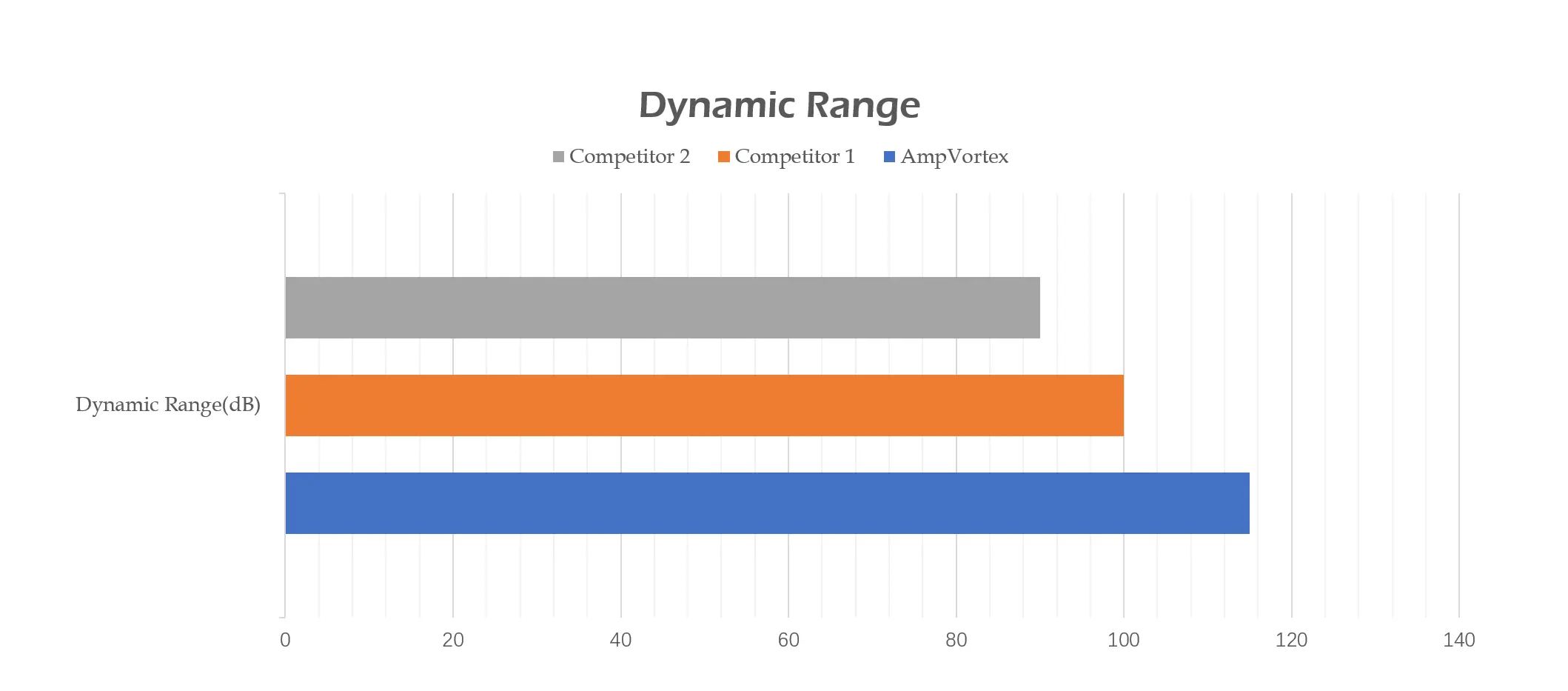
Dynamic range is the ratio between the loudest undistorted signal a system can produce and the lowest discernible signal above the noise floor. It determines how well subtle details and loud peaks coexist.
Formula:
DR = 20 · log10(Vmax / Vnoise)
Where:
- = Maximum undistorted voltage output
- = RMS voltage of system noise
Measurement Method:
- Play a calibrated sine wave at maximum output without clipping.
- Measure the RMS voltage of the system noise with no signal input.
- Compute the ratio in dB.
AmpVortex Advantage:
AmpVortex amplifiers maintain ultra-wide dynamic range, preserving both whisper-quiet passages and explosive peaks with zero audible compression, outperforming many consumer amplifiers.
2. Signal-to-Noise Ratio (SNR)
Basic Principle:
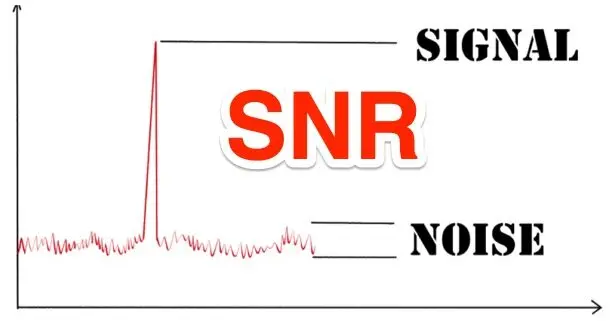
SNR compares the level of the desired audio signal to the background noise. Higher SNR means cleaner, clearer audio.
Formula:
SNR = 20 · log10(Vsignal / Vnoise)
Measurement Method:
- Input a known test signal (e.g., 1 kHz sine wave).
- Measure RMS voltage of the signal () and noise () separately.
- Calculate in dB.
AmpVortex Advantage:
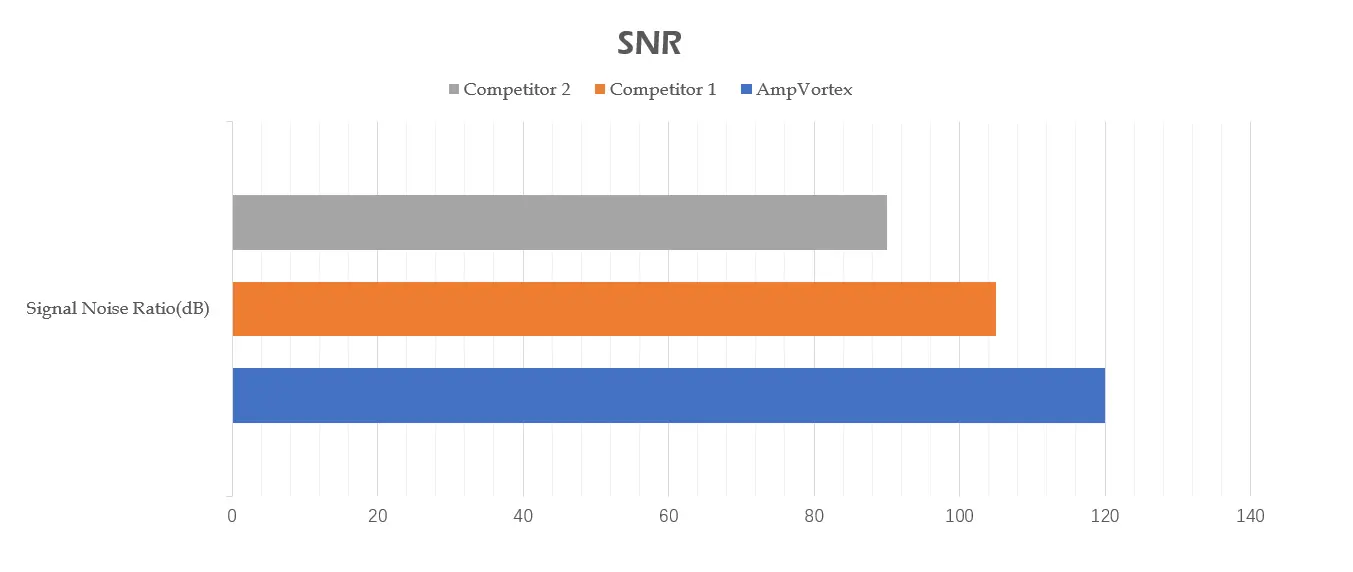
With industry-leading SNR, AmpVortex minimizes hiss and background noise, delivering clean, transparent audio even at high gain settings.
3. Total Harmonic Distortion + Noise (THD+N)
Basic Principle:
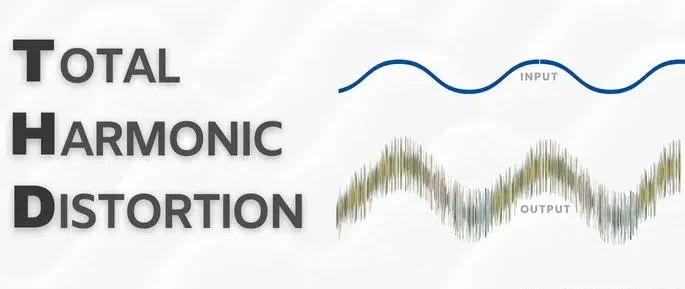
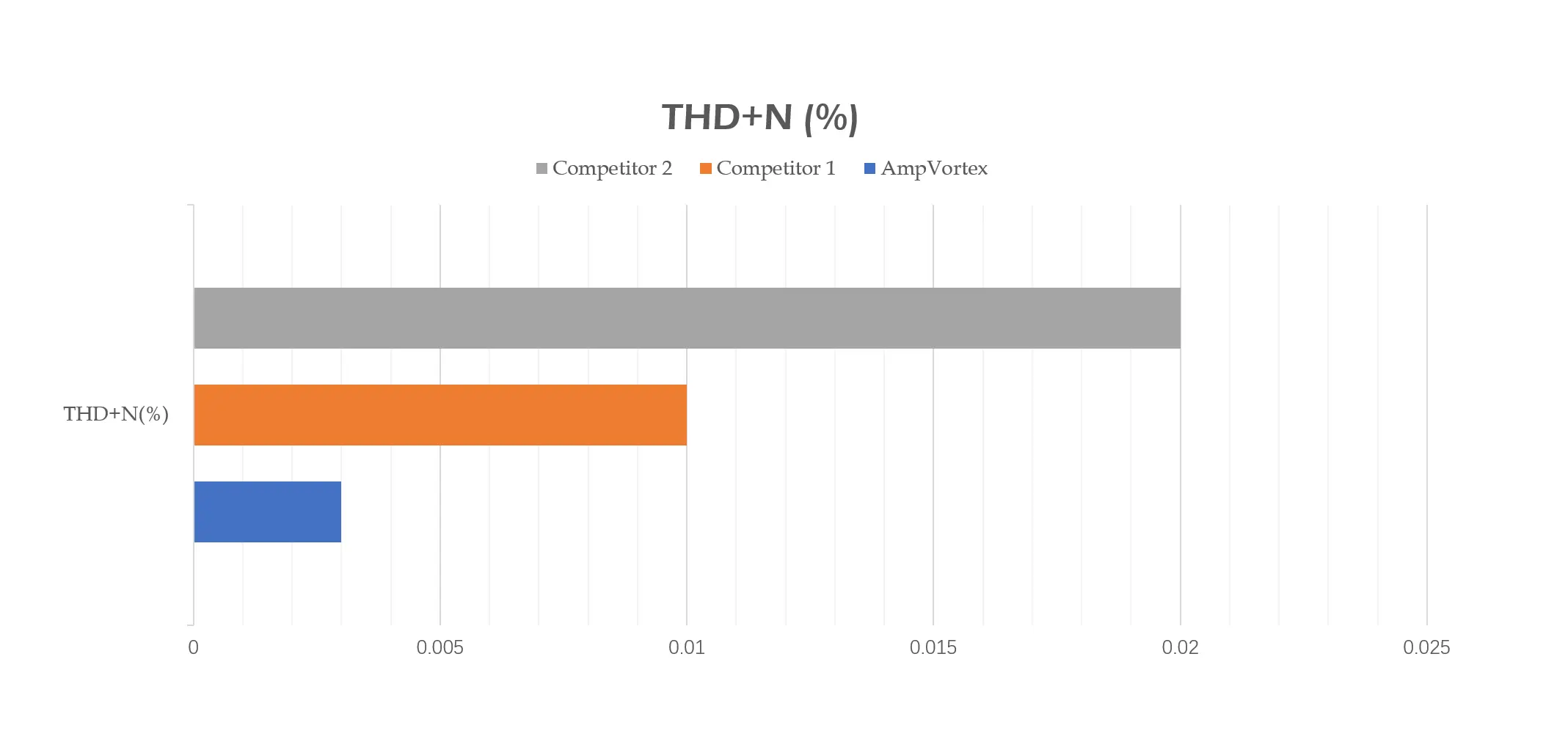
THD+N quantifies non-linear distortion plus noise introduced by the system, indicating how faithfully the amplifier reproduces the original signal.
Formula:
THD + N(%) = √(V2² + V3² + … + Vn² + Vnoise²) / Vfundamental × 100
Where:
- V2,V3,…,Vn= RMS voltages of harmonic components
- Vfundamental= RMS voltage of the original signal
Measurement Method:
- Feed a pure sine wave into the amplifier.
- Use a spectrum analyzer to separate fundamental and harmonic components.
- Compute THD+N as a percentage.
AmpVortex Advantage:
Advanced circuitry minimizes THD+N, ensuring transparent, faithful reproduction across the entire frequency spectrum.
4. Crosstalk
Basic Principle:
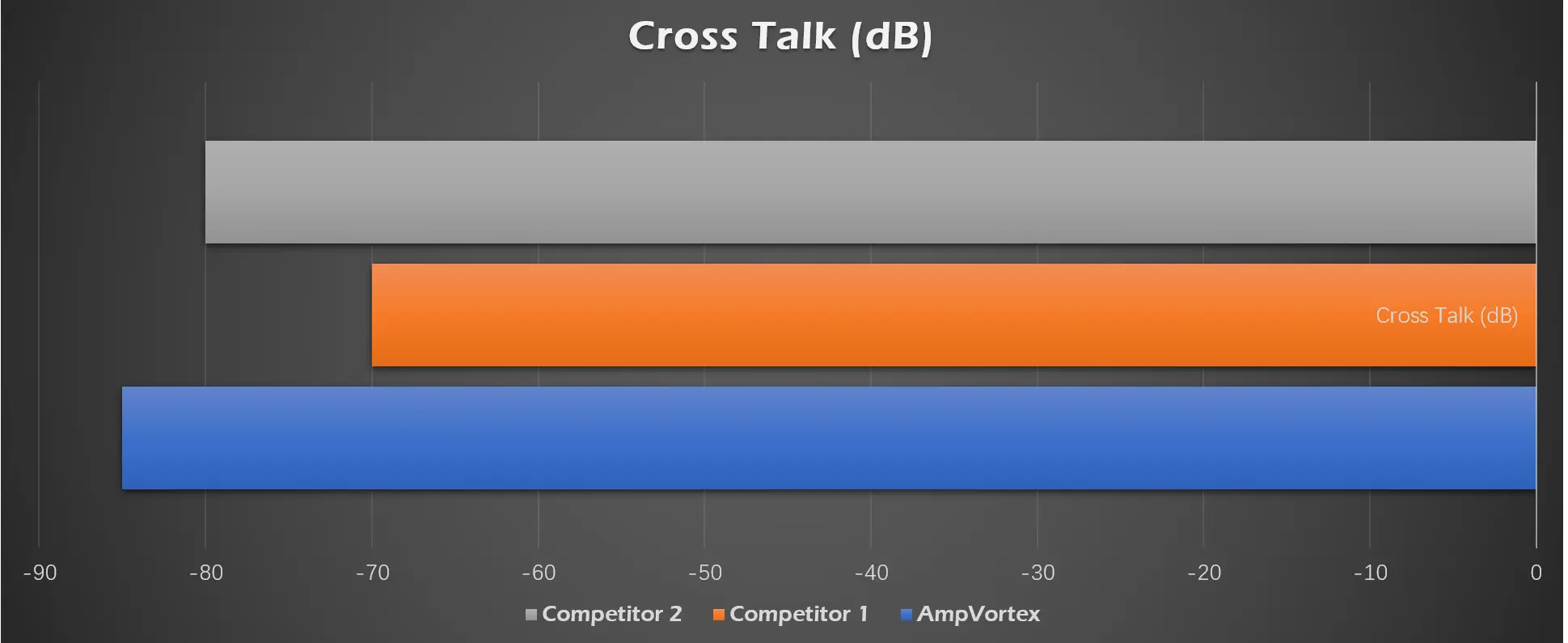
Crosstalk measures signal leakage between channels, affecting stereo separation and spatial imaging.
Formula:
XT=20 · log10(Vcrossed / Vsignal)
Where:
- = Signal measured on the adjacent channel
- = Original channel signal
Measurement Method:
- Input a test signal into the left channel only.
- Measure output on the right channel (crossed) and left channel (signal).
- Calculate in dB.
AmpVortex Advantage:
AmpVortex maintains exceptionally low crosstalk, preserving accurate stereo imaging and immersive sound.
5. Impedance & Sensitivity
Basic Principle:
- Impedance: Resistance presented to the amplifier by the speaker, affecting power delivery.
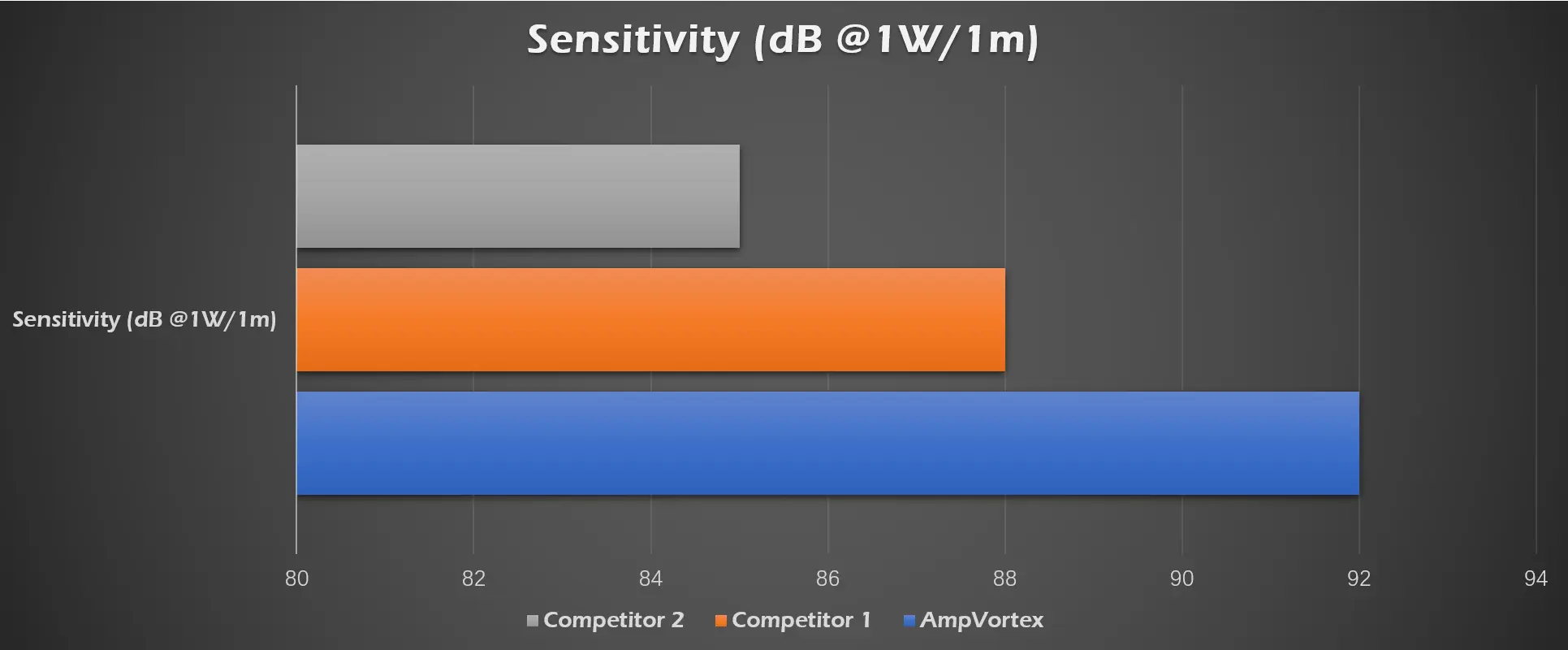
- Sensitivity: Sound output (dB) for a given input (1W at 1m).
Measurement Method:
- Impedance: Sweep frequency with a low-level AC signal, measure voltage/current ratio.
- Sensitivity: Input 1W signal, measure SPL at 1 meter distance.
AmpVortex Advantage:
AmpVortex amplifiers handle a wide range of speaker loads efficiently, delivering consistent output and damping, maximizing speaker performance.
6.Frequency Response
Basic Principle:
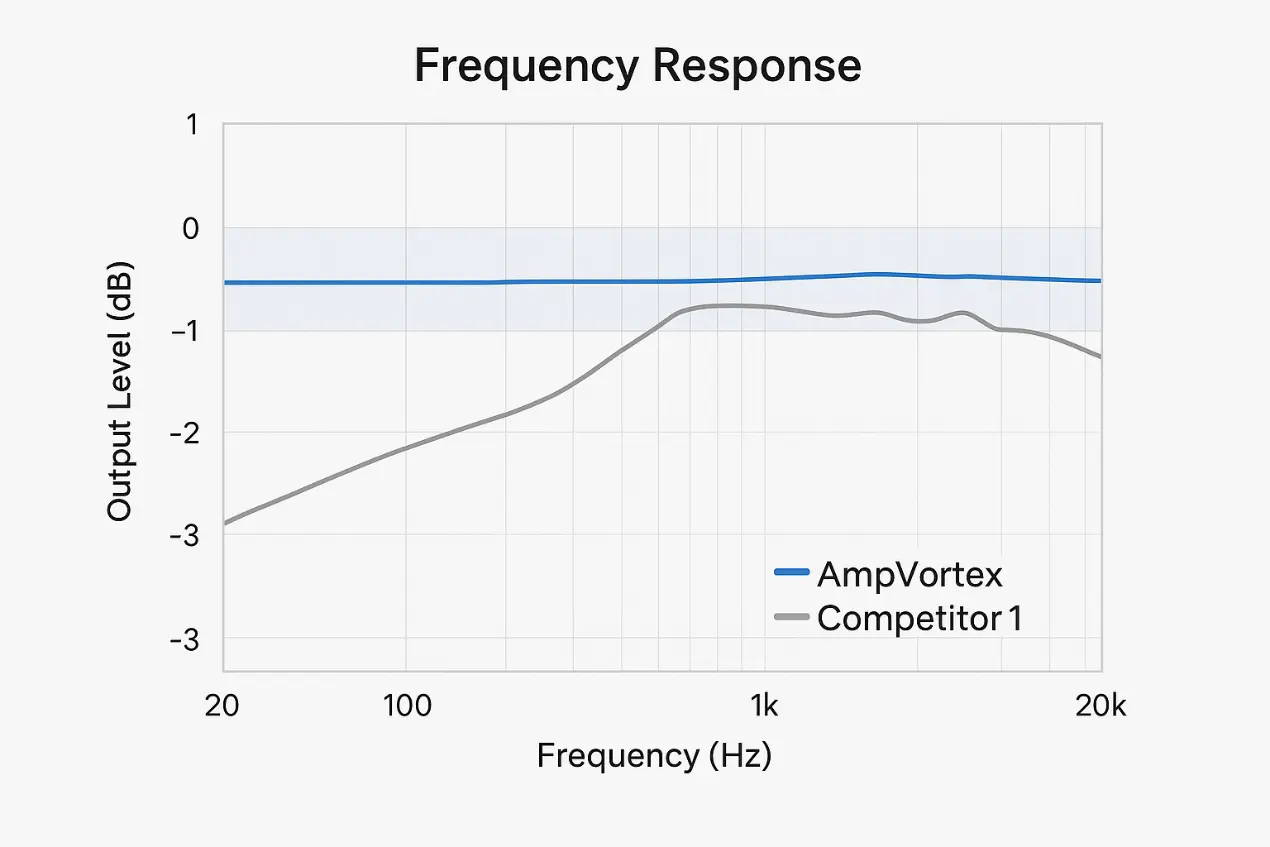
Frequency response measures how evenly a system reproduces all audible frequencies (20 Hz – 20 kHz).
Measurement Method:
- Play a swept sine wave or pink noise.
- Measure output amplitude at each frequency.
- Plot response curve in dB.
AmpVortex Advantage:
AmpVortex achieves flat and wide frequency response, ensuring accurate reproduction of bass, mids, and highs, delivering immersive and balanced sound.
By understanding the principles, formulas, and measurement methods behind each key metric, it becomes clear why AmpVortex systems outperform conventional devices. Every parameter — from dynamic range to crosstalk — is optimized to deliver true, high-fidelity, immersive sound in home theaters and multi-room setups.
| Metric | AmpVortex | Competitor 1 | Notes |
|---|---|---|---|
| Dynamic Range (dB) | 115 | 100 | AmpVortex delivers wider dynamic performance |
| SNR (dB) | 120 | 105 | Cleaner signal with lower background noise |
| THD+N (%) | 0.003 | 0.01 | Lower distortion, more transparent audio |
| Crosstalk (dB) | -85 | -70 | Better left-right channel separation |
| Impedance (Ω) | 4–16 Ω | 4–16 Ω | Supports common speaker loads; AmpVortex output more stable |
| Sensitivity (dB @1W/1m) | 92 | 88 | Higher SPL at the same input power |
| Frequency Response (Hz) | 20–20k, ±0.5dB | 20–20k, ±2dB | Flatter response for more accurate sound reproduction |