Speaker Cables Deep Dive

Speaker Cables Deep Dive

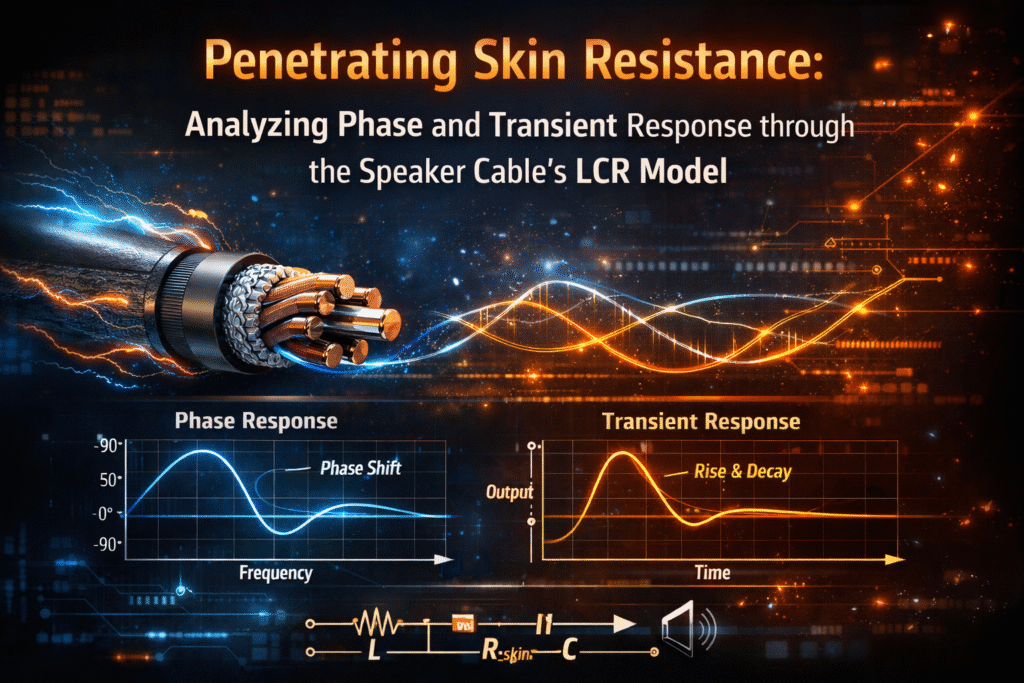
Penetrating Skin Resistance: Analyzing Phase and Transient Response through the Speaker Cable’s LCR Model

Keywords: Speaker Cable, LCR Model, Inductance, Capacitance, Skin Effect, Time Domain Distortion, OFC, Geometry, Hi-Fi Physics

For an amplifier system to achieve maximum resolution, the speaker cable is not merely a conductor; it is a complex electrical component characterized by Resistance (R), Capacitance (C), and Inductance (L). The cable’s geometry, materials, and length dictate its LCR parameters, which in turn govern the sound’s transient response and phase accuracy.

Ignoring a cable’s electrical properties allows for inevitable signal corruption before the sound reaches the driver.

1. The Cable’s Electrical Model: The Challenge of R, L, C

A cable’s performance can be modeled by a series of resistance (R) and inductance (L), and shunt capacitance (C). Excellent cable design aims to minimize R and L while optimizing C.

2. The High-Frequency Trap: The Skin Effect

    • Physical Principle:As signal frequency increases, electrons tend to flow along the surface of the conductor rather than through the center. This is known as the Skin Effect.
    • Consequence:It effectively reduces the available cross-sectional area of the conductor, increasing resistance only at high frequencies. This leads to attenuation and phase lag in treble signals.
    • Solution:Employing Litz Wire Litz wire uses multiple bundles of individually insulated fine strands to effectively maximize the surface area for high-frequency signals, countering the skin effect and ensuring high-frequency signal integrity.

3. Geometric Optimization for LCR Control

The geometry of the cable is key to controlling L and C parameters:

  • Twisted Pair Geometry:By tightly twisting the positive and negative conductors, the external magnetic fields generated by the currents effectively cancel each other out, thereby minimizing Inductance (L). This is crucial for reducing high-frequency losses.
  • Dielectric Materials:The insulation (dielectric) material significantly influences capacitance (C). Low-loss materials (like Teflon or advanced polyethylene) maintain better signal transmission compared to standard PVC.

4. Phase and Time Domain Distortion

The most subtle distortion in speaker cables lies in their differing transmission speeds for various frequencies, known as Time Domain Distortion.

  • L and C parameters cause a slight phase shiftbetween different frequency components. Although the delay may only be nanoseconds, in Hi-Fi playback, it slows the transient response and prevents the high and low frequencies from reaching the listener’s ear at precisely the same moment.
  • Audible Impact:The sound lacks focus, becomes smeared, and the imaging accuracy is reduced.

Conclusion: The Silent Guardian of System Performance

For systems like AmpVortex, designed for ultimate resolution, the cable must be viewed as an engineered component. Its design must strictly control the RLC parameters to guarantee time coherence and phase accuracy.

Investing in cables featuring Litz construction, high-purity OFC, and superior geometric design is key to ensuring your amplifier’s performance is translated into sound with the highest fidelity.

With AmpVortex, you choose top-tier electronic engineering; by choosing the right cable, you guarantee signal integrity.

For more information, please visit www.ampvortex.com

Leave a Comment

Your email address will not be published. Required fields are marked *