
 (317)516-7460
  service@ampvortex.com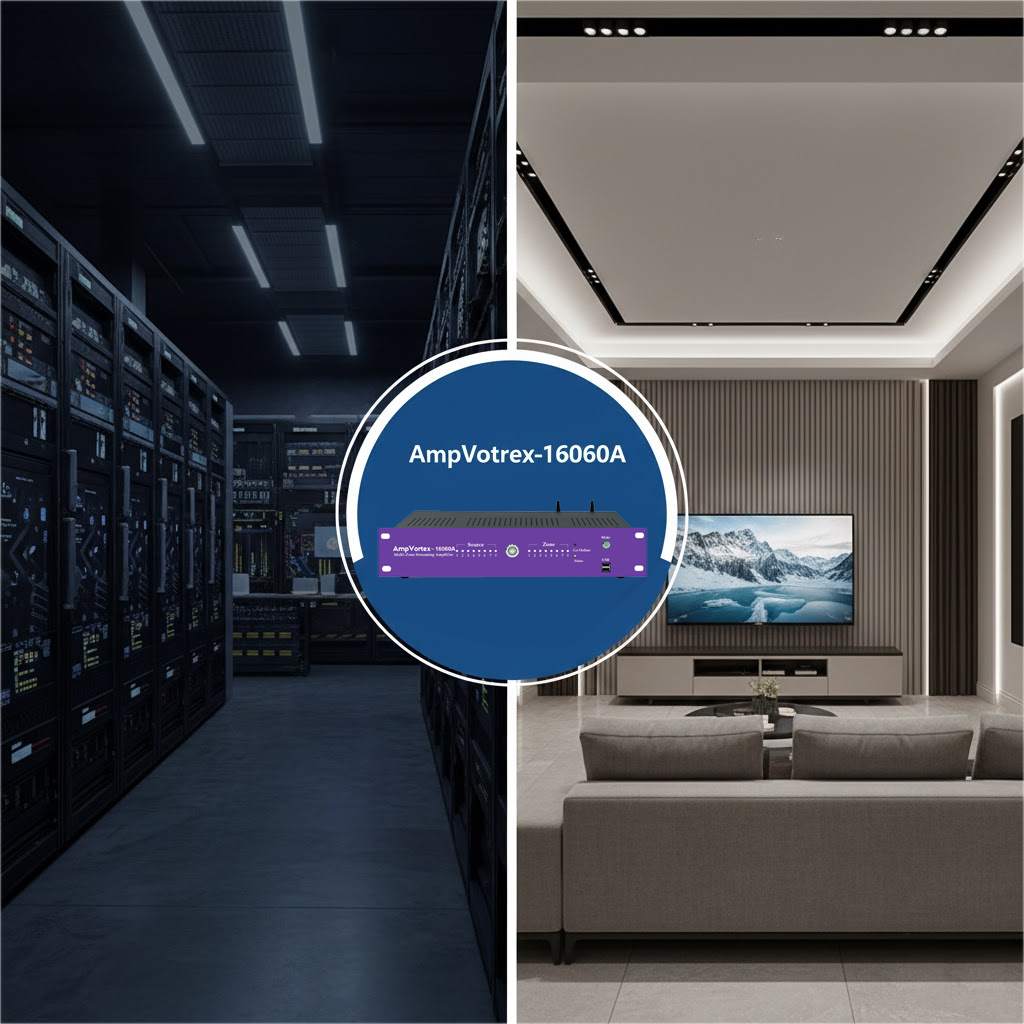
The Grand Stage vs. The Home Sanctuary: Decoding Digital Cinema vs. Home Theater
For centuries, the experience of watching a film has been intertwined with the dark, hushed reverence of a movie theater. Today, advancements in technology allow us to recreate breathtaking cinematic moments within our own homes. But what truly sets a professional digital cinema apart from a high-end home theater? And how does a powerhouse like the AmpVortex-16060A bridge this gap for the discerning home enthusiast?
While both aim for ultimate immersion, their underlying architectures, signal chains, and operational philosophies diverge significantly. Let’s explore these fascinating distinctions and surprising connections.
I. The Professional Digital Cinema: A Symphony of Specialized Systems
Stepping into a modern digital cinema (D-Cinema) auditorum is to enter a world of highly specialized, industrial-grade equipment. The design prioritizes uncompromised quality, robust reliability for continuous operation, and strict adherence to industry standards for distribution and playback.
1. Content Delivery & Playback: The Digital Cinema Package (DCP)
-
- DCP as the Standard:Unlike home media, professional films are distributed as a Digital Cinema Package (DCP). This is a collection of files (encrypted JPEG 2000 images for video, WAV files for audio, XML for metadata) that ensures consistent, high-quality playback across various cinemas.
- Specialized Servers:The heart of D-Cinema playback is a dedicated Digital Cinema Server (e.g., from Dolby, Barco, or GDC). This is not a consumer Blu-ray player; it’s a powerful, secure computer system specifically designed to decrypt, unpack, and play DCPs. These servers manage vast amounts of data, ensure perfect synchronization of video and audio, and often handle complex key management for encrypted content.
2. The Audio Chain: Precision & Protocol
- AoIP (Audio over IP) Dominance:In modern D-Cinema, the audio signal chain often moves beyond traditional analog or even AES/EBU digital connections. Technologies like AoIP (Audio over IP) protocols such as Dante and AES67 are increasingly prevalent. The digital cinema server sends multi-channel audio (often up to 16, 32, or even 64 channels for immersive formats like Dolby Atmos) over a standard Ethernet network.
- Benefits:AoIP provides superior signal integrity over long cable runs, reduces cable clutter, offers incredible flexibility for routing, and simplifies system expansion.
- Dedicated DACs:After the audio leaves the server via AoIP, it reaches dedicated, professional-grade Digital-to-Analog Converters (DACs). These DACs convert the pristine digital audio streams into high-quality analog signals. Each channel (or blocks of channels) might have its own dedicated DAC for optimal separation and clarity.
- Multi-Channel Analog Amplification:From the DACs, the individual analog audio channels are sent to a bank of powerful, typically mono or dual-channel analog power amplifiers. Each speaker (or often, groups of speakers) in the auditorium has its own dedicated amplifier, providing immense headroom, precise control, and robust power delivery to fill the massive space. This ensures dynamic range and impact are fully realized.
- Advanced Speaker Arrays:Cinema auditoriums feature complex speaker arrays, often including a screen channel LCR (Left, Center, Right) behind the acoustically transparent screen, numerous surround speakers, and dedicated overhead speakers for immersive formats. The sheer scale and number of speakers far exceed typical home setups.
II. The Home Theater: Convenience Meets Performance with AmpVortex-16060A
The home theater aims to replicate the cinematic experience within a residential setting, prioritizing convenience, user-friendliness, and a more integrated approach, while still striving for exceptional performance.
1. Content Delivery & Playback: Consumer-Friendly Formats
- Blu-ray/4K UHD Players & Streaming:At home, content typically comes from consumer devices like Blu-ray or 4K UHD players, or through streaming services integrated into smart TVs, media players (e.g., Apple TV, Roku), or directly into an AV receiver. These sources play back compressed or uncompressed audio/video formats suitable for home use.
2. The Audio Chain: HDMI Simplifies Complexity
- HDMI: The Unified Link:The single biggest differentiator in the home is HDMI (High-Definition Multimedia Interface). A Blu-ray player, for example, sends both high-definition video and multi-channel audio (like Dolby Atmos bitstream) via a single HDMI cable directly to the AV receiver.
- Passthrough & Decoding:The AV receiver (like our AmpVortex-16060A) is designed to receive and passthrough the video signal to the TV or projector, while simultaneously decoding the complex multi-channel audio format (e.g., Dolby Atmos) internally. This eliminates the need for separate digital cinema servers, AoIP protocols, or external multi-channel DACs. The AVR handles all the heavy lifting.
- Integrated Amplification:Following decoding, the AV receiver uses its integrated multi-channel power amplifiers to drive the home’s speaker system directly. While home speakers are typically passive (requiring external amplification), the AVR houses all necessary amplification within one chassis, significantly simplifying setup and wiring compared to a professional cinema.
- Speaker Layouts:Home theaters typically feature 5.1, 7.1, or more advanced layouts like 5.1.2, 7.1.4 (e.g., 5.1 channels plus 2 or 4 overhead speakers for Dolby Atmos), which are far less extensive than a commercial cinema but still provide a highly immersive experience.
AmpVortex-16060A: Bridging the Divide for Home Enthusiasts
This is precisely where the AmpVortex-16060A shines. As an integrated multi-room streaming amplifier and AVR hybrid, it brings professional-grade fidelity and immersive capabilities into the home environment with unparalleled convenience:
- Seamless Dolby Atmos Decoding:The 16060A directly decodes the original Dolby Atmos bitstream received via HDMI. This ensures you’re experiencing the film’s soundtrack as the director intended, with precise object-based audio rendering that creates a truly three-dimensional sound field in your living room. No need for complex external DACs or servers – the 16060A handles it all.
- Integrated Power & Precision:Unlike the sprawling component rack of a cinema, the 16060A combines robust multi-channel amplification, advanced DSP, and high-quality DACs within a single, elegant chassis. It delivers the power and clarity needed to drive your home theater speakers for breathtaking dynamics and subtle details.
- Streamlined Connectivity:HDMI inputs for all your sources, plus multi-room streaming capabilities for music, make the 16060A the ultimate hub for all your entertainment needs. It embodies the modern home’s desire for high performance without high complexity.
- Artistic Vision, Simplified:While you won’t need a digital cinema server or AoIP, the 16060A ensures that the artistic intention behind the film’s sound design is faithfully reproduced, offering an immersive experience that rivals – and often surpasses – what many people perceive as “cinema quality” in their local multiplex.
III. Shared Principles: The Enduring Pursuit of Immersion
Despite their architectural differences, digital cinemas and home theaters share a fundamental goal: to transport the audience into the film’s world.
- Immersive Soundscapes:Both strive to create a cohesive, believable sound field that enhances the visual narrative, with Dolby Atmos being a prime example of this shared pursuit across scales.
- Dynamic Range & Clarity:The ability to reproduce the quietest whispers and the loudest explosions without distortion, maintaining pristine dialogue, is paramount in both settings.
- Emotional Resonance:Ultimately, both systems aim to evoke emotion, whether through a soaring musical score or a sudden, impactful sound effect.
Conclusion: Your Stage, Your Experience
The professional digital cinema is a marvel of specialized engineering, built for scale and unyielding performance. The home theater, exemplified by devices like the AmpVortex-16060A, represents the democratization of that high-fidelity, immersive experience. It takes the complex technologies required for captivating film sound and packages them into a user-friendly, high-performance solution that makes cinematic magic accessible in your own living room.
You may not need a Dolby digital cinema server or Dante/AES67 in your home, but with the AmpVortex-16060A, you gain the power to decode and amplify the artistic brilliance of film sound, transforming your home into a personal grand stage.
**Ready to build your ultimate home cinema? Explore the AmpVortex-16060A and more at www.ampvortex.com today.**