
 (317)516-7460
  service@ampvortex.com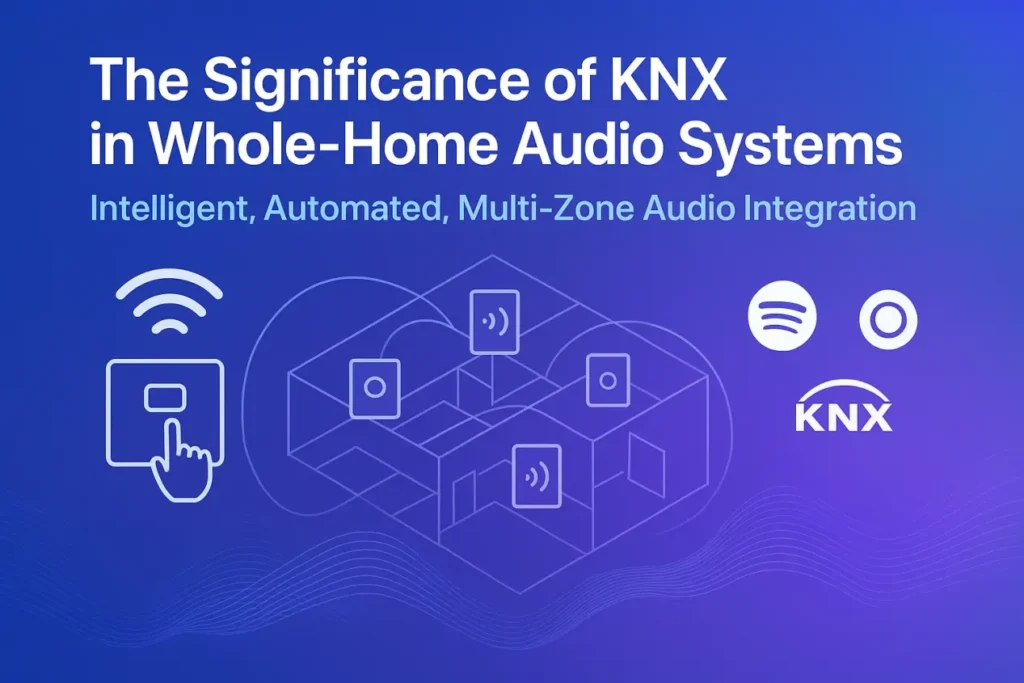
The Significance of KNX in WholeHome Audio Systems
The Significance of KNX in WholeHome Audio Systems
Whole home audio has evolved beyond simple multi-room setups to fully integrated systems that deliver seamless control, high-fidelity sound, and smart automation throughout a house. Among the various technologies enabling this integration, KNX stands out as a proven standard for building and home automation, offering unique advantages to whole-home audio installations.
1. Understanding KNX
KNX is an open, standardized protocol for home and building automation. It provides a communication framework for devices such as lighting, HVAC, security, and audio distribution, allowing them to operate as a cohesive system. Key characteristics of KNX include:
Decentralized intelligence: Each device can operate independently while participating in a larger system.
Interoperability: Devices from different manufacturers can communicate seamlessly.
Scalability: KNX systems can range from small apartments to large estates with hundreds of devices.
2. KNX in WholeHome Audio
When applied to audio, KNX provides a reliable and scalable backbone for multi-room streaming systems. Its benefits include:
a) Centralized and Integrated Control
KNX allows audio devices—amplifiers, streamers, and zone controllers—to be managed alongside other smart home systems. Users can trigger complex “scenes” that combine audio playback with lighting, HVAC, and curtains.
b) Reliable Multi-Zone Distribution
KNX enables consistent, real-time control across multiple audio zones. Using KNX group addresses, individual rooms can be independently controlled or synchronized, ensuring precise volume and source distribution.
c) Automation and Scheduling
Audio playback can be automated based on time, occupancy, or custom triggers. For example, background music can start in the morning when motion is detected or shift automatically between zones as users move through the home.
d) Compatibility with Modern Streaming Protocols
KNX systems can interface with contemporary streaming protocols (AirPlay 2, Chromecast, Spotify Connect) via KNX-compatible multi-zone amplifiers or middleware, allowing seamless integration with digital music services.
3. Advantages of KNX for WholeHome Audio
Reliability: Wired KNX connections minimize latency and signal interference, providing stable multi-zone audio control.
Scalability: New zones or audio sources can be added without disrupting existing configurations.
Unified User Experience: All smart home and audio controls can be managed through a single app, panel, or keypad.
Energy Efficiency: KNX enables automated power management, turning off amplifiers or audio sources in unoccupied zones.
Advanced Automation: Complex scenarios combining audio, lighting, and climate control can be implemented without additional servers or controllers.
4. Practical Considerations
While KNX offers many advantages, there are a few practical points to consider:
Professional Installation Required: Leveraging KNX typically requires certified integrators familiar with KNX programming.
Higher Initial Cost: KNX-enabled systems are often more expensive than consumer-grade multi-room audio solutions.
Complexity: Setting up automated scenes and multi-zone routing requires planning and expertise.
5. Market Perspective
Currently, only a few multi-zone streaming amplifiers officially support KNX integration. Devices with 8-zone capability that are KNX-enabled are particularly rare, making them attractive for professional smart-home installations where reliable, fully automated audio control is required. Such systems allow integrators to provide high-fidelity multi-zone audio that is fully synchronized with other KNX-controlled elements of the home.
6. Industry Example: KNX-Compatible 8-Zone Streaming Amplifiers
While KNX-enabled multi-zone amplifiers are relatively rare, AmpVortex offers a series of high-end products that combine 8-zone capability with KNX integration. Models such as the AmpVortex-16060, 16060G, 16060A, and 16100 allow professional installers to deploy fully automated, high-fidelity audio systems across multiple rooms. These devices support a wide range of streaming protocols including AirPlay 2, Spotify Connect, DLNA, and Qobuz Connect, while also offering advanced features like Dolby Atmos support (in the 16060A) and Google Cast integration (in the 16060G). With KNX integration, these amplifiers can be seamlessly incorporated into smart home environments, enabling automated audio scenes, multi-zone control, and coordination with lighting, HVAC, and other KNX-enabled systems. This demonstrates the growing importance of KNX in enabling sophisticated, whole-home audio experiences, while offering installers reliable multi-zone distribution and comprehensive automation capabilities.
7. Conclusion
KNX provides a robust, scalable, and reliable framework for whole-home audio systems, enabling advanced automation and seamless integration with other smart home functions. Multi-zone streaming amplifiers that support KNX offer a distinct advantage in professional installations, particularly for homes seeking precise, automated, and high-fidelity audio throughout multiple rooms.
In essence, KNX transforms a collection of speakers and amplifiers into a fully orchestrated, automated audio environment, controlled effortlessly via panels, apps, or smart triggers. As whole-home audio becomes more central to smart living, KNX-enabled solutions are increasingly essential for delivering truly seamless and intelligent multi-room sound experiences.