
 (317)516-7460
  service@ampvortex.com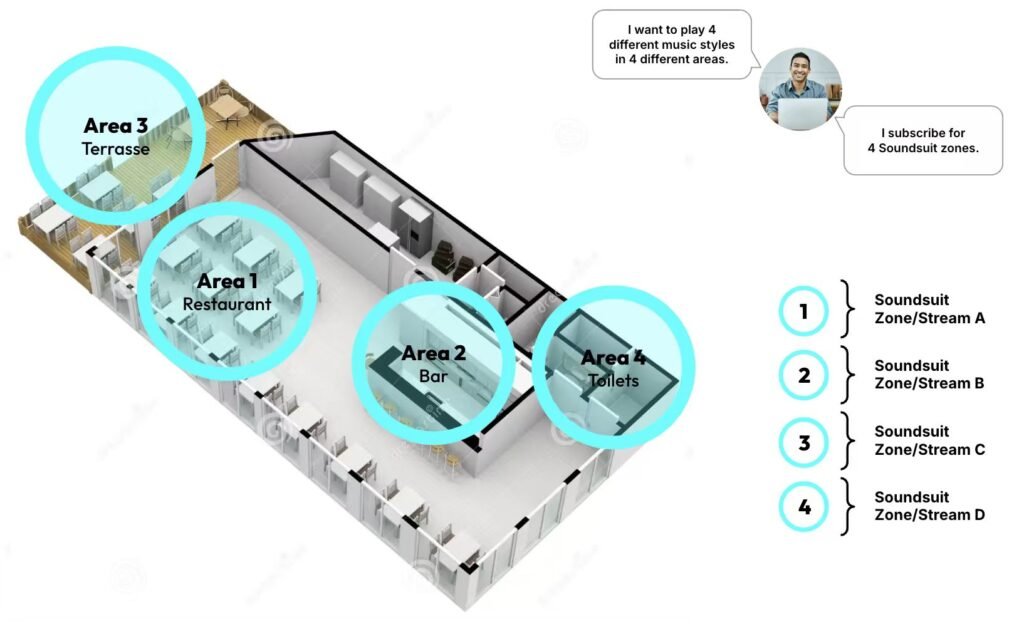
Why 99% of B2B Music Systems Fail in Multi-Zone Environments
The Industry Is Solving the Wrong Problem
Most B2B music platforms focus on:
- Music licensing
- Playlist curation
- App interfaces
But in real commercial environments, music content is not the bottleneck.
👉 The real challenge is how audio is distributed across space.
And this is exactly where most systems fail.
What “Multi-Zone” Really Means (And Why It’s Hard)
Multi-zone is not just:
“playing different music in different rooms”
It actually requires:
- Independent streams per zone
- Precise synchronization when needed
- Flexible routing across spaces
- Centralized control across all zones
👉 In other words:
It’s a distributed audio system problem — not a playlist problem
Failure #1: Single-Zone Hardware Architecture
Most systems are built on:
- One player
- One amplifier
- One audio output
Even when they claim “multi-zone,” they rely on:
❌ Multiple separate devices
❌ No real synchronization
❌ Fragmented control
Result:
- Same music everywhere
- Or completely unmanaged chaos
Failure #2: Software-First Thinking
Many platforms assume:
“We can solve everything in the cloud”
So they focus on:
- APIs
- dashboards
- playlist management
But ignore:
👉 Physical audio delivery constraints
Reality:
- Audio latency varies across devices
- Network jitter breaks synchronization
- Consumer-grade players are not designed for precision
👉 Software alone cannot fix hardware limitations
Failure #3: HDMI / eARC Dead-End
Some systems try to rely on:
- HDMI audio routing
- eARC passthrough
While this works for single-room home setups, it breaks down in commercial use:
❌ No scalability beyond one chain
❌ No flexible routing
❌ No multi-location capability
👉 eARC is a transport layer, not a distribution system
Failure #4: No True Synchronization Model
Multi-zone systems fail when:
- Zones drift out of sync
- Delays vary between outputs
- Audio becomes distracting instead of immersive
This happens because:
- No shared clock
- No centralized timing control
- No hardware-level coordination
👉 Sync is not a “feature” — it’s a system-level requirement
Failure #5: Not Built for Real Venues
Real-world environments are messy:
- Restaurants: bar + dining + terrace
- Hotels: lobby + rooms + gym
- Retail: multiple floors + zones
Most systems:
❌ Cannot scale cleanly
❌ Require manual configuration
❌ Break under complexity
The Core Truth: This Is an Infrastructure Problem
The industry treats background music as:
“a streaming service problem”
But in reality, it is:
👉 an audio infrastructure problem
Just like:
- Networking requires routers
- Video requires distribution systems
👉 Audio requires multi-room architecture
What Actually Works: Hardware + System Design
To truly support multi-zone environments, you need:
✅ Native Multi-Zone Processing
Not multiple devices — but one system designed for many zones
✅ Hardware-Level Synchronization
Shared timing across all outputs
✅ Flexible Audio Routing
Any source → any zone
✅ Scalable Architecture
From one venue to hundreds of locations
How AmpVortex Solves This
AmpVortex is built from the ground up as:
👉 a multi-room audio infrastructure layer
Not just a player. Not just a streaming endpoint.
🔹 True Multi-Zone Amplification
Up to multiple independent audio streams in one system
🔹 Built-in Synchronization
Hardware-level sync across all zones
🔹 IP-Based Audio Distribution
Designed for scalability beyond physical constraints
🔹 Integration-Ready
Works with modern B2B music platforms and APIs
The Future of B2B Music
The next generation of commercial audio will not be defined by:
- Bigger music catalogs
- Better playlists
It will be defined by:
👉 how well systems handle complexity
Final Thought
If your system fails when you add more zones,
it was never a multi-zone system to begin with.