(317)516-7460
  service@ampvortex.com
Exploring the World of Equalizers: From Basic to Advanced, and the AmpVortex Advantage
Exploring the World of Equalizers: From Basic to Advanced, and the AmpVortex Advantage
Introduction
Equalizers (EQs) are essential tools in the realm of audio, allowing users to fine-tune and optimize sound quality to meet specific preferences and requirements. Whether you’re a music producer, a sound engineer, or an audiophile looking to enhance your listening experience, understanding the different types of EQs is crucial. This article will delve into various EQ types, from basic to advanced, and highlight the unique capabilities of AmpVortex amplifiers, which feature a 31-band EQ derived from digital cinema sound tuning technology.
What is an Equalizer?
An equalizer is a device or software tool that allows you to adjust the balance of different frequency components in an audio signal. By boosting or cutting specific frequencies, you can enhance or correct the sound to achieve the desired tonal balance. EQs are used in various applications, from music production and live sound reinforcement to home audio systems and personal listening devices.
Types of Equalizers
1. Graphic Equalizers
Graphic equalizers are characterized by their sliders or knobs, each representing a specific frequency band. The number of bands determines the level of control and precision you have over the audio signal. Common types include:
- 10-Band Equalizer: This basic type offers 10 frequency bands, providing a good balance between simplicity and control. Each band typically covers a range of frequencies, allowing you to make broad tonal changes. It is suitable for general audio adjustments and is commonly found in consumer audio devices.
- 20-Band Equalizer: With twice the number of bands, a 20-band EQ offers more precise control over the audio spectrum. This type is often used in professional settings where detailed adjustments are necessary, such as in music production and live sound mixing.
- 31-Band Equalizer: This high-resolution graphic EQ provides the most detailed control over the audio signal, allowing for very precise adjustments. It is commonly used in professional audio applications, such as recording studios and live sound reinforcement systems, where fine-tuning is critical.
2. Parametric Equalizers
Parametric equalizers offer even more flexibility than graphic EQs. Instead of fixed frequency bands, parametric EQs allow you to adjust the center frequency, bandwidth (Q factor), and gain of each band. This level of control makes parametric EQs highly versatile and suitable for a wide range of applications:
- 3-Band Parametric EQ: This type provides three adjustable bands, each with controls for center frequency, bandwidth, and gain. It is suitable for general audio adjustments and can be found in many consumer audio devices.
- 5-Band Parametric EQ: With five adjustable bands, this type offers more detailed control and is commonly used in professional audio applications. It allows for precise adjustments to specific frequency ranges, making it ideal for music production and sound reinforcement.
- Multi-Band Parametric EQ: This type can have more than five bands, providing even greater control over the audio spectrum. It is used in high-end audio systems and professional studios where fine-tuning is essential.
3. Digital Equalizers
Digital equalizers use digital signal processing (DSP) to adjust the audio signal. They offer a high level of precision and flexibility, often including features like real-time analysis and automated adjustments. Digital EQs can be found in various forms:
- Software-Based EQs: These are digital EQs integrated into audio software, such as digital audio workstations (DAWs) used in music production. They offer a wide range of features and can be highly customizable.
- Hardware-Based Digital EQs: These are standalone devices that use digital processing to adjust the audio signal. They are often used in professional audio setups, such as live sound systems and recording studios, where high precision and reliability are required.
4. Shelving Equalizers
Shelving EQs are designed to adjust the level of frequencies above or below a specific cutoff point. They are useful for making broad tonal changes to the audio signal:
- Low-Shelf EQ: This type boosts or cuts frequencies below a specified cutoff point. It is useful for adjusting the bass response of an audio system.
- High-Shelf EQ: This type boosts or cuts frequencies above a specified cutoff point. It is useful for adjusting the treble response of an audio system.
AmpVortex: The 31-Band EQ Advantage
AmpVortex amplifiers stand out in the audio market with their advanced 31-band EQ, derived from digital cinema sound tuning technology. This high-resolution EQ provides unparalleled control over the audio spectrum, allowing users to fine-tune their listening experience to perfection. The 31-band EQ in AmpVortex amplifiers offers several key benefits:
- Precision Tuning: With 31 adjustable bands, users can make very precise adjustments to the audio signal, ensuring that every frequency is optimized for the best possible sound quality.
- Digital Cinema Sound Tuning: The EQ technology used in AmpVortex amplifiers is derived from digital cinema sound tuning, which is designed to deliver high-fidelity audio in professional settings. This ensures that the audio reproduction is both accurate and immersive.
- User-Friendly Interface: Despite its advanced capabilities, the 31-band EQ in AmpVortex amplifiers is user-friendly, making it accessible to both professionals and audiophiles. The intuitive interface allows users to easily adjust the EQ settings to suit their preferences and listening environments.
Choosing the Right Equalizer
The choice of equalizer depends on your specific needs and the application. Here are some considerations:
- Precision: If you need detailed control over specific frequencies, a parametric or high-band graphic EQ is recommended.
- Simplicity: For general audio adjustments, a 10-band or 20-band graphic EQ may be sufficient.
- Application: Consider the specific requirements of your application. For example, a 31-band EQ is ideal for professional audio applications, while a 10-band EQ may be more suitable for home audio systems.
- Digital vs. Analog: Digital EQs offer more flexibility and precision but may require a learning curve. Analog EQs provide a more tactile experience and can be easier to use for some users.
Conclusion
Understanding the different types of equalizers and their applications is essential for anyone looking to optimize their audio experience. From basic 10-band graphic EQs to high-resolution 31-band parametric EQs, each type offers unique benefits and levels of control. AmpVortex amplifiers, with their advanced 31-band EQ derived from digital cinema sound tuning technology, provide the ultimate in precision and sound quality. Whether you are a music producer, a sound engineer, or an audiophile, choosing the right EQ can make a significant difference in the quality and enjoyment of your audio.
Want to learn more about audio and multi-room streaming? Visit our website: https://www.ampvortex.com/
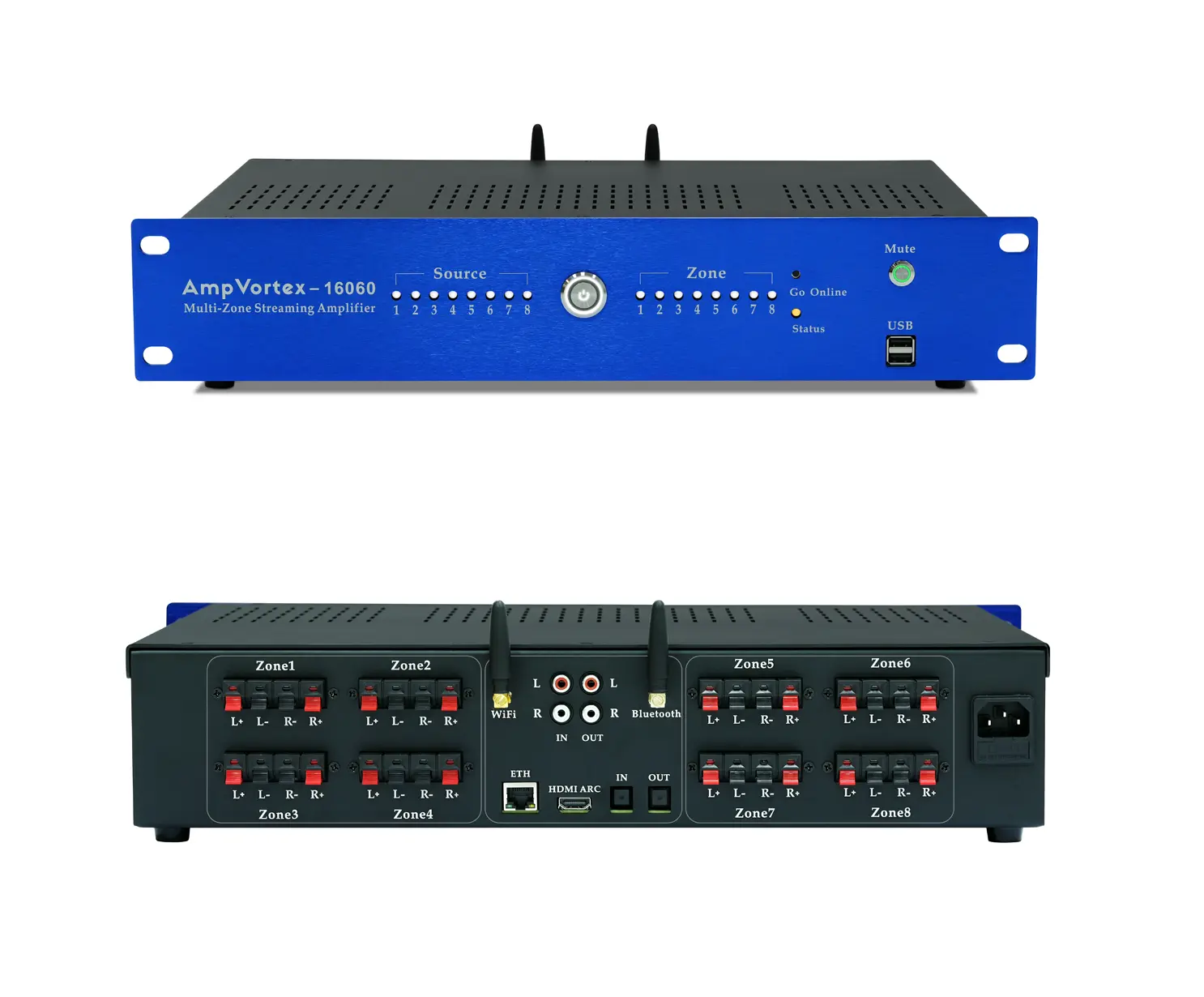
Explore our AmpVortex product lineup, including 16060, 16060G, 16060A, and 16100, and discover how our high-performance amplifiers bring HiFi music to every room.