In-Depth Analysis of Smart Home Platforms: Why Is Home Assistant So Unique?

In-Depth Analysis of Smart Home Platforms: Why Is Home Assistant So Unique?

As smart devices continue to grow explosively, an increasing number of platforms attempt to become the “digital brain” of modern homes. From user-friendly commercial apps to complex open-source ecosystems, each platform reflects a different philosophy about automation, privacy, and system control.

This article provides a deep, structured analysis of platforms similar to Home Assistant—examining their architectures, categories, strengths, and limitations. It also explains why Home Assistant (HA) stands out as the preferred choice for advanced users, integrators, and high-performance audio manufacturers such as AmpVortex.

I. The Three Core Architectures of Smart Home Platforms

Smart home platforms can be divided into three major architectural types based on how they handle data flow and control responsibility.

1. Cloud-Centric Architecture

The most common architecture, used extensively by large technology companies.

Representative Platforms

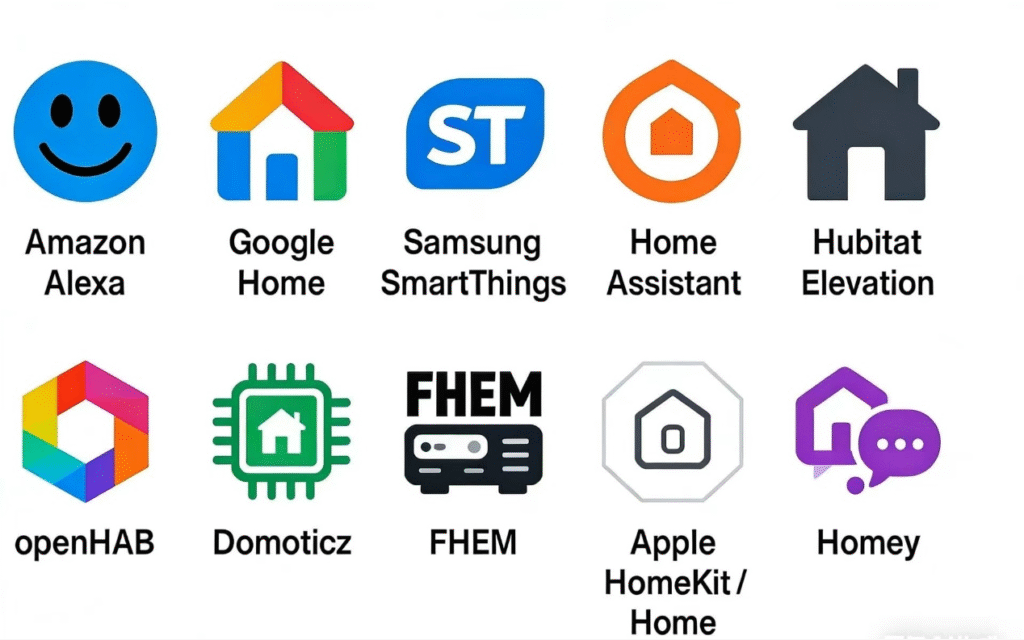
  • Amazon Alexa
  • Google Home
  • Samsung SmartThings (legacy model)

How It Works

Devices communicate with the manufacturer’s cloud, which then communicates with the platform’s cloud (e.g., Alexa/Google). Every command—whether from an app or voice assistant—passes through the cloud before reaching the device.

Advantages

  • Extremely easy to set up
  • Excellent voice control support
  • Convenient remote access

Drawbacks

  • Internet dependency (offline = non-functional)
  • Higher latency
  • Significant privacy concerns
  • Devices may stop working if vendors shut down cloud services

2. Local-First / Hybrid Architecture

Platforms that prioritize local processing, ensuring speed, privacy, and reliability.

Representative Platforms

  • Home Assistant
  • Hubitat Elevation
  • openHAB
  • Domoticz
  • FHEM
  • Samsung SmartThings (new architecture)

How It Works

The platform communicates with devices using local protocols such as Zigbee, Z-Wave, MQTT, or local APIs. Automations run even without an internet connection. Cloud is optional.

Advantages

  • Ultra-low latency
  • Maximum privacy
  • Highly reliable offline operation
  • Long-term compatibility

Drawbacks

  • Higher setup complexity
  • Requires technical knowledge
  • Remote access needs extra configuration (unless using Nabu Casa)

3. Closed Ecosystem Architecture

These platforms emphasize curated user experience, strict device certification, and strong security.

Representative Platform

  • Apple HomeKit / Apple Home

Characteristics

  • Local encrypted communication
  • Extremely strong security and privacy guarantees
  • Unified design and user experience

Drawbacks

  • Highly restricted ecosystem
  • Fewer compatible devices
  • Higher hardware costs

II. Additional Classification: Platforms Functionally Similar to Home Assistant

Beyond architecture, Home Assistant competitors can also be categorized based on philosophy, design, and target audience.

1. Open-Source, Self-Hosted Competitors

These platforms most closely mirror Home Assistant’s core ideals—open-source, local-first control, and deep customization.

These attract enthusiasts who prioritize maximum control, privacy, and open governance.

2. Commercial / Semi-Commercial Hub-Based Solutions

Built around dedicated hardware hubs, featuring simplified UX but reduced flexibility.

These platforms prioritize simplicity over deep customization.

3. Big Tech Ecosystems

Designed for mass-market adoption, voice-first interaction, and cloud convenience.

These ecosystems dominate consumer markets but may lack true local automation.

III. Why Home Assistant Holds a Unique and Dominant Position

Home Assistant succeeds because it combines the best elements from multiple worlds.

1. Fully Vendor-Agnostic

HA integrates more than 2,500+ official platforms, covering nearly all IoT standards, protocols, APIs, and DIY hardware.
It can even act as a bridge, translating:

  • Non-HomeKit devices → HomeKit
  • Cloud-only devices → Local automation
  • Multiple ecosystems → One unified interface

2. Local-First Design

  • Nearly all automations run offline
  • No mandatory cloud dependencies
  • True real-time control with minimal latency

This is especially important for applications requiring audio synchronization, home theater automation, and high reliability.

3. Fully Open Source

Anyone—including manufacturers—can build an official or custom integration.
There are no commercial barriers, unlike most big-tech ecosystems.

4. Ready for the Future: Matter & Multi-Ecosystem Bridging

Matter promises a unified standard for smart home communication.
Home Assistant is one of the most flexible Matter controllers while still supporting:

  • Zigbee
  • Z-Wave
  • Legacy Wi-Fi devices
  • Proprietary LAN APIs
  • DIY hardware

HA is becoming the central hub that unites old and new generations of devices.

IV. What This Means for Device Manufacturers (Including AmpVortex)

For high-performance audio brands, the choice of smart home platform dramatically affects user experience.

Cloud Platforms

Best for mass-market adoption and frictionless voice control.

Closed Ecosystems (Apple)

Perfect for high-end users who demand security and a polished UX.

Home Assistant

Ideal for advanced users, integrators, and audio enthusiasts who require:

  • Low latency
  • Local synchronization
  • Complex automation
  • Vendor-neutral control
  • Long-term reliability

This makes HA an excellent integration target for professional audio systems like AmpVortex.

V. AmpVortex — Official Website & Product Lineup

Official Website:
🔗 https://www.ampvortex.com

AmpVortex specializes in high-performance multi-room streaming amplifiers designed for whole-home installations, synchronized playback, and seamless integration with smart home platforms, including Home Assistant.

📦 Core Product Models

These models support local protocols and network automation, making them ideal for Home Assistant, Matter environments (via bridge), and professional AV installations requiring stable, low-latency audio distribution.

AmpVortex-16060: https://www.ampvortex.com/product/ampvortex-16060/

AmpVortex-16060A: https://www.ampvortex.com/product/ampvortex-16060a/

AmpVortex-16060G: https://www.ampvortex.com/product/ampvortex-16060g/

AmpVortex-16100: https://www.ampvortex.com/product/ampvortex-16100/

VI. Conclusion: Choosing the Right Smart Home Platform

Your platform choice should reflect the customer experience you want to deliver:

  • Cloud-first platforms→ simplicity, convenience, mass-market reach
  • Closed ecosystems→ premium experience, strict certification, high-end audience
  • Home Assistant→ unmatched flexibility, privacy, and professional-level automation

For audio-focused brands like AmpVortex, Home Assistant represents a powerful opportunity to deliver high reliability, synchronized multi-room playback, and advanced automation to demanding users.

Leave a Comment

Your email address will not be published. Required fields are marked *