(317)516-7460
  service@ampvortex.com
AmpVortex Releases the 2025 Automotive Immersive Audio Industry Report
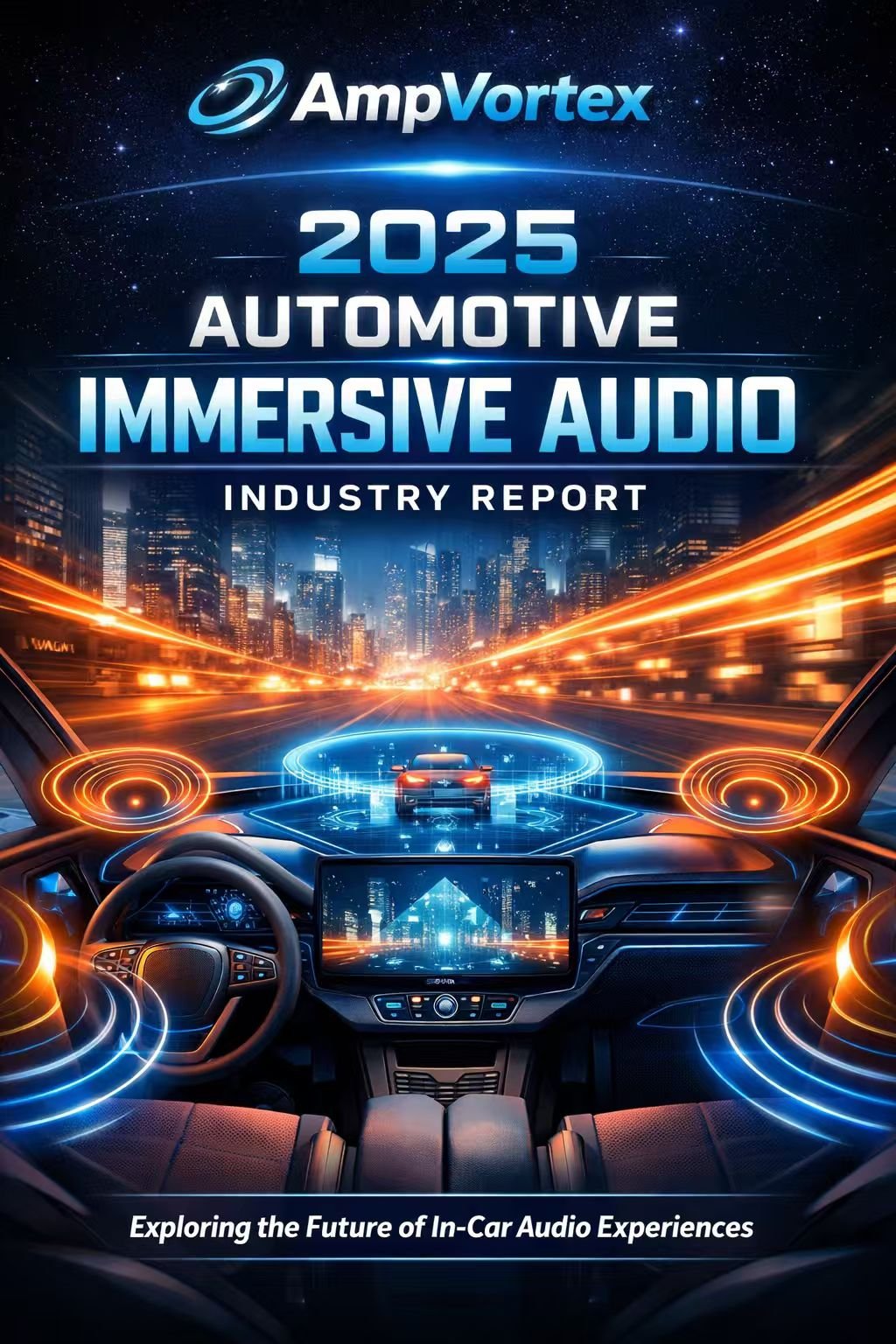
AmpVortex today announced the release of its 2025 Automotive Immersive Audio Industry Report, an in-depth analysis of how immersive audio is rapidly becoming a defining element of next-generation in-vehicle experiences.
As vehicles evolve into software-defined, experience-centric platforms, audio is no longer treated as a secondary infotainment feature. Instead, it is emerging as a core interface—shaping how drivers and passengers perceive space, receive information, and interact with increasingly intelligent vehicles.
From In-Car Entertainment to In-Cabin Experience
The report identifies a clear shift across the global automotive industry: from traditional in-car entertainment systems toward holistic in-cabin audio experiences. Driven by electrification, autonomous driving technologies, and high-speed connectivity, vehicles are becoming environments where audio must perform multiple roles simultaneously—entertainment, communication, navigation, and safety.
The study highlights how immersive audio architectures are uniquely suited to vehicle cabins, where controlled acoustics, proximity to listeners, and fixed seating positions enable precise spatial rendering that is often difficult to achieve in residential environments.
Key Findings of the Report
The 2025 Automotive Immersive Audio IndustryReport outlines several critical trends shaping the market:
- High-channel and object-based audio architectures are gaining traction as OEMs seek more realistic and engaging sound fields within compact cabin spaces.
- AI-driven audio processing is becoming central to system design, enabling real-time cabin tuning, noise adaptation, and personalized sound zones for each occupant.
- Personalized and zoned audio—including headrest speakers and seat-based localization—are redefining how content is delivered to drivers and passengers.
- Software-defined audio platforms are allowing immersive audio features to evolve over a vehicle’s lifecycle through OTA updates rather than fixed hardware limitations.
- Autonomous and assisted driving scenarios are accelerating demand for immersive audio as a primary user interface, especially when visual attention is reduced.
Rather than focusing on branded audio formats or marketing labels, the report emphasizes system architecture, processing capability, and real-world deployment constraints.
Implications for OEMs and Technology Providers
The report concludes that immersive audio is transitioning from a premium differentiator to a strategic capability that impacts brand perception, safety design, and long-term platform scalability.
For OEMs, decisions made today around audio architecture—centralized versus distributed processing, software abstraction, and AI integration—will shape not only sound quality, but also future flexibility and cost efficiency.
For suppliers and technology partners, the report highlights a growing need to move beyond component-level offerings toward system-level collaboration, combining hardware, software, and AI expertise.
AmpVortex’s Perspective
Drawing on its experience in distributed audio systems and system-level audio architecture, AmpVortex approaches automotive immersive audio not as an isolated feature, but as part of a broader, scalable platform strategy.
The report reflects AmpVortex’s long-standing view that the future of audio—whether in homes or vehicles—will be defined by architecture, integration, and intelligence, rather than by standalone devices or format logos.
Looking Ahead
As the automotive industry continues its transition toward software-defined vehicles and autonomous mobility, the insights in the 2025 Automotive Immersive Audio Industry Report provide a framework for understanding how audio will evolve into a foundational layer of in-cabin experience design.
The full report is now available from AmpVortex and is intended for automotive OEMs, Tier-1 suppliers, system architects, and industry analysts seeking a deeper understanding of immersive audio’s role in next-generation vehicles.