(317)516-7460
  service@ampvortex.com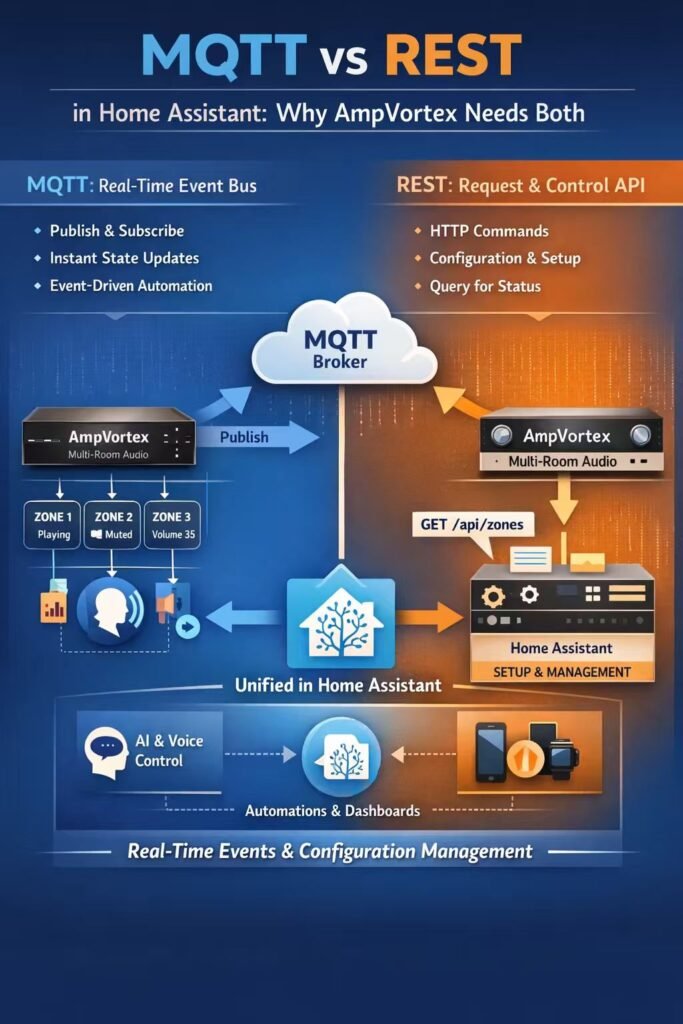
MQTT vs REST
Their Fundamental Differences in Home Assistant — and Why AmpVortex Needs Both
In modern smart home systems, MQTT and REST are often mentioned together, yet they serve fundamentally different roles.
Nowhere is this difference more visible than in Home Assistant, an automation platform built around events, state changes, and real-time reactions.
This article explores MQTT and REST from a system-architecture perspective, explains how they behave differently inside Home Assistant, and uses AmpVortex — a Whole Home Audio and Multi-room Streaming Amplifier — as a practical example of why both protocols are essential.
-
MQTT vs REST: This Is Not a Protocol Battle
REST: The World of Explicit Requests
REST APIs follow a simple and familiar model:
Client sends a request → Server returns a response
They are ideal for:
- Structured data
- Deterministic operations
- Configuration and management tasks
Typical REST calls in an audio system look like:
POST /zones/3/volume
GET /zones/3/state
REST is synchronous, explicit, and predictable.
MQTT: The World of Events and State Changes
MQTT works very differently. Its core idea is:
State changes are events, and events are messages
There is no mandatory request–response cycle. Instead:
- Devices publish messages
- Systems subscribe to topics
Example:
ampvortex/zone/3/volume/state
When the state changes, the message is pushed instantly to all subscribers.
MQTT is asynchronous, real-time, and continuously connected.
-
Why Home Assistant Amplifies the Difference
Home Assistant is fundamentally an event-driven automation engine.
It is not designed to constantly ask:
“What is the current state?”
Instead, it is designed to react when:
“Something has just changed.”
This makes MQTT and REST feel dramatically different inside Home Assistant.
-
REST in Home Assistant: Polling by Nature
When a device only exposes REST APIs, Home Assistant typically works like this:
- Periodically poll the device
- Compare the returned state
- Trigger automations if a change is detected
This approach introduces:
- Latency (polling intervals)
- Additional network and CPU load
- Non-real-time state awareness
In multi-room audio systems, these limitations become obvious:
- Volume changes feel delayed
- Multi-zone synchronization is imperfect
- Dashboards lag behind reality
-
MQTT in Home Assistant: State as a First-Class Citizen
With MQTT support, the flow is reversed:
Device state changes → MQTT publish → Home Assistant reacts instantly
Home Assistant no longer asks for state — it listens.
This enables several critical advantages:
1️⃣ True Real-Time State Updates
- Zone volume
- Mute status
- Playback start/stop
- Source changes
All are delivered as events, not queries.
2️⃣ Automation Logic That Feels Natural
MQTT aligns perfectly with real-world logic:
When Zone 3 starts playing → Dim the lights
When “Party Mode” is activated → Synchronize all zones
Instead of:
Poll every few seconds and hope the state has changed.
3️⃣ A Strong Foundation for AI and Voice Control
In a modern voice and AI pipeline:
Whisper → ChatGPT → Home Assistant → AmpVortex
MQTT allows:
- Instant execution of AI decisions
- Immediate feedback to the system
- A closed-loop, event-driven control flow
This transforms the system from a collection of APIs into a coherent intelligent platform.
-
Why REST Still Matters — A Lot
Supporting MQTT does not make REST obsolete.
In fact, a professional device should never rely on MQTT alone.
REST remains essential for:
✔ Configuration and Setup
- Zone naming
- Input routing
- DSP and EQ parameters
- System initialization
✔ Complex Data Structures
- Zone lists
- Source capabilities
- Device topology
- Bulk configuration
✔ Debugging and Maintenance
- curl
- Postman
- Browser-based access
REST is the configuration language of the system.
-
AmpVortex: Why MQTT and REST Must Coexist
As a Whole Home Audio and Multi-room Streaming Amplifier, AmpVortex operates in a domain defined by:
- Multiple zones
- Multiple sources
- Frequent state changes
- Strong automation and AI requirements
In such systems, a clean separation of responsibilities works best:
REST = Configuration-time API
MQTT = Run-time Event Bus
Recommended Responsibility Split
|
Function |
Preferred Protocol |
|
Real-time zone state |
MQTT |
|
Playback, mute, volume |
MQTT |
|
Multi-zone synchronization |
MQTT |
|
Automation triggers |
MQTT |
|
System configuration |
REST |
|
Bulk operations |
REST |
|
Debugging & maintenance |
REST |
This architecture is not experimental — it is a proven pattern in industrial control, building automation, and professional audio systems.
-
Industry Reference: This Is Already Happening
Professional multi-room audio platforms such as trivum have already adopted this model:
- MQTT for automation and system integration
- REST/Web interfaces for configuration and management
This confirms an important point:
MQTT is not a “hobbyist protocol”; it is a system-level building block.
-
Final Thoughts: It’s About System Identity
The real question is not:
“Should AmpVortex support MQTT?”
The real question is:
“Should AmpVortex behave like a device that must be polled,
or like a system-level audio node that actively participates in event flows?”
In a world where Home Assistant, AI, voice control, and automation converge:
MQTT is the nervous system.
REST is the language of configuration.
A modern audio platform needs both.