(317)516-7460
  service@ampvortex.com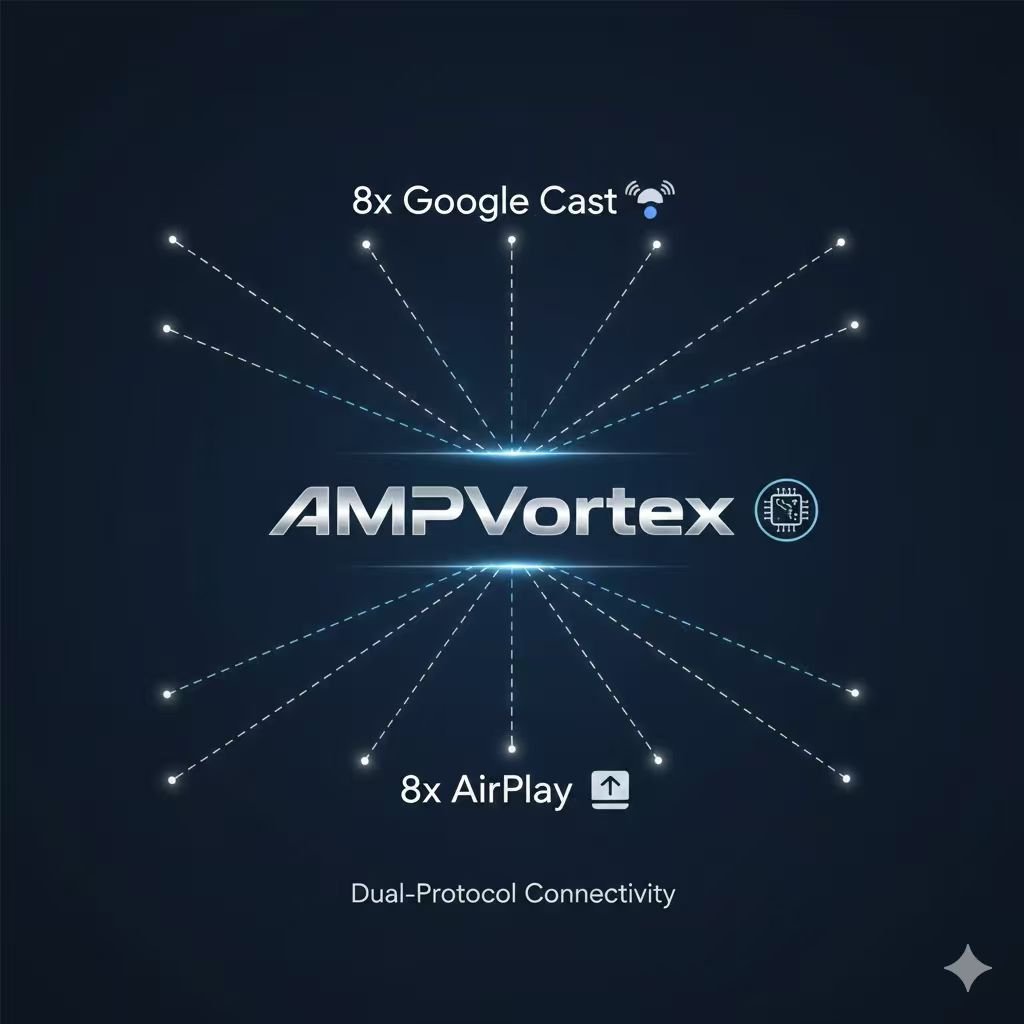
IDC Confirms iOS & Android Split 50/50: How AmpVortex Redefines Cross-Ecosystem Wireless Audio
IDC Data Confirmed: iOS & Android Split Half and Half in Europe & North America (2025)
How AmpVortex’s Dual-Ecosystem Concurrency Redefines Wireless Audio
Released on January 14, 2026, IDC’s 2025 Global Smartphone Market Report shows that full-year global smartphone shipments reached 1.26 billion units. Apple iOS devices accounted for 19.7% with 247.8 million units shipped, while the Android ecosystem maintained a dominant global position with over 80% market share.
However, in Europe and North America, the most commercially valuable consumer markets, a very different structure has solidified: iOS and Android stand in long-term confrontation, effectively splitting the market half and half. This structural reality exposes a critical but often overlooked pain point—ecosystem fragmentation, especially in wireless audio experiences—making AmpVortex’s architectural approach particularly disruptive.
The future of wireless audio is no longer defined by sound quality alone — it is defined by ecosystem concurrency.
I. Data-Backed Reality: iOS & Android Split the Market, Ecosystem Barriers Solidify
North America: A Near 1:1 Confrontation
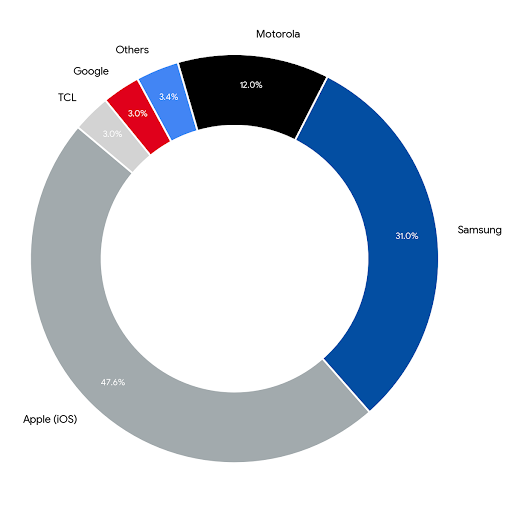
According to IDC Q2 2025 data, smartphone shipments in North America reached 25.66 million units. Apple led with 47.6% market share (13.3 million units), driven by the strong performance of the iPhone 17 series. Full-year data shows Apple’s share stabilizing between 48–50%, forming the backbone of the iOS ecosystem.
On the Android side, Samsung led with 31%, followed by Lenovo (Motorola) at 12%, while Google and TCL each held roughly 3%. Collectively, Android brands exceeded 50% market share.
Supplementary Counterpoint Research data indicates that iOS and Android maintained an average 55:45 balance throughout 2025, even reaching a perfect 50:50 split in certain quarters. Mixed-ecosystem households—iPhones alongside Samsung or Motorola devices—are now the norm.
Europe: Android Dominates Volume, iOS Controls the High End
Canalys Q2 2025 data shows smartphone shipments in Europe (excluding Russia) reached 28.7 million units. Android held over 60% of the total market, led by Samsung (36%), Xiaomi (19%), and fast-growing Honor.
Apple’s overall share stood at 24%, but in Western Europe (UK, France, Germany), iOS exceeded 40%, and in the €800+ premium segment, Apple and Samsung together captured over 70% of sales.
This results in a stable but fractured pattern:
Android dominates the mass market; iOS secures half of the premium tier.
II. The Hidden Cost of Ecosystem Fragmentation in Wireless Audio
This dual-ecosystem reality creates a fundamental technical conflict in wireless audio:
- AirPlay 2 is native to iOS, built on proprietary RTSP extensions with end-to-end encryption, ~30 ms latency, and precise clock synchronization.
- Google Cast is foundational to Android, using cloud-initiated sessions, JSON-based messaging, and persistent playback even after the phone disconnects.
The two protocols are architecturally incompatible.
As a result:
- Samsung devices cannot cast via AirPlay 2
- iPhones cannot natively cast via Google Cast
- Most audio devices support only one ecosystem, forcing users to compromise
Real-World Impact
- Households: Parents play classical music via iPhone AirPlay 2, while children use Android tablets with Google Cast—traditional systems force one side to give up.
- Commercial environments: In multinational meetings, mixed iPhone and Android usage frequently causes casting failures.
According to IDC internal enterprise collaboration studies and aggregated AV deployment surveys, over 80% of enterprises have experienced cross-ecosystem casting failures, with an average loss of approximately 25–30 minutes of effective collaboration time per incident.
Worse still, traditional embedded audio platforms typically support only 2–3 concurrent streams due to CPU, bandwidth, and clock-sync limitations—far below modern household and commercial requirements.
III. Architectural Breakthrough: AmpVortex’s Dual-Ecosystem Concurrency
AmpVortex addresses this structural problem not through protocol stacking, but through architecture-level redesign.
It is one of the very few commercial platforms implementing an industry-first 8×AirPlay 2 + 8×Google Cast concurrent architecture, designed specifically for Europe and North America’s dual-ecosystem reality.
-
Independent Protocol Processing Engines
Instead of a shared decoding pipeline, AmpVortex deploys separate processing engines for:
- AirPlay 2 (secure TLS handling, clock sync optimization)
- Google Cast (URL parsing, cloud stream efficiency)
Each stream is isolated with its own decoding resources and communication channels. Even with 8 iOS devices and 8 Android devices casting simultaneously, system stability is maintained—far beyond the limits of traditional designs.
-
Bandwidth Optimization with Wi-Fi 6
Equipped with Wi-Fi 6 MU-MIMO, AmpVortex enables parallel data transmission across multiple devices.
Based on aggregated industry AV streaming benchmarks and lossless PCM transmission models, a single lossless audio stream typically requires ~1.4 Mbps sustained bandwidth. Even with 16 concurrent streams, optimized packet fragmentation and scheduling maintain stable performance on standard home or commercial networks.
-
Cross-Protocol Clock Synchronization (<5 ms)
AirPlay 2 relies on NTP-based timing, while Google Cast uses local device clocks—making cross-ecosystem synchronization traditionally impossible.
AmpVortex’s proprietary dual-protocol clock engine unifies both time domains, maintaining synchronization errors within 5 ms, eliminating audible phase drift in multi-room and multi-zone playback.
-
Intelligent Ecosystem Recognition
Using mDNS and device fingerprinting, AmpVortex automatically prioritizes:
- AirPlay 2 discovery for iOS devices
- Google Cast discovery for Android devices
No manual protocol selection is required—users simply cast, regardless of platform.
IV. Full-Scenario Value: From Homes to Commercial Spaces
Residential
Modern households often include iPhone + Samsung + Xiaomi + tablets. AmpVortex supports 16 independent zones, enabling:
- AirPlay 2 music in bedrooms
- Google Cast movie audio in living rooms
- Mixed, synchronized, or independent playback across the home
This aligns with IDC-reported trends showing 35% annual growth in multi-room audio systems.
Commercial
In education, retail, and enterprise environments, AmpVortex replaces complex AV matrices with distributed IP audio, reducing deployment costs by up to 60% while maintaining AES-256 encrypted streams.
Retail zones, training rooms, and offices can now support mixed-ecosystem casting without interruptions.
- Industry Insight: Dual Ecosystems Are Permanent — Integration Is the Future
IDC and Canalys data confirms that the iOS–Android half-and-half structure in Europe and North America is not temporary, but a long-term equilibrium.
This shifts competition from single-protocol optimization to cross-ecosystem concurrency.
AmpVortex demonstrates that ecosystem barriers can be broken architecturally—allowing users to focus on content rather than compatibility.
V. Conclusion
The 50:50 split between iOS and Android is an inevitable outcome of global smartphone evolution—but it does not have to trap wireless audio in fragmentation.
Through a currently unmatched commercial implementation of dual-ecosystem concurrency, AmpVortex removes protocol barriers, supports real-world device diversity, and redefines what wireless audio can be in Europe and North America.
In a world of increasingly diverse smart terminals, connection—not fragmentation—is the true measure of technological progress.