(317)516-7460
  service@ampvortex.com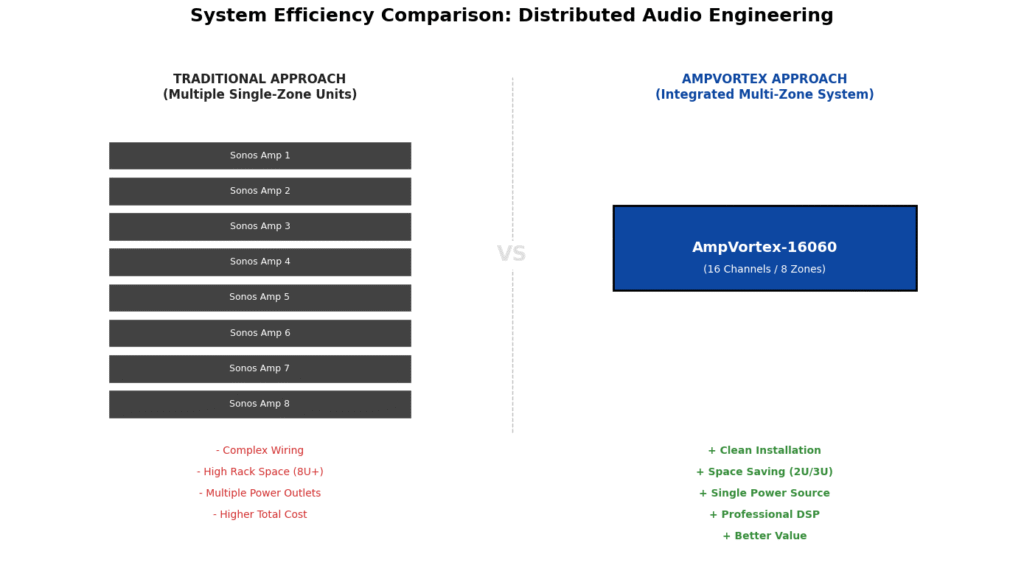
Multiple Single-Zone Streaming Amplifiers or One True Multi-Zone Streaming Amplifier?
Understanding the Real Difference Behind Whole-Home Audio Systems
In whole-home audio, custom installation, and multi-room streaming systems, one seemingly simple question appears again and again:
Should you use multiple single-zone streaming amplifiers to build a multi-room system,
or choose one true multi-zone streaming amplifier from the start?
At first glance, this looks like a matter of device count or budget.
In reality, it represents two fundamentally different system architectures—with very different outcomes for stability, scalability, automation, and long-term user experience.
1. Similar on the Surface, Completely Different Under the Hood
Option 1: Multiple Single-Zone Streaming Amplifiers
This approach typically works as follows:
- One single-zone streaming amplifier per room
- Each amplifier has its own streamer, DAC, network stack, and control logic
- Users attempt to “sync” them using apps or casting protocols
Its advantages are easy to understand:
- Lower perceived entry cost
- Flexible, room-by-room deployment
- Simple for very small systems
However, there is a critical limitation:
These devices do not form a system.
They are independent players that happen to exist on the same network.
Option 2: A True Multi-Zone Streaming Amplifier
A true multi-zone streaming amplifier is designed with a completely different assumption:
- One unified streaming core
- Multiple rooms exist as Zones, not devices
- Audio is centrally managed, distributed, and routed at the system level
In this architecture, multi-zone functionality is not “assembled”—
it is native by design.
2. The Real Difference Is Not Quantity, but Architecture
1️⃣ Synchronization: Shared or Fragmented Timebase?
- Multiple single-zone amplifiers
Each device runs its own clock and buffer. Short-term synchronization may appear acceptable, but drift is inevitable over time. - True multi-zone amplifiers
All zones share a single master clock and timeline, ensuring long-term, frame-accurate synchronization.
👉 This is not a tuning issue—it is a structural one.
2️⃣ Stability: Network and Control Complexity
With multiple single-zone amplifiers:
- Multiple network endpoints
- Multiple mDNS / SSDP broadcasters
- Multiple independent control sessions
As the number of rooms grows, system complexity increases exponentially.
A true multi-zone streaming amplifier, by contrast:
- Appears as a single logical device on the network
- Handles zone distribution internally via an audio matrix
- Is far more stable and automation-friendly
3. The True Divider: Can the System Route Audio at Any Time?
This is the most important—and most frequently overlooked—difference.
What Does “Live Audio Routing” Actually Mean?
Live audio routing means:
- Any source (Internet Radio, HDMI, Spotify, Cast, DLNA)
- Can be reassigned to any room or group of rooms
- Without stopping playback
- Without reconnecting the stream
- Without rebuffering
This is routing—not restarting.
Why Multiple Single-Zone Amplifiers Can’t Truly Do This
When attempting to move music from the living room to the kitchen in a single-zone setup, what really happens is:
- Playback stops in the living room
- A new streaming session is created in the kitchen
- The stream reconnects and restarts
This is Restart, not Route.
The consequences are clear:
- Audio interruption
- Lost ambience
- Broken multi-room continuity
- Awkward automation behavior
How True Multi-Zone Systems Handle Routing
In a true multi-zone architecture:
- The stream is pulled once
- Audio flows continuously inside the system
- Routing occurs at the audio matrix layer, not the app layer
When zones change:
The music does not restart—it moves.
4. Why Routing Matters More Than Specs
1️⃣ Real Life Is Dynamic
Daily life does not follow fixed room assignments:
- Music moves from the living room to the kitchen while cooking
- A new room joins the party temporarily
- Public areas shut down at night while bedrooms remain active
Audio should adapt instantly—without interruption.
2️⃣ Automation Depends on Routing
In systems like Home Assistant, KNX, or Crestron:
- Without routing: every action equals Stop → Play
- With routing: audio transitions feel natural and invisible
Automation is not about whether something works,
but whether it feels like it happened naturally.
3️⃣ Internet Radio Makes This Even More Critical
Internet Radio thrives on:
- Continuous ambience
- DJ-curated time flow
- Emotional and contextual continuity
Restarting a stream destroys that experience.
Only system-level routing preserves it.
5. When Are Multiple Single-Zone Amplifiers Acceptable?
There are scenarios where multiple single-zone amplifiers make sense:
- One or two rooms only
- No requirement for synchronization
- No automation system involved
- Temporary or modular installations
However, once you reach:
- Three or more rooms
- Long-term daily use
- Smart home integration
- Whole-home background audio
👉 A true multi-zone streaming amplifier becomes the only rational choice.
6. Final Conclusion: This Is a System Decision, Not a Device Count
You can summarize it clearly:
Multiple single-zone streaming amplifiers answer the question,
“Can each room play audio?”
A true multi-zone streaming amplifier answers,
“How does sound flow through the entire space?”
Or more succinctly:
Multi-zone audio is not about how many amplifiers you install,
but whether your system can route sound freely, instantly, and reliably.