(317)516-7460
  service@ampvortex.com
IAMF & Eclipsa Audio Post-Production Deep Dive: Break Channel Limits for Next-Gen Immersive Audio Experience
When a helicopter’s roar sweeps overhead and footsteps echo clearly behind, audiences can dive into a 3D soundscape without high-end theater gear—this is not a future concept, but the current experience enabled by IAMF (Immersive Audio Model and Format) and Eclipsa Audio. As a next-gen audio standard led by the Alliance for Open Media (AOM) and co-promoted by Google and Samsung, IAMF breaks the constraints of traditional channel-based audio, while Eclipsa Audio turns it into a scalable immersive solution via an open-source ecosystem. Together, they are reshaping post-production logic for film, gaming, and streaming, elevating sound from “accompanying visuals” to “defining experiences”.
1. Technical Fundamentals: Breaking Channel Shackles, Restructuring Core Audio Production Logic
Traditional multi-channel audio (5.1, 7.1) relies on fixed channel allocation, with sound positioning determined by speaker layout. Post-production only requires volume balancing across channels, leading to poor adaptability—cinema-grade 5.1 audio suffers from positioning confusion on headphones and loses spatiality on single-speaker devices. The subversion of IAMF and Eclipsa Audio lies in replacing channel dependence with a dual-core “object + scene” model, shifting post-production core from “mixing” to “spatial construction”.
IAMF is essentially a codec-agnostic open container format, compatible with Opus, AAC, FLAC and other mainstream encoders, so post-production teams do not need to replace core encoding tools, only adapt to its packaging logic. It supports three core audio elements: traditional channel-based audio (5.1.2, 7.1.4) for backward compatibility; scene-based audio (Ambisonics) for capturing 360° full soundfields; and 3D spatial audio objects—the core innovation of post-production. Creators can define spatial coordinates, motion trajectories and dynamic parameters for each sound object (dialogue, sound effects, soundtrack), and playback devices (headphones, speakers, soundbars) automatically render optimal effects.
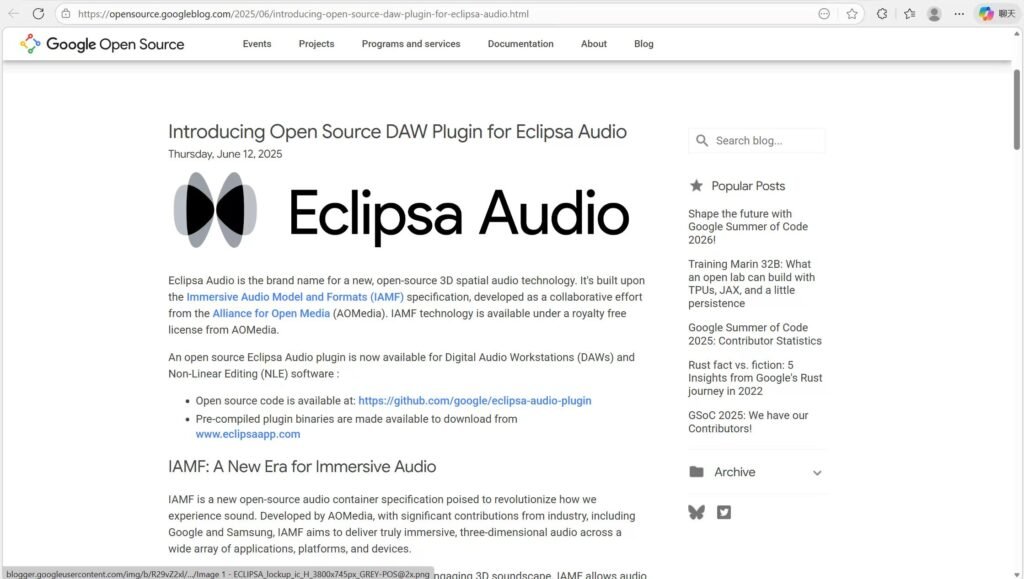
Eclipsa Audio is the open-source implementation carrier of the IAMF standard, co-built by Google, Samsung and Arm. It solves IAMF tool adaptation and optimizes cross-device performance, with core advantages in lightweight design and compatibility. Arm optimized the libiamf library via Neon SIMD extensions, enabling low-CPU complex spatial audio decoding on mobile devices; it also supports binaural rendering for perfect headphone immersive experiences. This allows post-production results to land on high-end home theaters and mobile devices alike, achieving “one production, full-device adaptation”.
2. Full Post-Production Workflow: Transition from Traditional Mixing to Spatial Audio Construction
IAMF and Eclipsa Audio post-production is not a minor tweak to traditional workflows, but a full-link restructuring from pre-preparation to master delivery, centered on “object definition” and “metadata configuration”. It has a mature toolchain and is divided into four core phases.
2.1 Pre-Preparation: Device Adaptation & Track Planning, Avoid Core Pitfalls
Unlike traditional audio production, pre-preparation focuses on clarifying spatial audio object classification logic rather than just channel track planning. First, confirm delivery platform requirements: for YouTube (native Eclipsa Audio support on Android TV 16), comply with IAMF Base/Enhanced Profile specs (max 28 input channels per file); for VR/360° video, prioritize scene-based audio with ambisonic microphones for raw soundfield capture.
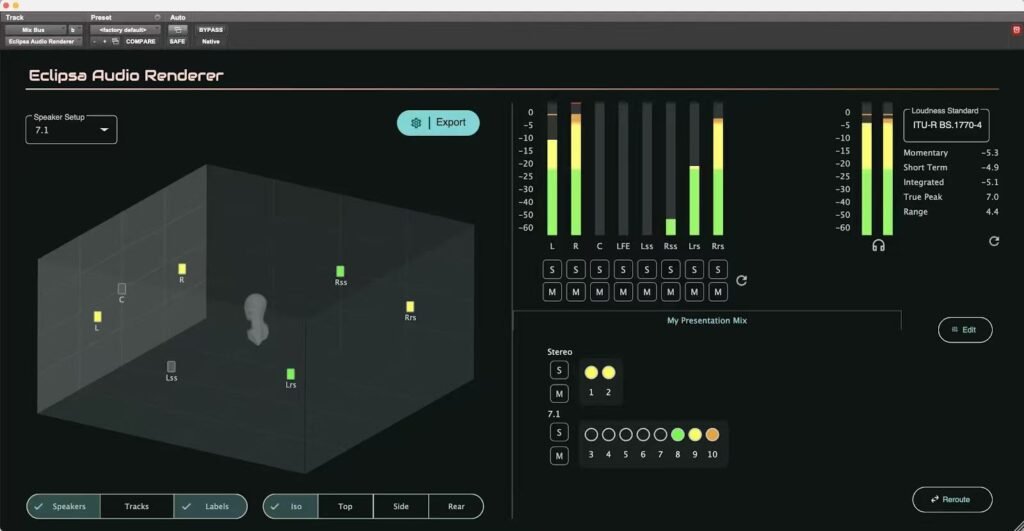
For tool selection, beginners can use Google’s open-source Eclipsa Audio Toolkit; professionals can adapt mainstream DAWs: Pro Tools supports the Windows Eclipsa Plugin (v1.4.0) for direct audio object track creation; Logic Pro enables IAMF export via AU plugins; Cubase/Nuendo links with VST3 plugins for visual editing of object motion trajectories. Note: Logic Pro does not support pan automation (manual keyframe setup required)—a core pitfall to avoid.
2.2 Core Production: Object Editing + Metadata Configuration, Endow Sound with Spatial Vitality
This is the core phase, divided into two steps centered on giving each sound a “spatial identity”. Step 1: Audio object editing—split dialogue, environmental sound effects and soundtrack into independent object tracks, defining spatial attributes for each. For example, a passing car in film requires initial coordinates, moving speed, attenuation curves and even Doppler effect parameters to make sound dynamic with the car’s position. Traditional production uses multi-channel volume fades for simulation, while IAMF only needs metadata configuration, boosting efficiency by over 30%.
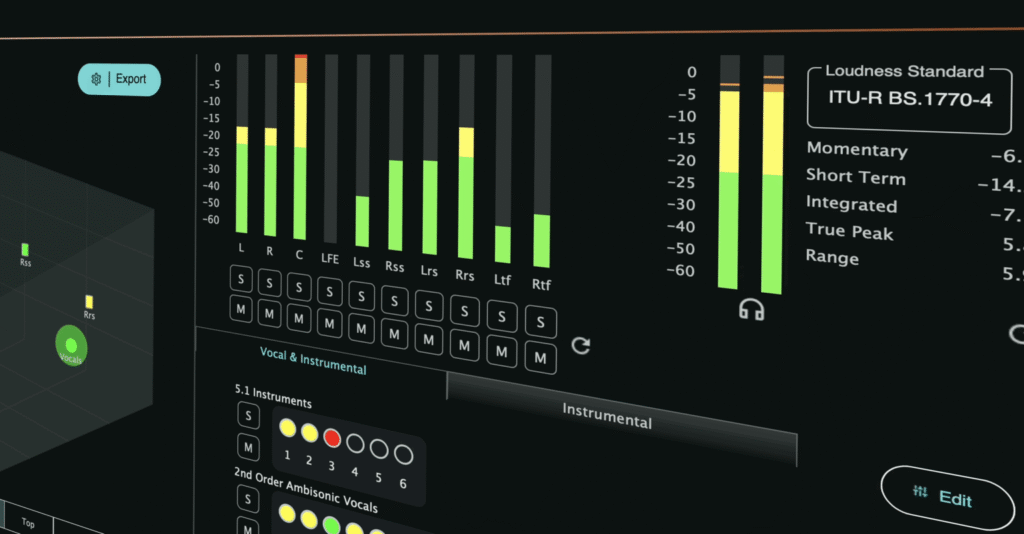
Step 2: Refined metadata configuration, the key to maximizing experience. IAMF metadata includes not only sound positioning, but also custom user interaction logic: e.g., independent dialogue volume adjustment for audiences without affecting soundtracks/sound effects; rendering priority settings to preserve core object spatiality on low-performance devices. Tools: Fraunhofer IIS IMF Studio for visual metadata editing; latest FFmpeg (with libiamf) for batch metadata configuration for industrial production.
2.3 Monitoring & Debugging: Multi-Device Verification for Full-Scene Adaptation
Immersive audio debugging focuses on cross-device consistency verification, covering headphones, 2.0 speakers, 5.1 soundbars and high-end theater systems to avoid “great theater effect, poor mobile experience”. Preferred tools: Eclipsa Audio Player for real-time spatial positioning monitoring and metadata validation; professional-grade Smaart linked with Eclipse Audio DSP for acoustic calibration to ensure precise positioning across devices.
Key debugging focuses: 1) Binaural rendering adaptation (enabled by default in Eclipsa Audio v1.2.1, avoid sound distortion on headphones); 2) Track position synchronization (some DAWs update track positions only after playback, requiring repeated preview to avoid audio-visual desynchronization).
2.4 Master Delivery: Packaging Format Adaptation, Unlock Cross-Platform Distribution
Traditional audio delivery requires multiple channel versions, while IAMF+Eclipsa Audio only needs one master file, adapted to different platforms via packaging—core is IMF master and streaming format linkage. Professionals use Fraunhofer IIS IMF Studio to package IAMF audio into IMF masters (complying with SMPTE specs) for Netflix/Disney+ delivery; for streaming, DaVinci Resolve directly exports IAMF files in MP4 (ISO-BMFF container) without secondary transcoding, cutting distribution costs significantly.
Note: Use iamf-tools v2.0.0 for export to boost speed, reduce CPU/memory usage and avoid end-of-export lag (optimized by 60% vs. older versions).
3. Technical Advantages & Industry Pain Point Resolution: Triple Breakthroughs in Cost, Adaptation and Innovation
IAMF and Eclipsa Audio gain rapid traction by solving three core pain points of traditional immersive audio (e.g., Dolby Atmos), making post-production more efficient, accessible and innovative.
3.1 Pain Point 1: High Costs from Closed Ecosystems, Open-Source Toolchains Cut Costs
Traditional immersive audio relies on proprietary codecs and tools with expensive licenses, out of reach for small-medium teams. IAMF uses a royalty-free open protocol, and Eclipsa Audio provides free open-source plugins/encoders. Arm-optimized libraries lower hardware thresholds (ordinary PCs suffice), cutting production costs by over 50%.
3.2 Pain Point 2: Poor Multi-Device Adaptation, One Production for Full-Terminal Support
Traditional multi-channel audio requires multiple versions for different devices, with high iteration costs. IAMF’s “one production, full-device rendering” logic eliminates extra adaptation work, boosting efficiency by 80%—the same master file delivers full 3D sound on 7.1.4 theaters, binaural immersion on headphones, and clear sound on single speakers, which drives YouTube and Samsung TV’s early adoption.
3.3 Pain Point 3: Limited Creative Boundaries, Object-Based Logic Unlocks Innovation
Traditional channel audio is limited by speaker count, unable to create complex spatial designs. IAMF’s object-based logic enables creators to build intricate soundscapes: e.g., game sound adjusts with player movement; film explosions wrap audiences in shockwaves—impossible with traditional channels. Interactive metadata also opens new dimensions for interactive film and gaming.
4. Industry Adoption & Future Trends: The Era of Mass Immersive Audio Is Coming
IAMF and Eclipsa Audio are scaling rapidly: Samsung TVs natively support IAMF; Android TV 16 integrates Eclipsa Audio; YouTube has rolled out applications; mainstream DAWs have plugin support. Immersive audio is expanding from professional film to creator content.
Future post-production trends: 1) Automation & Intelligence—AI will generate sound object trajectories to cut manual work; 2) Cross-Media Integration—IAMF links with head tracking in XR for real-time sound adjustment with head movement, creating mixed-reality immersion.
For audio professionals, IAMF and Eclipsa Audio are not optional skills but must-haves. Breaking channel shackles and building sound with spatial thinking is key to competing in next-gen audio-visual content. For users, cinema-grade immersion on mobile devices is the ultimate value of technological innovation—making premium experiences accessible to all.
AmpVortex Venue Audio Solution Overview
AmpVortex multi-room streaming amplifiers/AVRs are the ideal hardware carrier for IAMF/Eclipsa Audio immersive audio in commercial and venue scenarios, with core advantages:
- Native support for IAMF, Dolby Atmos and IAMF immersive formats, perfectly matching post-production results of Eclipsa Audio tools
- 8×AirPlay 2 + 8×Google Cast multi-protocol support, realizing seamless multi-zone audio synchronization and independent control
- High-power output and built-in DSP room correction, adapting to different space sizes (from small exhibition booths to large museum halls)
- Easy integration with venue interactive devices (infrared sensors, touch terminals), supporting trigger-based sound effect playback for customized experiences
- Stable long-term operation, meeting the 8+ hour daily use needs of science and technology museums, museums and other public venues