(317)516-7460
  service@ampvortex.com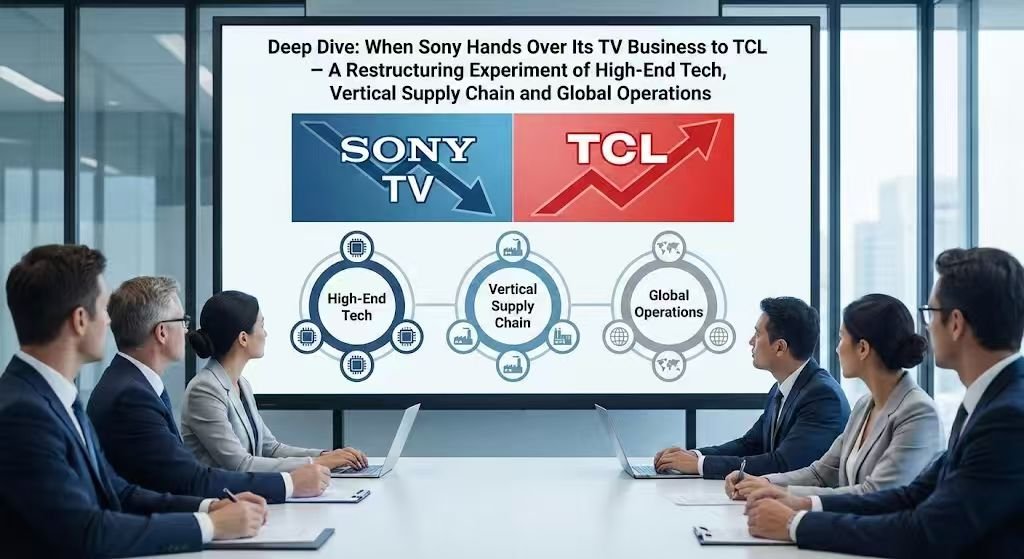
Sony–TCL TV Joint Venture: A Deep Dive into High-End Tech and Global Restructuring
Deep Dive: When Sony Hands Over Its TV Business to TCL
A Restructuring Experiment of High-End Technology, Vertical Supply Chains, and Global Operations
Introduction: A Strategic Restructuring, Not a Sell-Off
The 2026 announcement that Sony will establish a joint venture with TCL—handing over the full-chain operation of its global TV and home audio business—has sent ripples across the global consumer electronics industry.
This move is neither a simple sell-off of an underperforming business nor a blind expansion of TCL’s high-end ambitions. Instead, it represents a targeted restructuring experiment that combines Sony’s high-end technological strengths, TCL’s vertical supply chain advantages, and both parties’ global operational capabilities.
Behind this cooperation lies a broader industrial trend: deeper specialization, clearer division of labor, and complementary integration across the global audio-visual ecosystem—including downstream industries such as audio amplifiers.
Why Sony Is Handing Over the TV Business: A Rational Strategic Shift
Sony’s decision is best understood through its long-term strategic positioning.
From Heavy Assets to High-Value Focus
In recent years, Sony has increasingly concentrated on high-margin, technology-driven businesses, including:
- Image sensors
- Gaming consoles and platforms
- Music, film, and content IP
In contrast, the TV business remains a heavy-asset, margin-sensitive industry, constantly pressured by panel price fluctuations and intense competition from global scale players.
Sony’s Core TV Competitiveness Has Not Disappeared
Importantly, Sony is not exiting the TV market in substance. Its core competitive assets remain industry benchmarks:
- XR Cognitive Processor
- BRAVIA ENGINE image processing technology
- Dolby Atmos and DTS:X audio decoding and tuning
- Strong premium brand equity and user loyalty
By forming a joint venture with TCL, Sony can strip away manufacturing and supply chain burdens, focus on technology output and brand authorization, and preserve high margins while reducing operational risk.
This marks a transition to a “light-asset + high-value” model, not a retreat.
Why TCL Wants Sony’s TV Business: Breaking the High-End Ceiling
Vertical Supply Chain Strength as a Foundation
As the world’s second-largest TV manufacturer, TCL holds significant structural advantages:
- CSOT panel self-sufficiency
- Mature large-scale manufacturing capacity
- Established global distribution channels
These strengths allow TCL to control costs, ensure delivery efficiency, and scale rapidly.
The Long-Standing High-End Dilemma
Despite strong Mini-LED and QLED technologies, TCL has struggled with a familiar challenge:
Scale without premium.
What TCL has lacked is:
- Top-tier global brand premium
- Deep accumulation of audio-visual tuning expertise
By partnering with Sony, TCL gains direct access to world-class audio-visual technology and brand influence, enabling a rapid upgrade of its high-end product line and narrowing the gap with Samsung and LG.
The Core of the Cooperation: Technology Empowerment Meets Efficient Execution
The true value of this partnership lies in precise synergy, not simple resource stacking.
Deep Technical Integration
Sony’s XR cognitive chip is expected to be deeply integrated with TCL’s display technologies, including:
- Mini-LED
- QLED
- Potential future OLED platforms
Frame-by-frame cognitive analysis combined with TCL’s advanced panel performance will elevate visual quality in the high-end segment.
In audio, Sony’s mature decoding and tuning expertise will strengthen TCL’s home audio offerings—addressing one of its long-standing weaknesses.
Supply Chain Synergy as a Force Multiplier
TCL’s vertically integrated supply chain—from panels to final assembly—will:
- Reduce production costs
- Shorten product cycles
- Preserve margin space for high-end models
- Enable mid-to-high-end products to gain cost advantages
This is not additive synergy, but a chemical reaction:
Sony’s technology creates premium value, while TCL’s supply chain ensures scalable, efficient market deployment.
Global Operations: A Dual-Market Expansion Strategy
From a global perspective, the joint venture combines complementary strengths:
- Developed markets (Europe, North America):
Leveraging Sony’s brand equity to consolidate high-end positioning - Emerging markets (Southeast Asia, Latin America):
Utilizing TCL’s cost control and channel penetration to expand volume
This dual-track strategy allows the joint venture to cover both premium and mass-market segments, positioning it as a serious challenger to Samsung’s global leadership.
Impact Beyond TVs: Implications for the Audio-Visual Ecosystem
Rising Demand for High-End Audio Amplifiers
As TV picture quality advances, user expectations for audio performance rise in parallel. The joint venture’s high-end TVs will naturally drive demand for:
- High-fidelity amplification
- Multi-zone streaming systems
- Immersive audio solutions
New Opportunities for Amplifier Brands
The joint venture’s global channels will open broader market access for audio amplifier manufacturers—both in:
- Premium systems aligned with Sony’s audio-visual standards
- Cost-efficient mid-to-high-end systems targeting performance-oriented users
This restructuring therefore reshapes not only the TV market, but the entire upstream and downstream audio-visual ecosystem.
Challenges Ahead: Integration, Boundaries, and Profit Balance
Despite strong fundamentals, the joint venture will face real challenges:
- Corporate culture integration
- Clear boundaries in technology licensing
- Profit-sharing mechanisms
However, the complementary nature of technology, supply chain, and global operations provides a solid foundation for long-term success.
Conclusion: A Blueprint for the Next Phase of Consumer Electronics
The Sony–TCL joint venture is more than a corporate restructuring—it is a template for industrial transformation in the global consumer electronics sector.
It demonstrates how:
- High-end technology can be decoupled from heavy assets
- Vertical supply chains can amplify premium innovation
- Global operations can balance scale and value
This experiment not only opens a new path for Sony and TCL, but also sets a benchmark for the future evolution of the global audio-visual industry toward higher efficiency, deeper specialization, and greater value creation.
Editor’s Note
From a broader industry perspective, the Sony–TCL restructuring is not an isolated event, but a clear signal of how the global audio-visual industry is evolving: high-end technology is increasingly decoupled from heavy manufacturing assets, while system-level integration and ecosystem coordination become the new core of value creation.
This trend is highly relevant to companies like AmpVortex, which operate at the intersection of video, audio, and system integration. As display technologies rapidly advance, the industry is shifting its focus from standalone devices toward end-to-end audio-visual experiences—where multi-zone audio distribution, immersive sound formats, and seamless streaming interoperability are no longer optional, but essential.
AmpVortex’s ongoing innovation in multi-zone amplification, high-performance streaming architectures, and protocol-agnostic system design reflects this same structural direction. Rather than competing at the component level, AmpVortex is building toward a future where amplifiers function as intelligent audio hubs, capable of integrating with next-generation TVs, advanced codecs, and global streaming ecosystems.
Looking ahead, as industry boundaries continue to blur and vertical specialization deepens, the role of audio platforms like AmpVortex will become increasingly strategic—bridging premium visual technology with scalable, flexible, and future-proof audio systems. In this sense, the Sony–TCL joint venture is not only reshaping the TV market, but also accelerating the transformation of the broader audio-visual landscape that AmpVortex is actively helping to define.