(317)516-7460
  service@ampvortex.com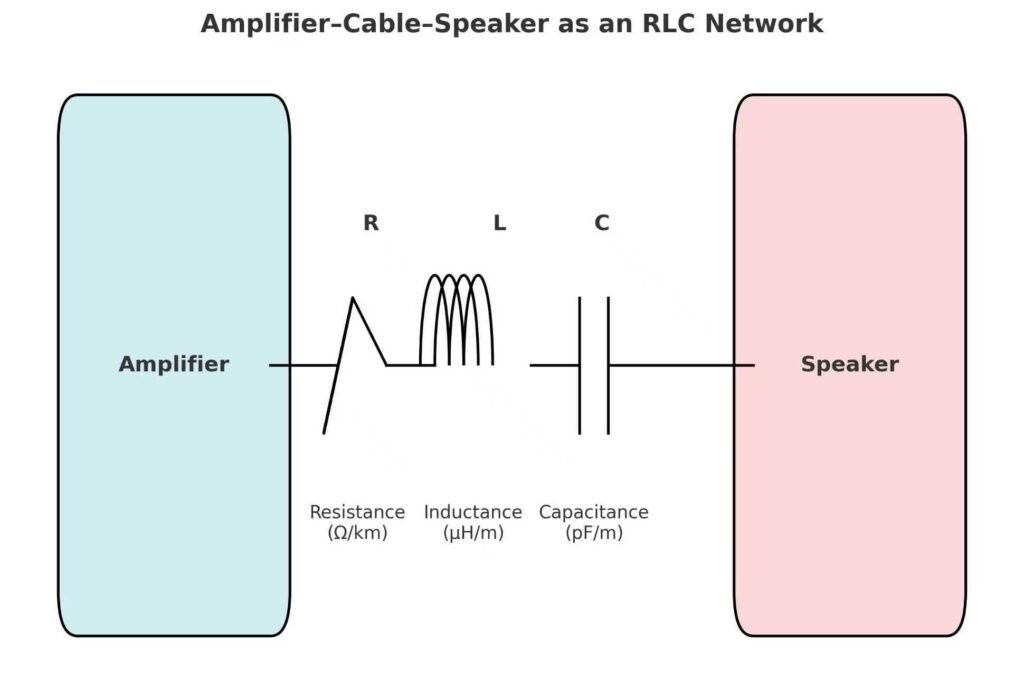
Viewing Signal Transmission Efficiency From the Core Technical Parameters of Speaker Cables
1️⃣ Why Technical Parameters Matter in Speaker Cables
Speaker cables are responsible for transmitting high-current power signals from amplifiers to speakers. Unlike signal-level interconnects, they must carry significant electrical load while maintaining minimal loss and distortion.
For AmpVortex amplifier users, understanding the technical fundamentals behind cable performance ensures:
- Maximum signal transmission efficiency
- Minimal power loss
- Stable impedance behavior
- Full release of amplifier performance
2️⃣ Conductor Cross-Sectional Area: The Foundation of Efficiency
The cross-sectional area is the most critical parameter of a speaker cable.
It determines:
- Current-carrying capacity
- Resistance level
- Power loss during transmission
Larger cross-section → Lower resistance → Higher efficiency.
AmpVortex Minimum AWG Recommendations:
| Amplifier Model | Minimum Cable Spec | Cross-Section |
| 16100 (High Power) | 12AWG | 3.31mm² |
| 16060 / 16060A / 16060G | 14AWG | 2.08mm² |
| Desktop Scenarios | 16AWG | 1.31mm² |
These minimum values are defined to ensure proper current handling and reduced transmission loss.
3️⃣ The Skin Effect: High-Frequency Transmission Challenge
The skin effect is a physical phenomenon in AC signal transmission.
At higher frequencies:
- Current density concentrates near the conductor surface
- Effective resistance increases
- High-frequency transmission efficiency decreases
Since AmpVortex amplifiers feature wide frequency response and high-resolution treble reproduction, minimizing skin effect impact is essential.
4️⃣ Multi-Strand Fine Wire Structure: Reducing Skin Effect
High-quality speaker cables use:
- Multi-strand fine wire construction
- Increased total surface area
- Precision surface polishing
Advantages:
- Improved high-frequency transmission
- Reduced effective resistance
- Lower signal reflection and scattering
- Better flexibility for installation
AmpVortex official cables adopt optimized multi-strand fine conductor design to support wide-bandwidth signal stability.
5️⃣ Cable Impedance: Resistance, Inductance & Capacitance
Speaker cable impedance consists of:
- Resistance (R)
- Inductance (L)
- Capacitance (C)
Ideal cable characteristics:
- Low resistance → Reduced power loss
- Low inductance → Stable high-frequency performance
- Low capacitance → Reduced signal interference
Excessive inductance or capacitance may degrade high-frequency response and introduce unwanted coloration.
6️⃣ Impedance Matching: Ensuring Maximum Transmission Efficiency
Most home audio systems follow the 8Ω impedance standard.
Proper impedance alignment between:
- Amplifier output
- Speaker load
- Cable characteristics
ensures:
- Reduced signal reflection
- Stable frequency response
- Efficient power delivery
AmpVortex amplifiers are designed for standard 8Ω systems, and official cables are optimized to maintain impedance stability across the audio frequency range.
⚠ Poor impedance matching can result in:
- Signal reflection
- Distortion
- Thermal stress
- Potential amplifier instability in extreme cases
7️⃣ Material Stability & Impedance Consistency
Conductor material quality directly affects impedance stability.
Inferior recycled copper:
- Contains impurities
- Higher resistivity (up to ~30% higher)
- Large impedance fluctuation
- Greater distortion risk
High-purity oxygen-free copper:
- Stable impedance across frequency range
- Lower resistivity
- Reliable long-term conductivity
AmpVortex strictly recommends high-purity OFC to ensure impedance consistency within the amplifier’s full frequency response range.
8️⃣ Practical Cable Selection Strategy
Effective cable selection requires balancing:
- Amplifier power
- Speaker sensitivity
- Wiring distance
- Installation environment
- Technical parameters (AWG, RLC, material)
AmpVortex Simplified Selection Principle:
- Match AWG to amplifier model and cable length
- Use high-purity oxygen-free copper
- Ensure 8Ω system compatibility
- Choose multi-strand construction
- Avoid undersized or unstable materials
Following these principles ensures maximum signal transmission efficiency and optimal sound performance.