(317)516-7460
  service@ampvortex.com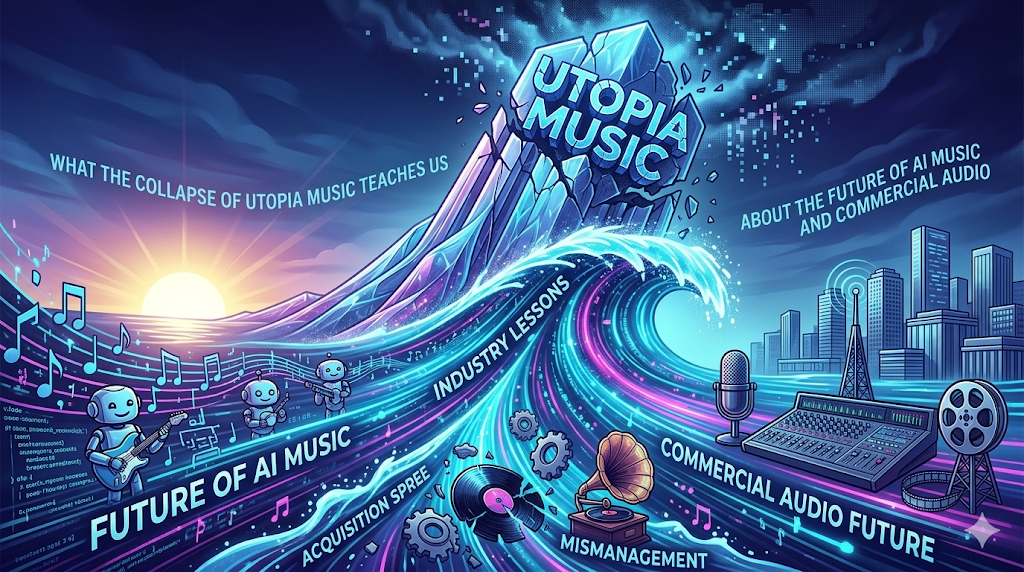
What the Collapse of Utopia Music Teaches Us About the Future of AI Music and Commercial Audio
What the Collapse of Utopia Music Teaches Us About the Audio IndustryIn recent years, Utopia Music was positioned as one of the most ambitious companies in the music technology space. With a vision to fix the music industry through data, transparency, and fair payments, Utopia raised significant funding and acquired multiple companies — including Musimap. Yet despite its bold vision, the company ultimately collapsed.
So what went wrong — and more importantly, what does this mean for the future of AI-driven music platforms?
A Vision Without a Business Model
Utopia aimed to solve some of the biggest structural problems in music:
📊 Fragmented Rights Data
Attempting to unify disparate music rights databases across global markets and jurisdictions
🔍 Lack of Transparency
Addressing opacity in royalty payments and usage reporting throughout the music value chain
💸 Inefficient Royalty Distribution
Streamlining payment processes from streaming platforms to artists, songwriters, and rights holders
While these are real challenges, they are also system-level problems — difficult to monetize directly. The core issue was simple:
⚠️ The Core Problem
Solving industry problems is not the same as building a scalable business.
The Risk of “Middle-Layer” Music Technology
Utopia’s strategy focused heavily on:
- Data aggregation across music platforms and databases
- Music intelligence and analytics services
- Rights infrastructure and royalty management systems
However, it lacked control over:
- End users and their listening behaviors
- Playback environments and audio delivery systems
- Distribution channels and customer relationships
This placed it in what can be described as the “middle layer” of the music ecosystem. And historically, this is the most vulnerable position.
📈 The Middle Layer Problem
Companies operating exclusively in the middle layer — between content creation and end-user consumption — face inherent disadvantages: they lack direct customer relationships, have limited control over user experience, and struggle to capture value from the services they provide. This structural weakness ultimately undermines long-term sustainability.
Why Control of Playback Matters
In commercial audio environments — such as retail, hospitality, and public spaces — value is created not just by content, but by delivery. The companies that ultimately win are those that control:
- How music is distributed to physical and digital spaces
- How it is played across different zones and environments
- Where it is deployed in real-world commercial settings
Because this is where:
✅ Where Value is Created
- Customer relationships exist and are maintained
- Recurring revenue is generated through service contracts
- Real-world usage happens and can be measured
AI Music Is Changing the Industry — But Structure Still Matters
AI is rapidly transforming music in several key areas:
🎵 Music Generation
AI-created tracks and automated composition for Ghost Artist applications
🎯 Personalization
Dynamic content adaptation based on location, time, and audience demographics
📋 Automated Playlisting
Algorithmic playlist generation and curation for Half Listening scenarios
However, AI alone does not create a business. Without integration into a real distribution and playback system, AI-generated music remains:
- Disconnected from end users who actually consume the content
- Difficult to monetize through traditional or new business models
- Hard to scale without direct control over deployment channels
From Content to Deployment: Closing the Loop
The future of commercial audio will not be defined by any single layer — whether content, AI, or data. Instead, success will depend on connecting the full chain:
🔗 The Complete Value Chain
Only when these layers are integrated can music truly become:
🚀 Integration Benefits
- Scalable: Deployed across thousands of locations with consistent quality
- Controllable: Managed in real-time through unified platforms and multi-zone systems
- Monetizable: Connected to paying customers through hardware and service contracts
A Different Approach: Building from the Ground Up
At AmpVortex, we take a different approach. Rather than starting from data or abstract infrastructure, we focus on:
🏢 Real-World Deployment
Installing and managing multi-zone commercial audio systems in retail stores, hotels, restaurants, and offices
🎛️ Direct Hardware Integration
Built-in AmpVortex amplifiers including 16060, 16060A, 16060G, and 16100 models for seamless platform integration
🌐 Smart Home Compatibility
Native support for Google Cast, AirPlay 2, KNX, and Matter protocols
This ensures that:
✅ The AmpVortex Advantage
- Music is not only created or analyzed in the cloud
- But also delivered, controlled, and experienced in real environments
- Through multi-zone streaming amplifiers that connect content to physical spaces
Looking Ahead
The fall of Utopia Music is not a failure of vision — it is a reminder of structure. In the next phase of the music industry, the winners will not be those who only:
- Understand music and its cultural significance
- Analyze music data and listening patterns
- Or generate music through AI and algorithms
But those who can:
🎯 The Future Winners
Connect music to real-world usage, at scale.
This means building integrated solutions that span from content creation through distribution, playback, and hardware — exactly the approach AmpVortex takes with its 16060 series amplifiers and commercial audio platforms.
🎯 Key SEO Keywords Integrated
This article naturally integrates critical SEO terms: Utopia Music collapse, AI music platform failure, commercial audio distribution, music streaming business model, AmpVortex 16060, AmpVortex 16060A, AmpVortex 16060G, AmpVortex 16100, multi-zone audio amplifier, commercial audio systems, AI music generation, music rights data, royalty distribution, Musimap acquisition, smart home audio, background music solutions.
AmpVortex website:https://www.ampvortex.com