
 (317)516-7460
  service@ampvortex.com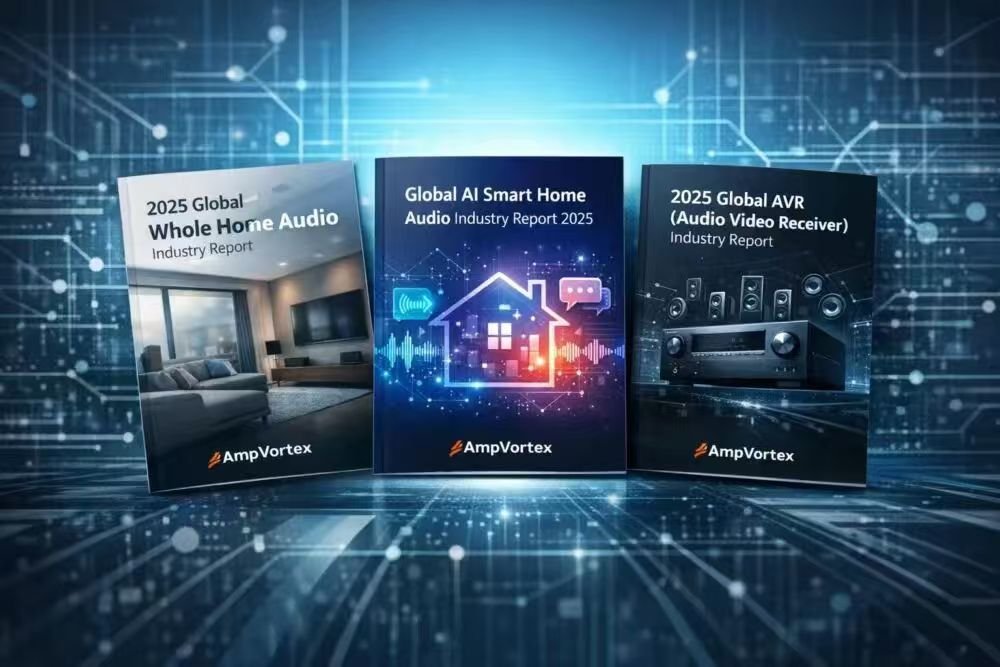
As 2025 Draws to a Close, AmpVortex Releases Three In-Depth Industry Reports
As 2025 draws to a close, the global residential audio and home entertainment industry is entering a period of structural realignment. The conversation is no longer dominated by individual features or logo-driven specifications, but by deeper questions of system architecture, scalability, and long-term interoperability.
Against this backdrop, AmpVortex has released three in-depth industry reports, each addressing a critical layer of the modern home audio and AV ecosystem. Together, the reports offer a comprehensive view of how residential audio systems are evolving—from control and intelligence, to whole-home distribution, and finally to high-channel immersive playback.
1. 2025 Global Whole Home Audio Industry Report
The 2025 Global Whole Home Audio Industry Report examines the rapid transformation of multi-room audio from a convenience feature into core home infrastructure.
Key findings highlight several irreversible trends:
- 192kHz and lossless audio are becoming baseline expectations in premium residential projects, driven by streaming platforms such as Qobuz.
- True multi-zone systems, typically starting at eight zones or more, are now standard in larger homes rather than niche installations.
- Native KNX integration remains essential in European markets, reinforcing the importance of installer-first, standards-based design.
- Matter support is emerging as a strategic requirement for future-proof interoperability across smart home ecosystems.
The report concludes that whole home audio is no longer peripheral—it is a permanent, system-level component of modern residential design.
2. Glohttps://www.ampvortex.com/bal AI Smart Home Audio Industry Report 2025
The Global AI Smart Home Audio Industry Report 2025 shifts focus to the control layer, exploring how artificial intelligence is redefining the way users interact with residential audio systems.
Rather than framing AI as a novelty, the report analyzes practical deployments:
- Voice and contextual control powered by platforms such as ChatGPT and Google Gemini.
- The convergence of audio control with broader smart home automation workflows.
- The limitations of legacy voice assistants designed around command-based interactions.
The report positions AI not as a replacement for professional system design, but as a new interface layer—one that amplifies the value of well-architected audio infrastructure already in place.
3. 2025 Global AVR (Audio Video Receiver) Industry Report
The 2025 Global AVR (Audio Video Receiver) Industry Report takes a deliberately format-agnostic approach, focusing on physical channel capability and real-world system design rather than branded audio logos.
Key insights include:
- Growing demand for high-channel-count layouts such as 9.1.6 and 10.4.6, driven by larger rooms and more sophisticated home theaters.
- Structural constraints of traditional all-in-one AVRs, particularly around power delivery, thermal limits, and channel scalability.
- The continued relevance of established AVR brands such as DENON, Marantz, YAMAHA, and JBL, alongside the emergence of hybrid architectures.
The report concludes that immersive audio’s future depends less on ever-larger receivers and more on distributed, modular system design.
From Products to Architectures
While each report stands on its own, together they reflect a broader shift within the industry—from short product cycles toward long-term system thinking.
AmpVortex’s role across these studies is not positioned as a replacement for existing AV ecosystems, but as an enabling platform: one that bridges whole home audio, high-channel theater systems, and emerging AI-driven control models.
By releasing these three reports in close succession, AmpVortex underscores a clear philosophy:
the future of residential audio will be defined by architecture, not by checklists.
As the industry moves into 2026, the insights from these studies offer integrators, consultants, and ecosystem partners a framework for building systems that scale, integrate, and endure.
Please contact us at service@ampvortex.com
AmpVortex website: www.ampvortex.com
Great to see AmpVortex releasing such detailed reports. I’m looking forward to what they have to say about the future,
I’m impressed by AmpVortex’s commitment to providing in-depth industry reports. These insights will definitely help guide our decisions as we move into 2025 and beyond.